Why NASA is launching rockets into the solar eclipse


Next week's total solar eclipse is an exciting prospect for a whole heap of reasons, including for regular folk who might get a look at an incredibly rare sight.
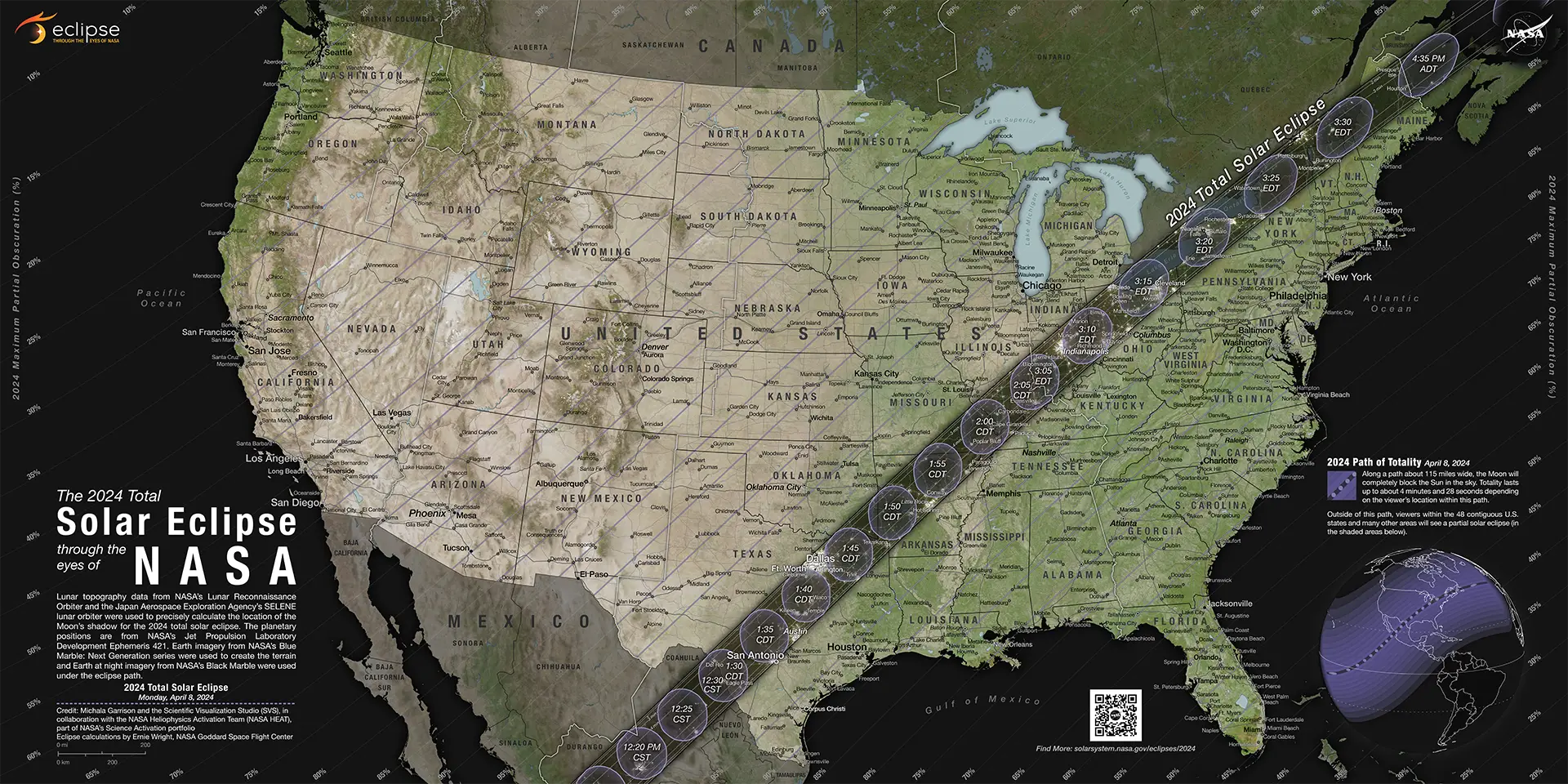
With a wide slice of the eclipse's totality falling across the US and Canada, plenty of people will be able to see the sun's light disappear completely for up to a few minutes depending on their location.
However, scientists are aiming to use those few minutes very carefully to learn more about the effects of solar eclipses.
Advert
NASA, in fact, will launch three rockets on 8 April - one before, one during and one after the eclipse in order to gather data that can compare those three moments.
In particular, it's interested in learning more about how the arrival of an eclipse affects the Earth's atmospheric layers. The boundary between our lower and upper atmosphere is of specific interest in this area, apparently.
The research is being led by Aroh Barjatya, a professor of engineering and physics at Embry-Riddle Aeronautical University, who has already been looking into this boundary, known as the ionosphere (which will probably go down as the best word we learnt this week).
His team will launch three rockets from NASA's Wallops Flight Facility on Wallops Island, Virginia, although there's one small flaw in the plan. Because no one can control the path of totality for an eclipse, it would require real luck for the launch facility to get complete totality.
Instead, they're going to get 81.4% totality, which will still apparently be enough to learn a lot about the effect of this solar dimming on the ionosphere, but won't quite be the same as a 100% total location.
This isn't the first time that Barjatya's team has sent up rockets during an eclipse, though, and it probably won't be the last, so there's always an opportunity to learn more down the line.
According to Barjatya: "We are super excited to relaunch [the rockets] during the total eclipse, to see if the perturbations start at the same altitude and if their magnitude and scale remain the same".
Each rocket will be loaded up with sensors and measuring devices, firing up to its maximum altitude before falling back to the planet's surface. At their highest point, each should reach around 260 miles above surface level, and they each have a bonus feature, as explained by Barjatya, who says: "Each rocket will eject four secondary instruments the size of a two-liter soda bottle that also measure the same data points, so it's similar to results from fifteen rockets, while only launching three."
That seems like a very smart way to maximise resources.
If you're hoping to catch the total solar eclipse yourself, though, you might want to make sure that you head to a location with actual totality.