
NASA shares footage of 'city-killing' asteroid after officially updating threat level again


The National Aeronautics and Space Administration is doing a bang-up job of making us think the end of the world is nigh, with regular updates on a supposed 'city-killing' asteroid giving everyone one more thing to worry about at night. The mystic Nostradamus made a chilling prediction that a 'harbinger of fate' asteroid would hit us in 2025, and while it looks like he was out by a few years, one could still be on the way from the depths of space.
The eyes of the world are on the 2024 YR4 asteroid, as NASA keeps us updated on its current trajectory and the chances it'll hit Earth. Some 100 million people are living in the risk corridor of this asteroid that could have an impact power 500 times greater than the atomic bomb dropped on Hiroshima, so it's no surprise we're keeping tabs on where things are up to.
NASA has shared new footage of 2024 YR4, and while it doesn't exactly show much, it's reminded us that it's out there somewhere. 27 million miles sounds like a long way away, but with 2024 YR4 potentially striking Earth in 2032, that doesn't give us long to get our affairs in order.
Advert
A new post makes for some grim (and confusing) reading, and with the skies becoming clearer, NASA’s Center for Near-Earth Object Studies at the agency’s Jet Propulsion Laboratory in Southern California updated the astroid's impact probability from 2.3% to 3.1%. Considering it recently doubled from just 1%, you can't blame us for being a little nervous. As NASA notes, the 3.1% probability is the highest impact probability recorded for an object of this size or larger.
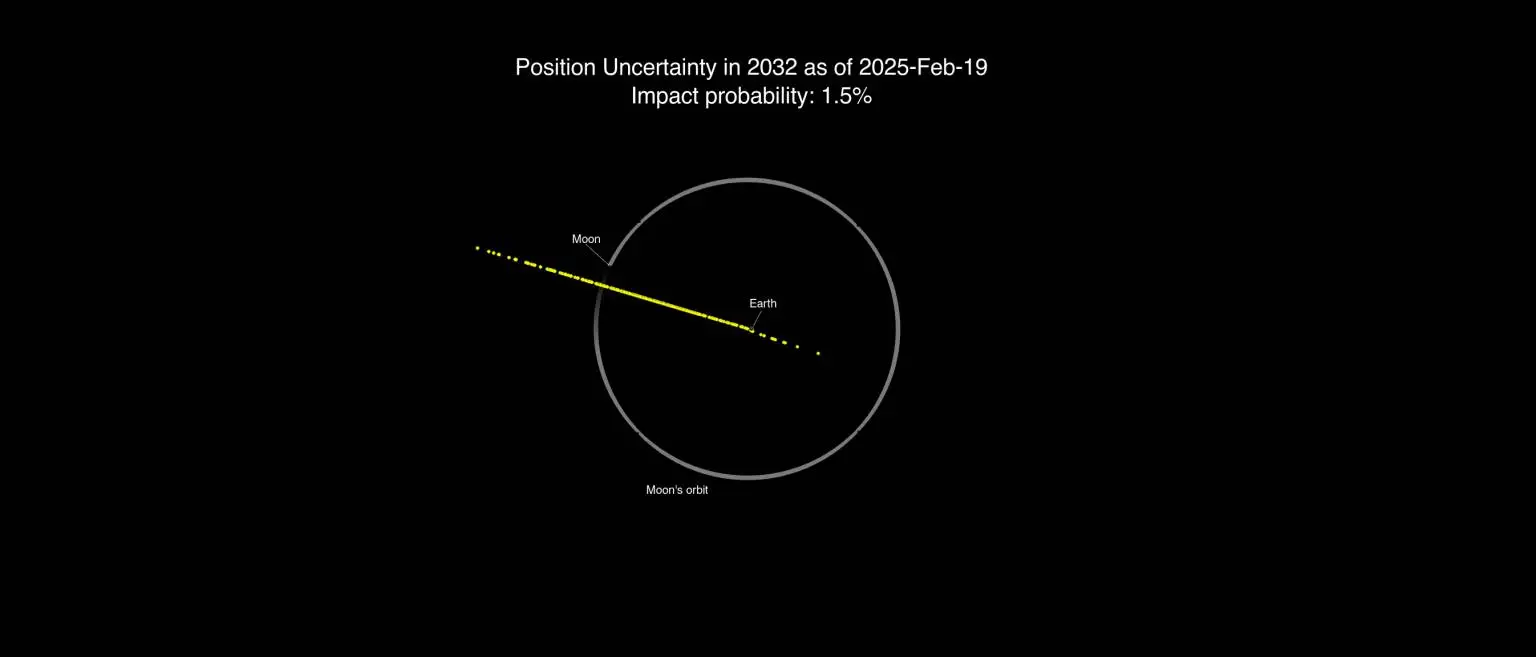
Giving us some slightly brighter news, the latest data again brought it back down to 1.5%, suggesting that the 'city-killing' asteroid could pass us by. When discovered in December 2024, 2024 YR4 was originally designated a 1-in-83 chance of hitting Earth. It's since fluctuated to a high of 1-in-32 but now settled back down to a 1-in-67 chance.
As reported by the New Scientist, we could be running out of time to figure out what's going on with the asteroid. According to the University of Southampton's Professor Hugh Lewis, it will soon pass behind the Sun: "Any observations we can make between now and when it’s out of view will obviously help us to refine the orbit and to make better predictions.
“That doesn’t necessarily mean that it will go down before April. It could continue to go up, but still ultimately miss us."
It's now a race against time as the James Webb Space Telescope scrambles to determine the size and composition of the asteroid. As Lewis notes: "That will help us determine what we need to do about it, because if it’s a stony asteroid, that’s very different from a high proportion of iron-metal asteroid."
An iron-rich asteroid will apparently be much worse, as he concludes: "The mass makes a huge difference in terms of the energy and whether or not the atmosphere has an effect on it."
Even though we're fully invested in this one, the fact that NASA is constantly adjusting the probabilities that 2024 YR4 will actually hit us means it's probably not best to look at the numbers.