• News
    • Tech News
    • AI
  • Gadgets
    • Apple
    • iPhone
  • Gaming
    • Playstation
    • Xbox
  • Science
    • News
    • Space
  • Streaming
    • Netflix
  • Vehicles
    • Car News
  • Social Media
    • WhatsApp
    • YouTube
  • Advertise
  • Terms
  • Privacy & Cookies
  • LADbible Group
  • LADbible
  • UNILAD
  • SPORTbible
  • GAMINGbible
  • Tyla
  • FOODbible
  • License Our Content
  • About Us & Contact
  • Jobs
  • Latest
  • Topics A-Z
  • Authors
Facebook
Instagram
X
TikTok
Snapchat
WhatsApp
Submit Your Content
Scientists announce risk of asteroid hitting Earth in 2032 just increased

Home> Science> Space

Published 11:58 7 Feb 2025 GMT

Scientists announce risk of asteroid hitting Earth in 2032 just increased

Experts believe the risk of an impact has now doubled

Rikki Loftus

Rikki Loftus

Scientists have announced what the risk is of an asteroid hitting Earth in 2032.

And unfortunately it’s bad news because our chances of a collision have just increased.

When Asteroid 2024 YR4 was discovered in December, it was determined that there was a remote possibility of it hitting Earth.
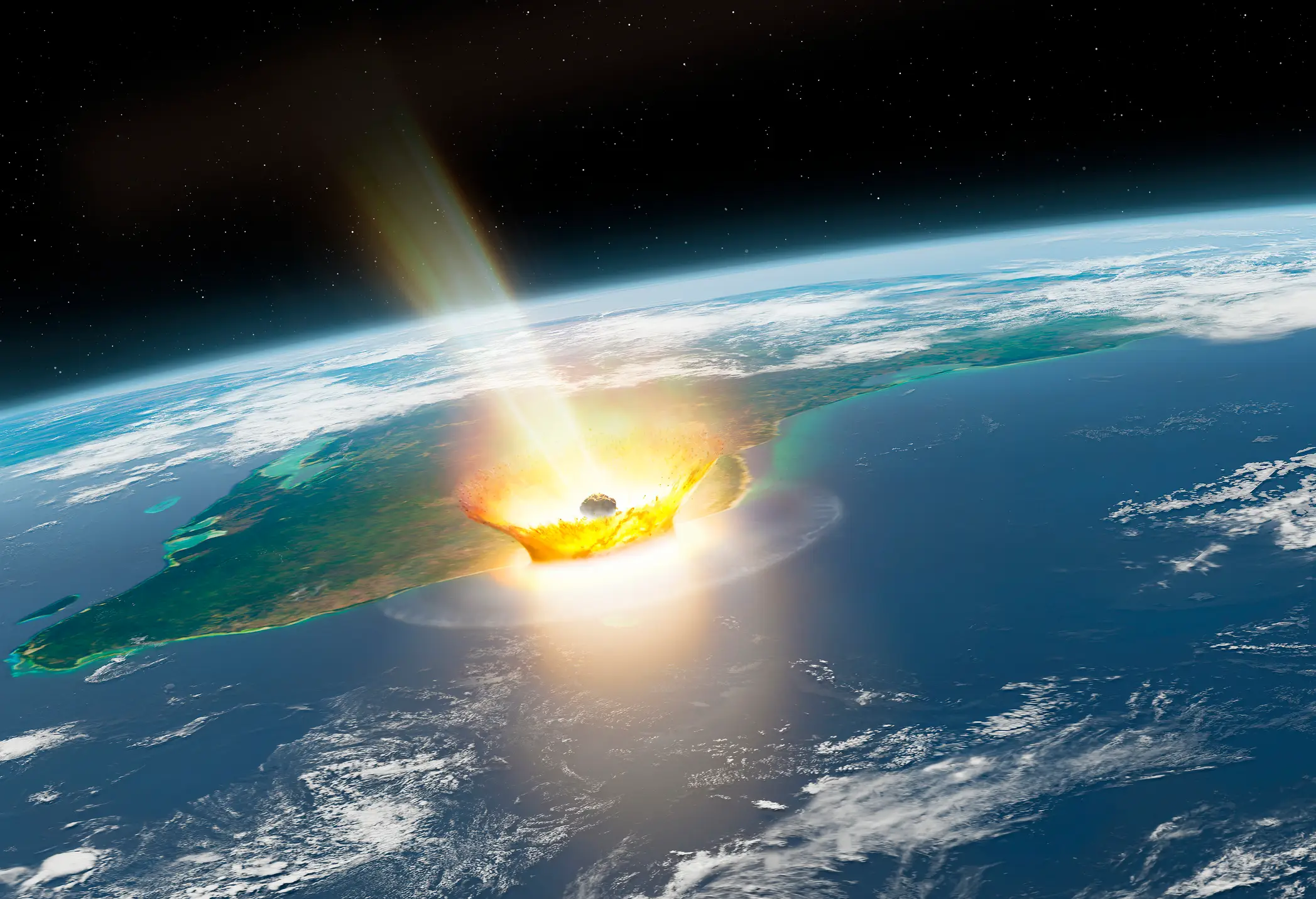
The asteroid could hit Earth in 2032 (MARK GARLICK/SCIENCE PHOTO LIBRARY/Getty Images)

Advert

This is because it was placed at Level 3 on the Torino impact scale, which measures the likelihood of a collision and the scale of the threat and damage.

Level 3 meant that there would be a 1.2% chance of the asteroid making impact with our planet on December 22, 2032.

However, things have now changed and more recent studies have shown that things could be worse than were originally thought.

In fact, astronomers reckon that the odds have more than doubled as of yesterday (February 6).

Advert

That doesn’t mean we all need to panic just yet, the chance of anything happening is still only 2.3%.

Now, experts are working to establish the risk corridor, which is the narrow plane of the asteroid’s orbit.

And there’s some better news - latest studies have revealed that the size of the rock is actually a bit smaller than what was originally thought.

It’s now estimated to be around 131 to 295 feet in diameter.
Advert

Space agencies around the world are monitoring the asteroid (STEFANI REYNOLDS/AFP via Getty Images)

In a statement after the discovery of the asteroid, NASA said: “Asteroid 2024 YR4 was first reported on Dec. 27, 2024, to the Minor Planet Center– the international clearing house for small-body positional measurements – by the NASA-funded Asteroid Terrestrial-impact Last Alert System station in Chile. The asteroid, which is estimated to be about 130 to 300 feet wide, caught astronomers’ attention when it rose on the NASA automated Sentry risk list on Dec. 31, 2024.

“The Sentry list includes any known near-Earth asteroids that have a non-zero probability of impacting Earth in the future.

“There have been several objects in the past that have risen on the risk list and eventually dropped off as more data have come in. New observations may result in reassignment of this asteroid to zero as more data come in. ”

Advert

The European Space Agency (ESA) also revealed that it is ‘actively monitoring’ the space rock.

It added: “It is possible that asteroid 2024 YR4 will fade from view before we are able to entirely rule out any chance of impact in 2032. In this case, the asteroid will likely remain on ESA’s risk list until it becomes observable again in 2028.”

Featured Image Credit: MARK GARLICK/SCIENCE PHOTO LIBRARY/Getty Images
Earth
Nasa
Space

Advert

Advert

Advert

Choose your content:

a day ago
2 days ago
  • @_mohamed247 via X
    a day ago

    People mind-blown as dystopian bright pink sky takes over major city

    The Wicked: For Good marketing has gone too far

    Science
  • Paul Hennessy/Anadolu via Getty Images
    a day ago

    NASA officially trigger medical evacuation of ISS astronauts for the first time in history

    A safe return is being scheduled over the next 48 hours

    Science
  • James Stewart Whyte / YouTube
    a day ago

    Man who spent entire year doing 100 pushups every day reveals exactly how it's changed his body

    No pain, no gain

    Science
  • Iuliia Burmistrova via Getty
    2 days ago

    Scientists warn this facial feature could be an early warning sign of dementia

    Don't ignore the warning signs

    Science
  • NASA scientists have just a few months to examine asteroid after risk of collision with Earth doubles
  • Nostradamus might have predicted the 'city killing' asteroid that threatens to hit Earth in 2032
  • Shocking cost to NASA if they decide to intercept asteroid at risk of hitting Earth in 7 years
  • James Webb Telescope catches sight of ‘city killer’ asteroid that scientists feared could hit Earth