
Horrifying Marvel movie comes to life as scientists tell us to halve the human population to survive


The Marvel Cinematic Universe used to be dogged by complaints that it had a villain problem, with the likes of Ant-Man's Yellowjacket and Guardians of the Galaxy's Ronan the Accuser being pretty lame.
As the MCU continues to deliver complex villains, and we gear up for Robert Downey Jr.'s take on Doctor Doom for Avengers: Doomsday, Josh Brolin's Thanos remains a jewel in the Infinity Gauntlet.
You might remember all those 'Thanos was Right' memes from back when Avengers: Infinity War and Avengers: Endgame released, but now, they're back with a vengeance as scientists tell us to follow in the bald brute's footsteps.
For those who need a refresher, Thanos watched his own planet of Titan crumble under the strain of overpopulation, and hoping to save the rest of the universe from the same plight, he planned to use the Infinity Stones to eradicate half of the population.
Advert
Spoilers from a movie that came out eight years ago, but Avengers: Infinity War ended with him achieving his goal and half of the universe being snapped out of existence.
Even though Elon Musk is banging the drum about falling birth rates and claiming we need to populate now more than ever, there are continued concerns about the stress we're putting on the planet.
Whether it be global warming and extreme weather wiping us out, or AI guzzling water while leading to a shortage, you don't need to be Baba Vanga to realize the future of the human race doesn't exactly look rosy.
In a new study published in the journal Sustainable Development, researchers appear to suggest that taking a leaf out of Thanos' book might not be a bad idea as they write: "Our collective impact upon the planet's ecosystems has become overwhelming and unsustainable."
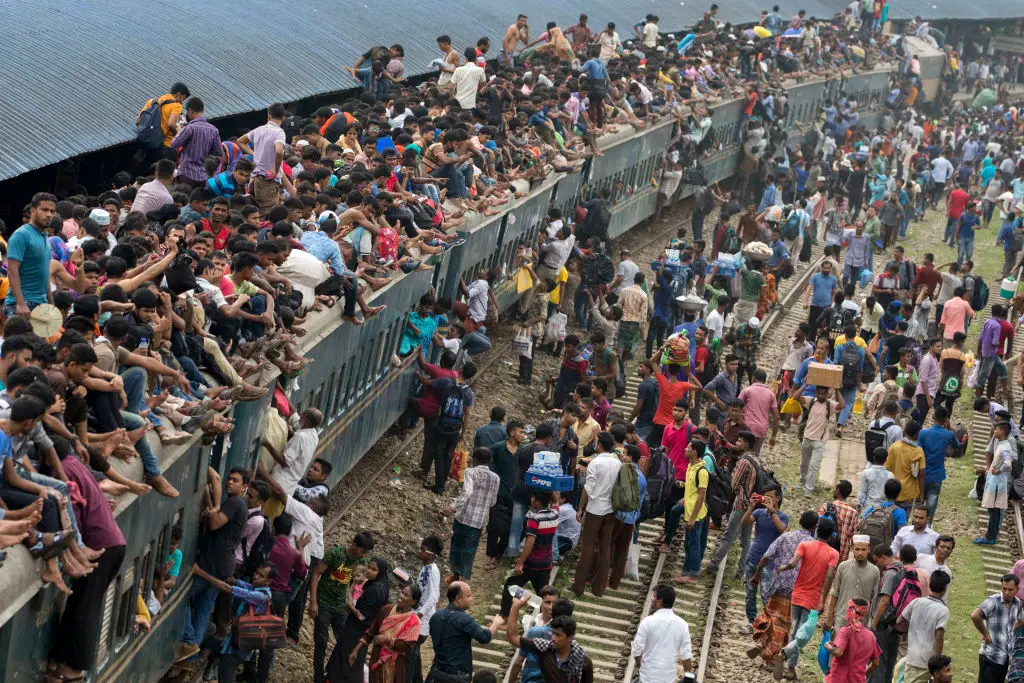
Then again, with the world's population sitting at around two billion in the 1920s and soaring to 8.3 billion in 2026, it's not hard to extrapolate the data when you look at reports that numbers are increasing around 0.85% every year.
Crunching the numbers, the impact we're having on the planet is each person's individual contribution to resource consumption and waste production multiplied by how many people there are on Earth. With resource consumption and waste production levels only going up, the paper posits that in order to save the planet, we should reduce the population to around four billion in 2200. The team writes: "Easing to a smaller and sustainable population would not deprive additional billions of life but instead ensure that when they do arrive conditions will be good."
It comes as the past 50 years have seen CO2 emissions more than double as the population has doubled. Elsewhere, biodiversity has more than halved, and our energy use has skyrocketed by three times. Unsurprisingly, those in high-income nations are reportedly consuming 13 times more energy per capita than those in low-income nations.
If all of this wasn't enough to keep you up at night, mineral extraction and pesticide use are said to have more than quadrupled in the past half a century.

While the scientists aren't quite suggesting we get a magical golden glove and try to turn half of the world to dust, but saying that "gently reversing population growth is the better course," they reiterate: "Global environmental problems are caused by people, nothing else...Helping population growth end and gently and justly reverse, while also moderating per capita impacts, is our best hope to secure a sustainable, desirable future worldwide."
It's not just for the good of the planet that we slow down the human race's expansion, with research claiming a lower population will lead to better economic well-being of nations. Apparently, countries with declining populations have enjoyed increases in per capita GDP and better wages.
All of this comes as conservative estimates point to the world population leaping to 11.4 billion by 2100.
Despite there being plenty of critics of the idea, the team concluded: "Among the benefits are habitat recovery and conservation of wild species, reduced greenhouse gas emissions and other pollutants, reduced conflict over resources, and the reduction of global poverty.
“A more modest population – gently easing population to 4 billion by 2200 – would protect Earth's natural heritage, including its wild habitats, wild species, and its climate. Such a world is within our grasp."