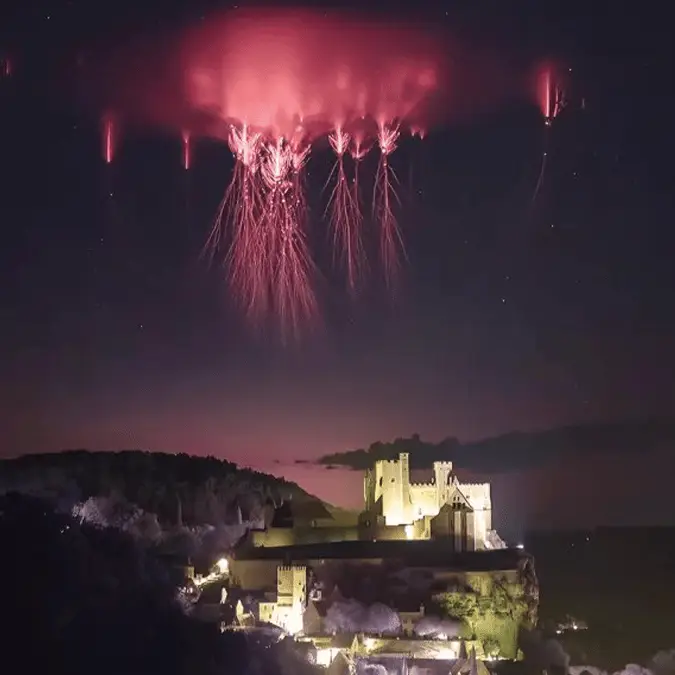
NASA speaks out over 'red jellyfish' floating above storm after residents sound the alarm


NASA has explained the science behind a mysterious 'red jellyfish' spotted hovering above storms worldwide.
Bizarre jellyfish-like lights appearing above thunderstorms around the globe have caught the public's eye. People were baffled with some even suggesting signs of alien life.
Luckily, NASA has stepped in to address the mystery and put the theories to bed.
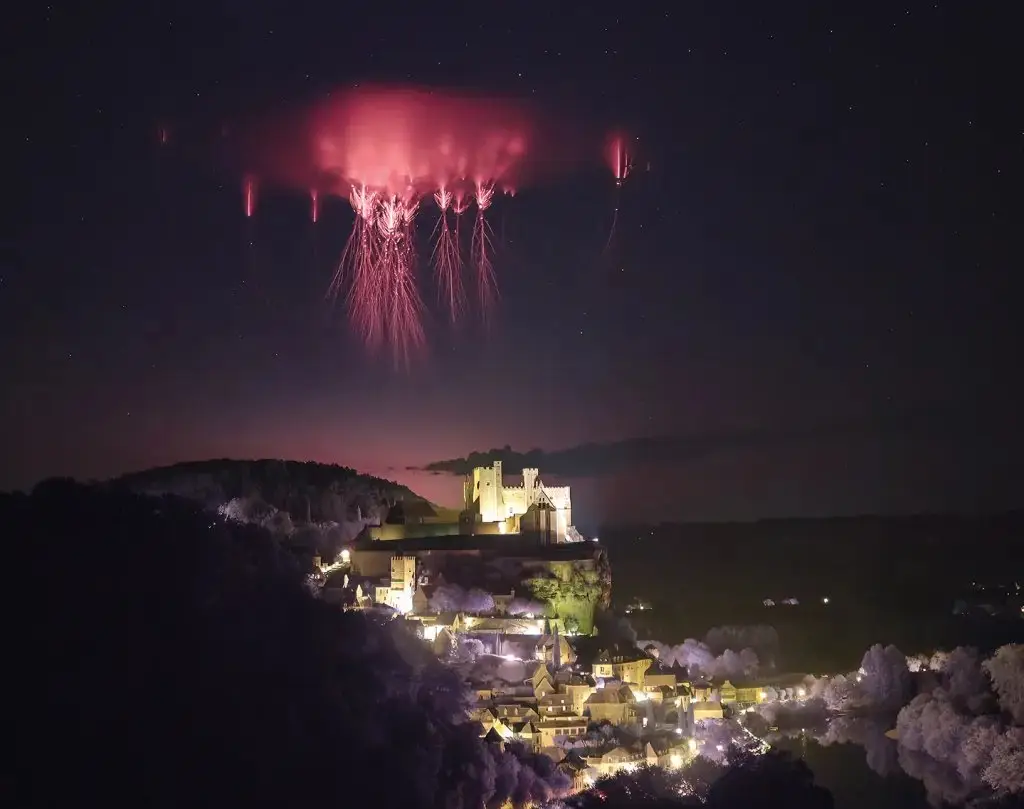
According to the US space agency, the sighting is known as a red sprite lightning discharge (or sprites), a rare type of electrical flash that occurs above intense thunderstorms. Unlike typical lightning that strikes downward toward Earth's surface, these formations shoot upward into the atmosphere.
Advert
Their vivid red colouring is a result of the interaction between high-altitude atmospheric conditions and nitrogen, which glows when these energy bursts pass through it.
Though they exist for only a few milliseconds, their pattern of long, luminous tendrils that extend downward with a bright 'head' above can be spotted, similar to the shape of a jellyfish. The flashes occur in the mesosphere, an atmospheric layer situated approximately 50 to 90 kilometres above Earth's surface.
Perhaps most interestingly is how rare these jellyfish lights are. They require extremely powerful thunderstorms below for them to form.
While they're only visible through specialised cameras or from space, their scarcity is why space scientists find them fascinating to study. In fact, astronauts aboard the International Space Station have enjoyed a front-row seat to these enigmatic lights.
One of the most recent was photographed during an orbital pass above a massive storm system, capturing details that would've otherwise been impossible to collect from the ground.
As the striking images circulated online, numerous observers jumped to conclusions about potential alien origins. However, NASA has since countered these claims by explaining that the lights are entirely natural, backed by decades of scientific research into atmospheric electrical phenomena.
Over on X, NASA posted an image of a spectacular red sprite, reportedly captured by citizen scientist Nicolas Escurat through the citizen science project Spritacular.
The agency wrote: "This fleeting red flash above a thunderstorm cloud is one of Earth's most elusive electrical phenomena!" NASA pointed to decades of research into sprites, confirming that their appearance and colour align completely with electrical processes in Earth's upper atmosphere.
Scientists can use their understanding of these flashes and red sprites to demonstrate how energy transfers during severe storms. With this, they can research into improving weather models, enhancing lightning prediction, and broadening our understanding of Earth’s electrical environment.