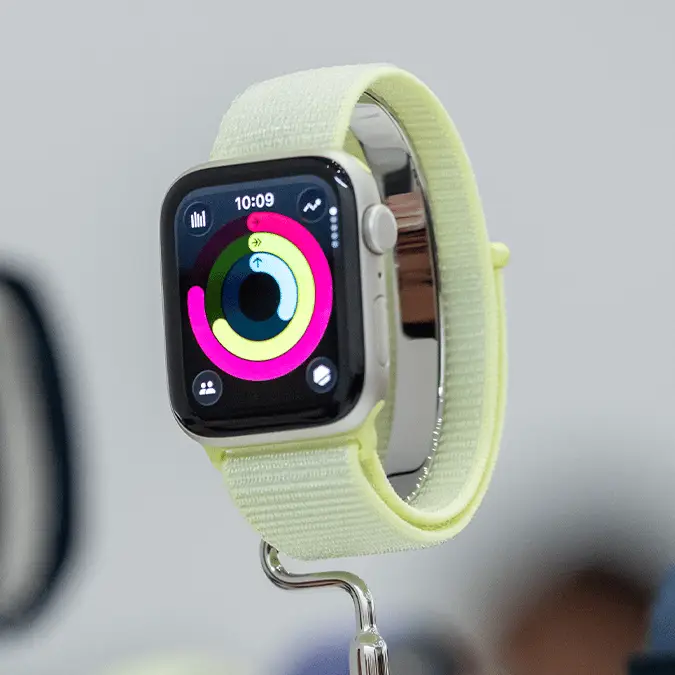
YouTuber tested how accurate the Apple Watch calorie calculator really is in mind-blowing experiment


While there might be nothing worse than fitness influencers shoving their healthy mantras down your throat, legions of you continue to lace up those fancy new trainers and pound the pavement in search of that summer body.
There's more health tech out there than you can shake a dumbbell at, with the likes of Peloton, Lululemon, and Strava making bank.
We've also seen a boom in more advanced tech, like Tonal with its AI-adaptive resistance and interactive coaching. As you can imagine, Google and Apple have jumped on the bandwagon with wearables like Fitbit and the Apple Watch.
There are champions of both, while YouTube is inundated with various reviews, making it even more confusing about what the right device is for you. Each have their own pros and cons, but if you want to keep track of how many calories you burn, you might want to watch Shervin Shares' video.
Advert

Real name Shervin Shaikh, his YouTube channel is known for sharing videos on everything from what it's like taking testosterone pills to running in barefoot shoes, testing ice baths to how 1,000 days with WHOOP apparently changed his life.
Putting the accuracy of the Apple Watch's calorie counting through its paces, Shaikh went to a professional performance service and got his 'official' calorie burn per hour. His experiment was spurred on by an AIM7 article that suggests wearables could be around 20% off when it comes to measuring heart rate, while they can supposedly be up to 100% off in terms of caloric expenditure measurements.
That same article accused Apple of miscalculating calorie burn by 115%, meaning Shaikh wanted to delve a little deeper.
The idea is that if you're calculating how many calories you should be consuming based on your Apple Watch, you could be way off. Still, he admitted the video was more for entertainment than science.
In one test where professionals declared he'd burned 579.2 calories, a Garmin wearable recorded 593, the Apple Watch clocked 636, WHOOP at 430, and an Oura ring claimed he'd burned 739. More than just overestimating, the suggestion is that some devices are underreporting your calorie burn.
When it came to cycling, the official numbers listed his calorific burn at 380.3. This is compared to WHOOP's 352, Oura's 320, Apple Watch's 466, and Garmin's 471. Again, there's no correlation between a specific brand being the most or least 'accurate'.
He goes on to say that it depends on where you place your Apple Watch, the weight, the model, and even the kind of strap it's attached with. Shaikh also maintains that the color of your skin, how much hair you have, and tattoos can also alter an Apple Watch's calorie tracking.
The gold standard of measuring calorific expenditure is done with a mask, but as most people don't want to go around looking like Bane, even slightly inaccurate wearables are the next best thing.
At the end of the video, Shaikh concluded: "So I think the biggest takeaway is knowing that your wearable is not going to be very accurate when it comes to caloric expenditure. So if you're trying to calculate how much to eat, take that information with a grain of salt."