Four more countries tighten security at airports as deadly Nipah virus continues to surge


2026 is already off to an alarming start, but alongside plunging temperatures and President Donald Trump vowing to take Greenland, making it feel like the Doomsday Clock will be ticking closer to midnight this year, we now have a potentially deadly pandemic to deal with.
It (thankfully) seems like a lifetime ago that we were locked up in our homes as COVID-19 spread across the globe, and while it's true that people are still dying of it (365 in the past week), most have put it to the back of their minds.
While we'll likely never get to the truth of what really caused Covid, conspiracy theories continue to swirl. Now, we're warned to brace for another deadly Covid-esque infection, as the Nipah virus is in danger of spreading across Asia.
Adding to our fears, The Independent warns that airports across Asia have tightened their security and introduced similar measures to those that were used to deal with Covid.
Advert
Although we managed to largely dodge the 'Camp Hill Virus' as a distant cousin of the Nipah virus, our brushes with this kind of outbreak need to be taken seriously.
Nepal, Taiwan, and Thailand are among those that are undertaking precautionary measures after five cases of the Nipah virus were confirmed in India’s West Bengal.
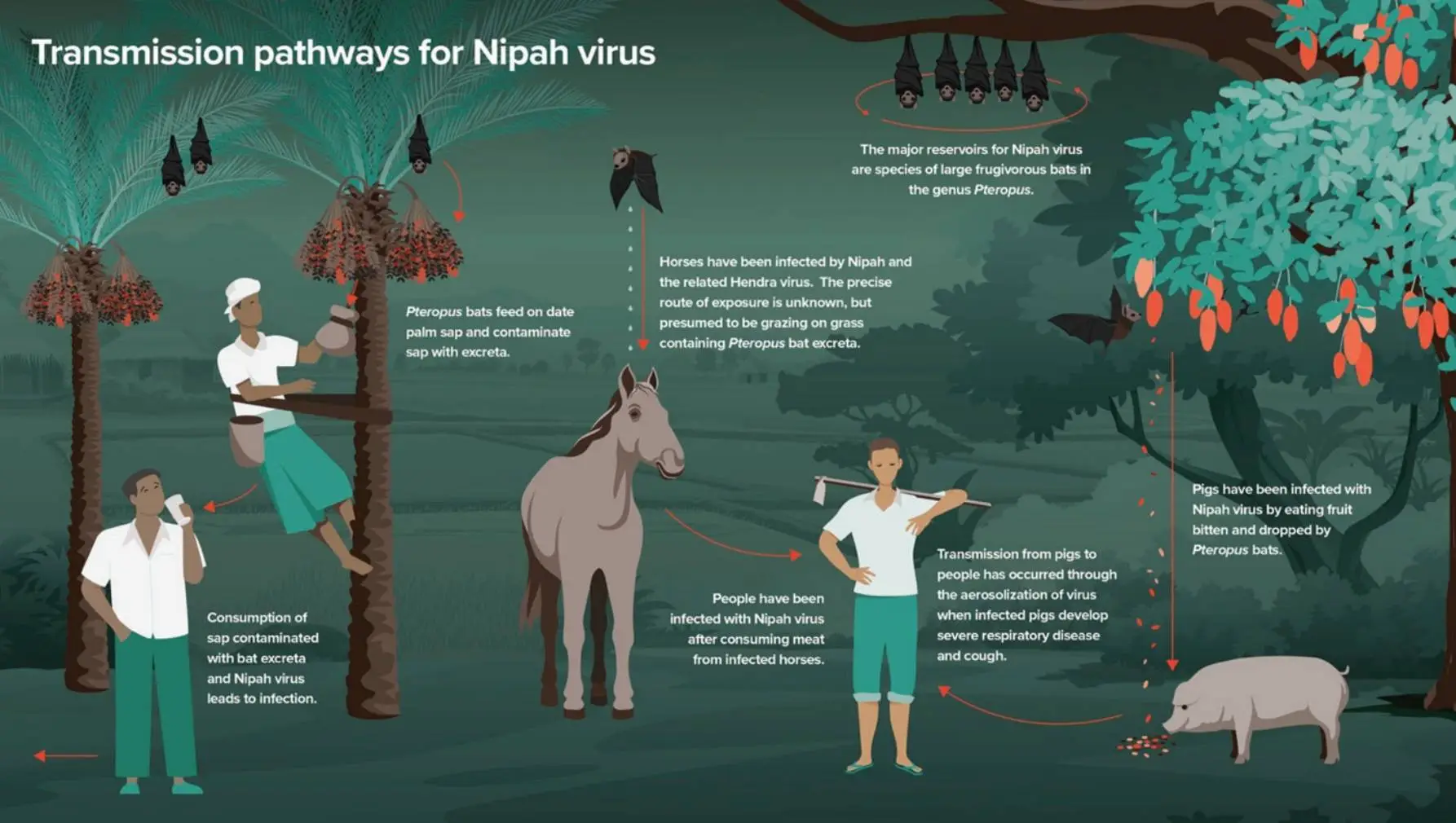
The Nipah virus can be passed to humans by contact with infected pigs and bats through their saliva and urine, although it can also be contracted by eating contaminated food and via human-to-human contact.
In Thailand, the Ministry of Public Health has upped screening in major airports, focusing on anyone arriving from West Bengal.
It's said that health 'beware' cards are being issued to passengers, while Suvarnabhumi, Don Mueang, and Phuket airports are looking out for flu-like symptoms and respiratory distress, that were also telltale signs of Covid.
Hong Kong is the latest country to raise awareness of the Nipah virus, as its own airports introduce similar measures.
Thought to have originated in a West Bengal hospital, 100 people were quarantined. A male and female nurse were the first positive cases, with a doctor, another nurse, and a fellow staff member then bringing it up to five.
Thailand's Prime Minister, Anutin Charnvirakul said that while no domestic Nipah cases had been recorded, the country would remain on high alert. The Thai government added: "Thailand's Department of Disease Control screens travellers from West Bengal, India at Suvarnabhumi & Don Mueang airports starting 25 January amid Nipah virus outbreak. Health officials implement strict measures as passengers show excellent cooperation at checkpoints."
Elsewhere, the India outbreak has led to Thailand ordering stricter screenings in cave areas and national tourist attractions where a potential spread could be triggered.
For now, Thailand is going with the motto of: "Don’t hunt, don’t forage, don’t eat."
Nepal has introduced its own checks at Kathmandu's Tribhuvan International Airport, as well as 'key' land and border crossings with India. Officials have especially raised concern over the country's open borders with West Bengal as a neighbor.
Taiwan is set to list Nipah virus as a Category 5 notifiable disease, making it the highest classification.
As the world waits, the World Health Organisation has reiterated that the Nipah virus is a priority pathogen due to its ability to trigger an epidemic.
With a mortality rate anywhere between 40% and 75% based on past outbreaks, authorities are being praised for acting early.