
NASA reveals huge clue about medical emergency behind historic ISS evacuation


NASA has dropped a huge clue about the medical emergency that triggered its ISS evacuation.
A 'serious' medical situation that cut short a space mission and brought four astronauts home early has left many wondering what exactly happened aboard the International Space Station (ISS) earlier this month.
Crew-11 wrapped up their orbital stay a month early after what NASA described as a 'serious' health concern.
On 14 January, the team climbed into their Dragon capsule, undocked from the ISS and splashed down in the Pacific Ocean near San Diego the following morning.
Advert
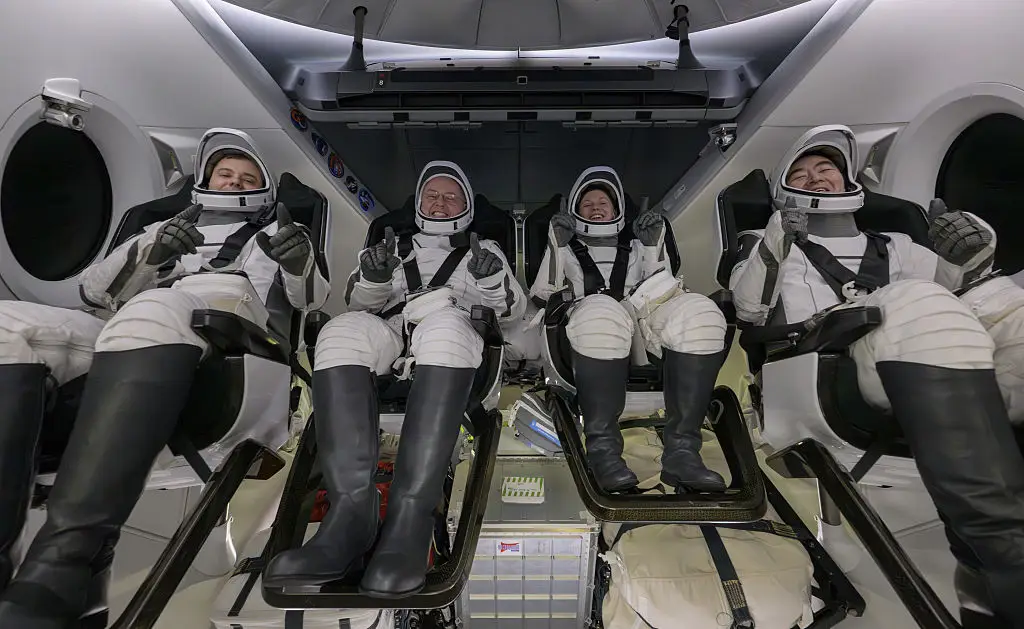
The NASA astronauts consisted of Zena Cardman, Mike Fincke, Japanese astronaut Kimiya Yui and Russian cosmonaut Oleg Platonov.
Upon touchdown, the crew was airlifted to a hospital in the San Diego area, where they spent the night undergoing medical assessments, before heading to NASA's Johnson Space Center in Houston.
While the space agency confirmed everyone remained in stable condition throughout, officials were vague on the details.
"Just to start off, of course, we are back here a little earlier than we were expecting. And just to say it up front, we are not going to be identifying the crew member or talking through the differential (diagnosis) or any of the details of the medical situation," said Cardman on the post-flight news conference. "Thank you so much for respecting our privacy."
However, NASA has now shed some light on one major clue that led to the urgent evacuation.
In their first public appearance since touching down on Earth, NASA pilot Fincke revealed that 'when we had this emergency, the ultrasound machine came in super handy'.

"Having a portable ultrasound machine helped us in this situation; we were able to take a look at things that we didn't have," he explained.
Fincke didn't detail the exact nature of the emergency, but the mention of ultrasounds suggests two possibilities.
One common use of ultrasound technology in space is to monitor astronauts' cardiovascular health in microgravity conditions. Without Earth's gravity pulling fluids downwards, blood tends to drift up from the astronauts' feet and collect around their head and chest, which increases the risk of fatal blood clots.
Another main use for ultrasound in space is to monitor astronauts' eye health. The same fluid buildup in the head that affects circulation can also cause swelling, leading to a condition known as 'spaceflight-associated neuro-ocular syndrome.'
That being said, ultrasound is a versatile diagnostic tool for countless medical scenarios, so the specific emergency remains an open question.
During the press conference, Fincke added that all future spaceflights should be equipped with portable ultrasound machines.
"Of course, we didn't have other big machines that we have here on planet Earth," he said. "We do try to make sure that everybody before we fly are really, really not prone to surprises. But sometimes things happen and surprises happen, and the team was ready […] preparation was super important."
The Crew-11 astronauts splashed down on 15 January, marking the first time the ISS has ever been evacuated.