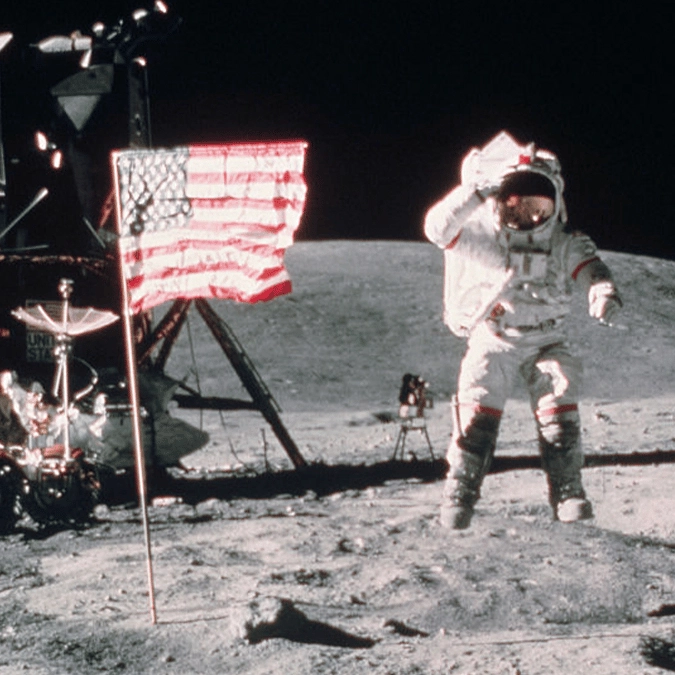
Reason why NASA has halted 2027 moon landing mission


For months, NASA’s Artemis comeback has been sold as the moment the space agency finally puts humans back on the lunar surface, but it has now been stalled.
The latest wobble centres on Artemis II, the mission meant to carry astronauts around the Moon on a roughly ten-day trek. It was initially slated to lift off on February 8, but NASA has been wrestling with fueling issues that pushed the launch window back to April. That delay has fed straight into the online rumour mill, where every slip becomes supposed proof of something bigger.
The delay has reignited claims that NASA is stalling for reasons it won’t say out loud.
Critics and conspiracy theorists have been pushing the idea that the agency is trying to bury alleged ‘ancient structures’ on the Moon’s far side, despite the US government maintaining that no definitive evidence of extraterrestrial life has been found and that an unknown civilisation there has not been proven.
Advert

As reported by the Daily Mail, NASA Administrator Jared Isaacman revealed that Artemis III, which had been scheduled to touch down in 2027, will now only ‘circle the moon’ instead — pushing a potential landing mission to 2028 ‘at the earliest’.
Isaacman’s argument is that NASA needs to lock down the basics before it tries to pull off the headline moment. According to the Daily Mail, he said: “NASA must standardize its approach, increase flight rate safely, and execute on the President’s national space policy.” He followed that with: ‘’With credible competition from our greatest geopolitical adversary increasing by the day, we need to move faster, eliminate delays, and achieve our objectives.”
That thinking is echoed in a longer line laying out the strategy: “Standardizing vehicle configuration, increasing flight rate, and progressing through objectives in a logical, phased approach, is how we achieved the near-impossible in 1969, and it is how we will do it again.”

In other words, NASA wants a step-by-step build-up because it believes there are too many development and production risks right now to make a 2027 landing and safe return realistic.
Isaacman also said the agency was going back ‘to the wisdom of the folks that designed Apollo.’ He added: “The entire sequence of Artemis flights needs to represent a step-by-step build-up of capability, with each step bringing us closer to our ability to perform the landing missions.”
NASA’s current plan is for Artemis III to run a similar flight to Artemis II in 2027, with Artemis IV then landing around ten months later in 2028. Isaacman also noted Artemis V could follow later in 2028 if the first landing goes smoothly.