
NASA announce new launch date for Moon mission and it sounds like a joke


NASA's Artemis II mission has faced a series of setbacks that have tested the patience of the space agency and its team.
The ambitious lunar mission, which aims to return humans to the Moon for the first time since 1972, has been plagued by technical difficulties and weather-related delays.
Originally scheduled for launch in late 2024, the mission was first pushed to February 2025, then delayed again due to heat shield concerns and other spacecraft issues.
The crew consists of NASA astronauts Reid Wiseman, Victor Glover, and Christina Koch, and the Canadian Space Agency's Jeremy Hansen, who will journey on a 10-day trip around the Moon and back. Artemis II has also been designed with advanced systems for evacuation and escape at any stage of the journey.
Advert

While Artemis II won't actually land on the lunar surface, it will take the crew farther into deep space than any human has travelled before.
“They’re going at least 5,000 nautical miles (around 5753 miles) past the Moon, which is much higher than previous missions have gone,” Artemis II flight director, Jeff Radigan explained last September.
However, the preparations haven't been going to plan with the launch date pushed back several times due to poor weather conditions and spacecraft malfunctions.
After delaying the launch to April, NASA has revealed a new target date just weeks away.
According to the US space agency, Artemis II will potentially launch on 1 April at 6:24pm ET.
With it falling on the same day as April Fool's Day, you'd be forgiven for thinking it's a joke. But the space agency only has a handful of days in early April (2, 3, 4, 5, 6) to launch before pushing it back until 30 April into May.
Mission planners also have to wait until the Moon is in the right part of its orbit, which complicates the launch window even further.
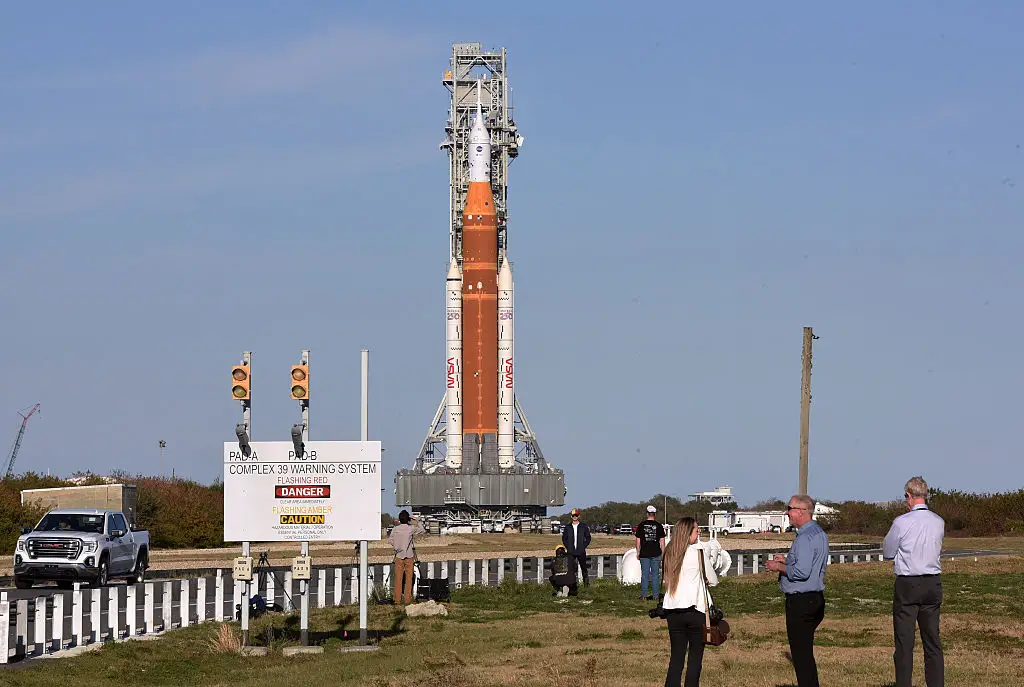
Despite the recent complications, NASA's team claims the 'excitement' is 'really starting to build.'
“Every night I look up at the Moon, and I see it, and I get real excited because I can feel she’s calling us and we’re ready,” NASA’s Lori Glaze said at a press conference last month. “We can really start to feel it. It’s coming.”
Fortunately for viewers who don't want to miss the event, NASA has developed a tracking app that lets people follow the crew's progress as they journey to the Moon, around it, and back home. The Artemis Real-time Orbit Website (AROW) will provide live tracking of the spacecraft, including its distance from Earth and the moon, and the mission duration.
Elsewhere, SpaceX and Blue Origin are progressing towards lunar landers by 2028, but they are also met with technical challenges, such as in-orbit refuelling.