
Scientists may have finally solved mystery of space’s strange 1.4-Hour radio signal


Scientists may have finally solved the mystery of a strange 1.4-Hour radio signal out in space.
While the success of the historic Artemis II mission has reignited excitement about what's next for lunar travel, other sightings of space rock explosions have left many US residents shaken.
Now, scientists have turned their attention to a mysterious ticking sound in space, which they believe they have finally cracked.
Since 2005, a strange repeating signal has been pulsing every 1.4 hours. Known as a long-period radio transient, it belongs to a category of cosmic signals that have baffled astronomers since their discovery.
Advert

What is causing the mysterious signal?
According to the research team, the source has been traced to a star system called ASKAP J1745-5051, which they have described as a 'vampire star.' It's located an almost incomprehensible distance from Earth, roughly one followed by sixteen zeroes in miles.
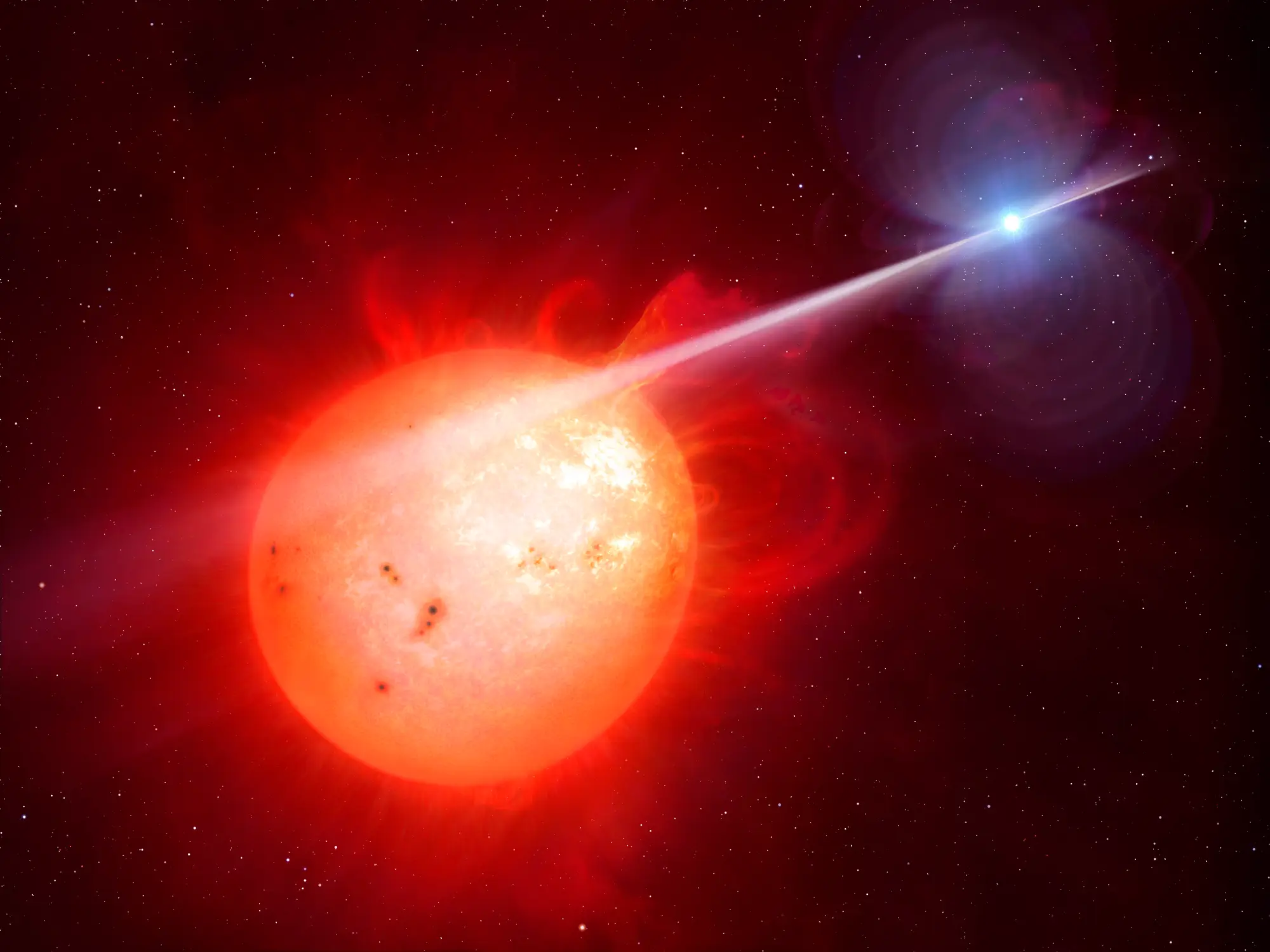
The system contains a white dwarf and a red dwarf, locked in a one-sided gravitational relationship. In other words, the white dwarf is feeding on its red dwarf companion, giving it the 'vampire' nickname.
The material accumulates on the white dwarf's surface and heats to millions of degrees, triggering a nova explosion and emitting X-rays, as observed by the Australian SKA Pathfinder radio telescope.
"For the first time, we have pinpointed the origin of these signals, confirming the source to be a 'cataclysmic variable', or an accreting white dwarf star," said lead author and PhD student Kovi Rose from the University of Sydney’s School of Physics. "Long-period radio transients have puzzled astronomers for years"
He added: "We’ve only found about a dozen, and their origins have been unclear. Now, we’ve been able to show that the source for one of these transients comes from a white dwarf actively pulling material from a companion star."
How does the signal work?
As the two stars orbit each other every 1.4 hours in an elliptical path, they periodically draw close before drifting apart again. When they come close to one another, their magnetic fields interact, clashing and stripping particles from each other's surfaces.
Those particles are flung outwards, generating radio waves known as synchrotron radiation. It is this magnetic interaction, rather than the stars themselves, that is producing the signal, the team noted.
Dr Alfredo Carpineti, who was not involved in the study, told Metro that the findings are 'very exciting.'
He explained: "There are many radio events in the universe that remain mysterious and connecting a signal to a source is crucial to understanding how they are produced. The discovery of an X-ray signal connected but seemingly independent is even more exciting."
The astronomer added that the 'light invisible to our senses is key to solving this mystery.'
What does the discovery mean for future research?
Rose hopes the discovery could provide a framework for distinguishing between different types of long-period radio transients and understanding what produces them. He and his team plan to continue studying the system across radio, optical, and X-ray wavelengths to get a 'bigger picture' of what's happening.
"We’re only just beginning to understand this new class of cosmic events," Rose concluded.