'Doomsday argument' math equation that predicts end of humanity said to be 95% accurate


Experts believe that they have figured out when the world will end with a success rate of around 95%, as a 'doomsday argument' math equation suggests that there's an end point for humanity's existence.
First proposed by Australian astrophysicist Brandon Carter – who the equation itself is named after – the Carter catastrophe or 'doomsday argument' suggests that there is a fixed number of humans that will ever live, and when that runs out the world as we know it will end.
As shared by IFLScience, this proposition hinges on an earlier hypothesis known as the Copernican principle, which itself dates all the way back to the 16th century and argues that observations from Earth are representative of the average position in space, and not a privileged position.
While our failure to discover any other living beings beyond our planet might suggest that we hold a unique stature, the principle argues that our location is fundamentally ordinary and representative of the wider universe as a whole.
Advert
It has been used as baseline for predictions for hundreds of years, with J. Richard Gott III using it as a test to work out how long certain plays would run for on Broadway, and it also informs something far more consequential — the end of our existence.
Under the impression that the total number of humans to ever exist is already defined, any one person's existence can be presumed to be any position within that total figure, which can then be used to predict that there's a 95% chance that anyone is born within the last 95% of all total humans.
This then approximates that roughly 60 billion humans have been born so far, with there subsequently being a 95% chance that the total figure for humanity's existence sits at 1.2 trillion.
There exist a number of fascinating counter arguments to this equation – including one that suggests the opposite, that we're only within the first 5% of humanity's total existence – but the Carter catastrophe does provide a seemingly concrete year for when the world will end.
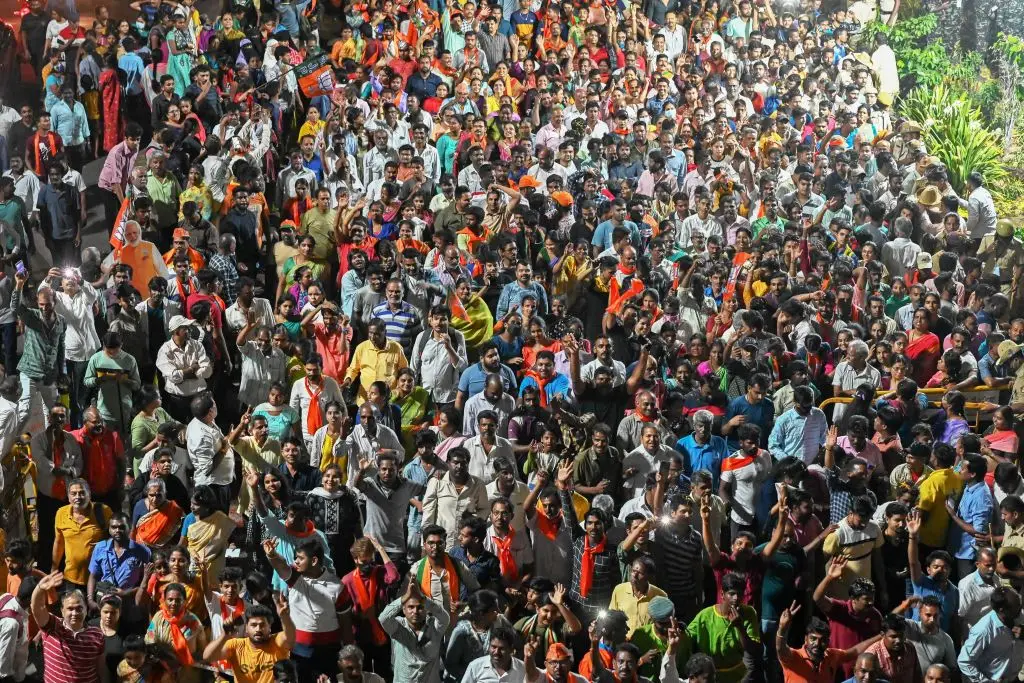
It relies on the notion that population numbers will stabilize at roughly 10 billion with a continued average life expectancy of 80 years – two concepts which can easily be debated considering their own individual evolutions over the last few centuries – but this puts a deadline of the year 11,146, or 9,120 years into the future.
This is unfathomably far into the future for any one human being alive right now – despite the notion that we're seemingly in the final stretches of existence – yet it remains still a frightening concept to have such a definitive end date.
There's also the very real chance that our planet will become inhospitable well before that point anyway as a consequence of climate change, and then even further into the distant future we have the prospect of the Sun consuming Earth to deal with, so we're destined for extinction no matter where you look.