Researchers warn 'Doomsday Glacier' is closer than ever to catastrophic collapse


Experts are warning that the ‘Doomsday Glacier’ is closer than ever to catastrophic collapse.
This comes as a team of researchers discovered that there could be profound implications should the collapse occur.
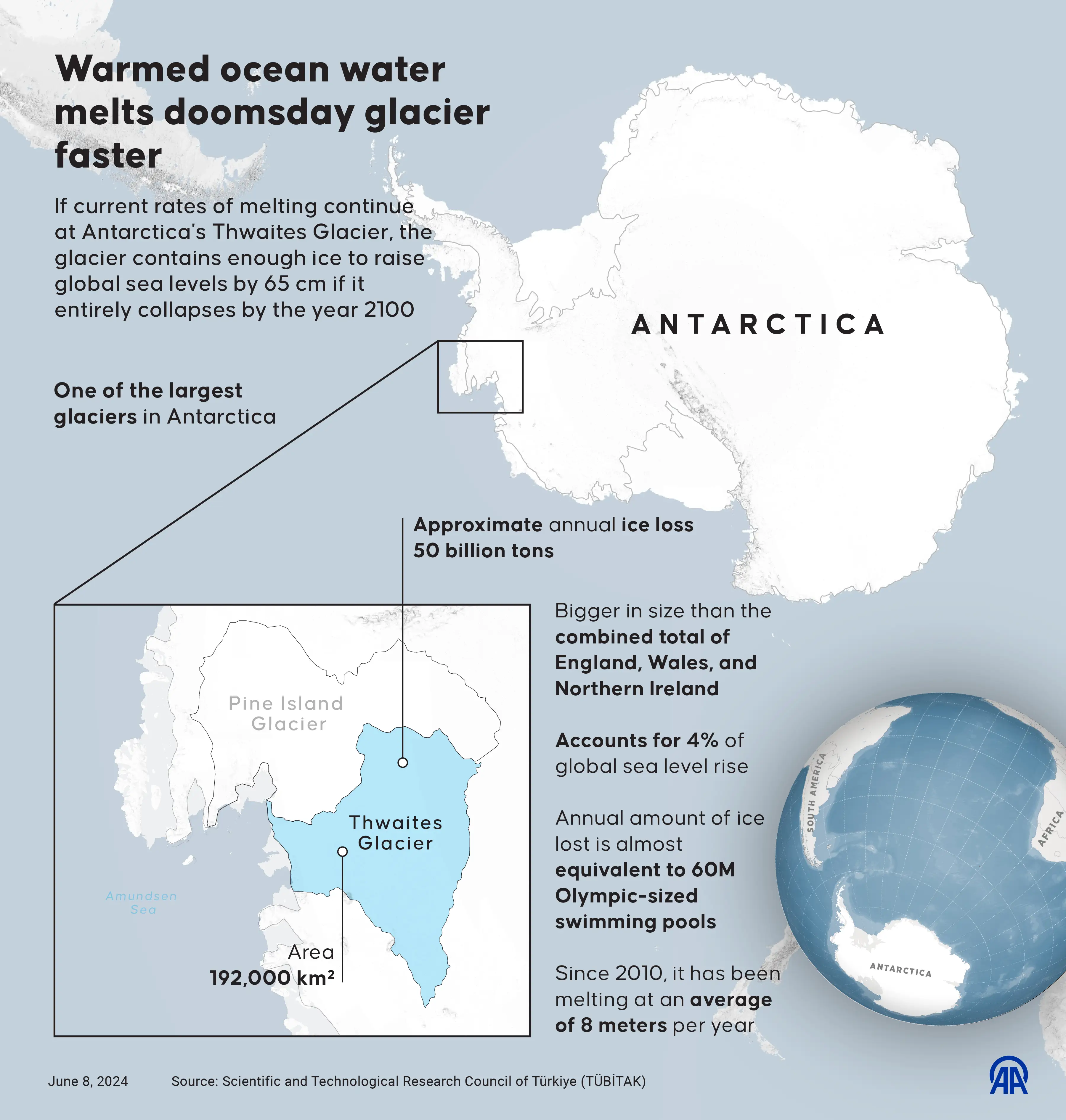
The glacier in question is known as the Thwaites Glacier and is located in Antarctica, with scientists having now released a new study to warn the public on what could happen should the event take place.
In the study, which was published on Advancing Earth and Space Sciences, it detailed: “Our findings demonstrate that the progressive disintegration of the shear zone exerts a dynamic influence on the upstream flow. During the terminal phase of TEIS’s evolution, we detect a coherent pattern of velocity perturbations emanating from the shear zone and propagating across the mid-shelf domain, suggesting a strong dynamic linkage between localized structural failure and its shelf-wide flow response.
Advert
“In addition, we have seen accelerated mid-shelf flow correlating with increasing shear strain rates and fracture growth within the shear zone, particularly after 2017, after the long shear zone fractures nearly disconnected the shelf from its pinning point.
“We find that the sequence of events observed during the terminal phase of TEIS is consistent with the initiation phase of a self-reinforcing feedback mechanism… This mechanism involves damage accumulation within shear margins, localizing strain concentration and promoting upstream acceleration, which in turn exacerbates damage further. If this feedback is operating on TEIS, it is likely to accelerate its disintegration.”
If the ice shelf is to face collapse, this will come with devastating consequences for the entire planet as scientists warn that this will cause global sea level to rise by a whopping 11 feet.
And it is looking more likely than ever as fractures in the ice have grown from around 100 miles to over 200 miles long.
The study went on to say: “Uncertainty in the future behavior of Thwaites Glacier constitutes one of the major uncertainties in global sea level rise projections. Thwaites Eastern Ice Shelf is a floating extension of Thwaites Glacier and is anchored by a submerged ridge at its northern edge, called a pinning point. Pinning points obstruct the flow of the ice, also causing it to deform, compress, and fracture. Over the past 20 years (2002–2022), Thwaites Eastern Ice Shelf (TEIS) has experienced a significant increase in fracturing upstream of its pinning point.”
The progress of the glacier will continue to be monitored as fears grow surrounding the potential collapse.