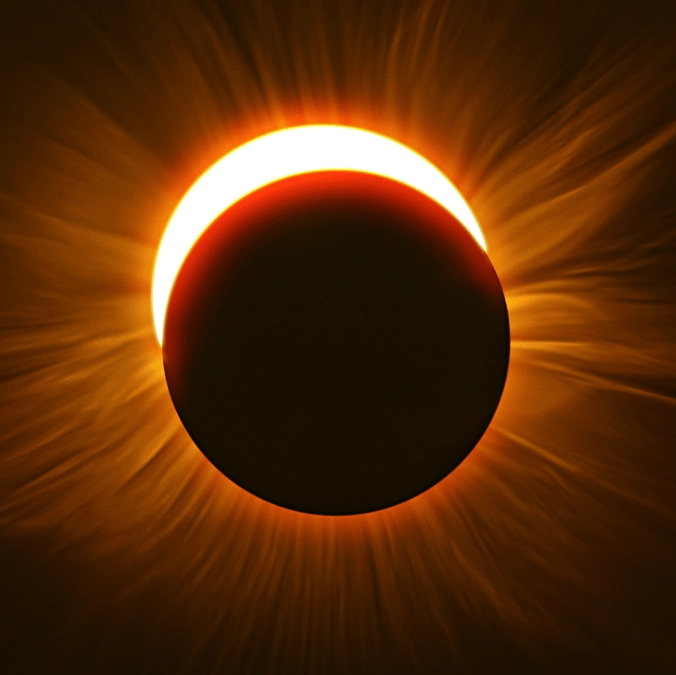
NASA announce official date for the longest solar eclipse in 100 years


NASA has confirmed the official date for the longest solar eclipse in 100 years and it's coming soon.
Brace yourselves because the longest solar eclipse of the century is due to happen in less than two years’ time. NASA has announced that parts of Europe, North Africa and the Middle East will all fall under the moon’s shadow during the rare event.
Solar eclipses occur when the moon moves directly between the Sun and Earth, casting a shadow that blocks some or all of the Sun's light from reaching us.
How long will the 2027 eclipse last?
Total solar eclipses vary in duration. The April 2024 eclipse that crossed North America lasted four minutes and 28 seconds, and the one expected in Spain next August will last under two minutes.
Advert
Meanwhile, the longest total eclipse ever recorded was seven minutes and 28 seconds on 15 June, 743 B.C in the Indian Ocean off the coast of Kenya and Somalia in Africa, based on NASA's calculations.
Robert Massey, deputy executive director of the Royal Astronomical Society said that the 2027 solar eclipse is 'significant due to its duration.' According to the US space agency, the upcoming celestial event will last six minutes and 23 seconds on 2 August 2027.
"It’s unusual to have one this long, and requires the combination of the new moon being close enough to the Earth to cover the sun for a longer than usual time," he explained. "Eclipse durations vary quite a bit – if the moon is further away, then the apparent size of the silhouetted moon is a bit smaller, so it covers the sun for a shorter time."
He added: "Beyond a certain distance, the eclipse is annular, and a bright ring of the solar surface is visible even mid-eclipse."
Where is the 2027 eclipse taking place?
The eclipse will begin in Morocco and southern Spain before advancing through Algeria, Tunisia, Libya and Saudi Arabia, NASA stated. It's then expected to peak in Yemen and along the coast of Somalia, before its maximum duration is recorded in Egypt, specifically in the historic cities of Luxor and Aswan.
"NASA [and others] use data from organisations like the US Naval Observatory and HM Nautical Almanac Office to calculate the precise position of the Moon in the sky, and how far away it is from the Earth," Massey said. "Interestingly, the change in rotation of the Earth makes a difference here, something we don’t know far into the future, so the precise track of the shadow of the moon is harder to determine in, say, ten thousand years’ time."
He noted: "But we do know how far away the moon is, and when an eclipse will happen."