Archaeologists make remarkable discovery inside 'time capsule' cave sealed for 300,000 years


Archaeologists make a remarkable discovery inside a sealed 'time capsule' cave.
A cave in northern Israel that remained sealed for hundreds of thousands of years has revealed a remarkable collection of remains.
According to the Israel Antiquities Authority (IAA), archaeologists discovered the prehistoric cave near the town of Fureidis and the Zichron Yaakov interchange. The site is believed to date from approximately 250,000 to 400,000 years ago, placing it near the end of the Lower Palaeolithic period.
Its unusually well-preserved contents could offer scientists a glimpse into how early humans lived before they evolved into Neanderthals and modern humans.
Advert

Following the finding, the IAA and the University of Haifa have launched a wide-ranging research programme to piece together how early humans lived, adapted to their surroundings, and developed new technologies and ways of life as evolution unfolded.
Professor Ron Shimelmitz of the University of Haifa described it as a 'privilege' to excavate a place of 'unique global importance.'
He added: "Only a handful of sites from this important stage have been uncovered in Israel and the Levant as a whole, and most of them are not accessible for research."
According to Shimelmitz, 'gradual changes' in human anatomy, technology and society during the Lower Palaeolithic period helped lay the foundations for the more complex behaviour later associated with Neanderthals and modern humans.
"One of the central processes taking place during this period was the transition to life in larger groups and longer stays at the same sites," Shimelmitz explained.

He noted that part of that transition was a move toward living in larger groups and staying put in one place for longer: "In caves from this period, evidence has been found of intensive use of fire and prolonged human activity, evidence of complex and rich camp life.
"These are findings that many researchers link to the development of social cooperation and the transmission of knowledge, as part of the processes of human development."
Meanwhile, Dr Kobi Vardi, head of the Prehistory Branch at the IAA, said it was 'very rare' to find a prehistoric site preserved to such a high standard.
He described that the site will allow his team to 'study in high resolution how humans lived at the time.'
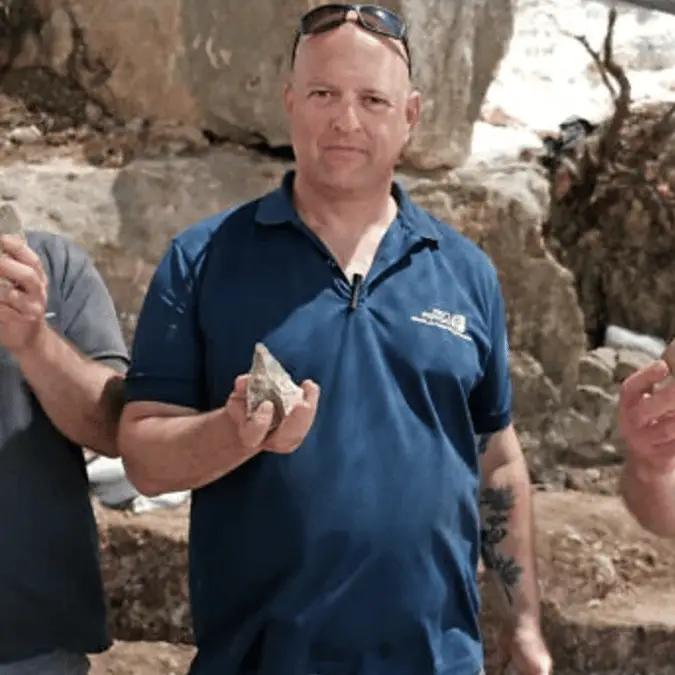
The excavation has already uncovered a variety of flint tools produced using advanced techniques including small hand axes, scrapers and blades.
Animal bones have also been found at the site, including the remains of fallow deer, gazelles and equids, as well as nearby water which 'may have made the site a focal point for ancient hunter-gatherer groups,' Dr Vardi added.
The researchers concluded: "The hope is that after the research is completed, there will be an open and accessible site here for everyone, for the residents of Fureidis, for students and for anyone interested in the prehistory of the Land of Israel."