What Microsoft's latest Code Red move means for millions of people who use it every day


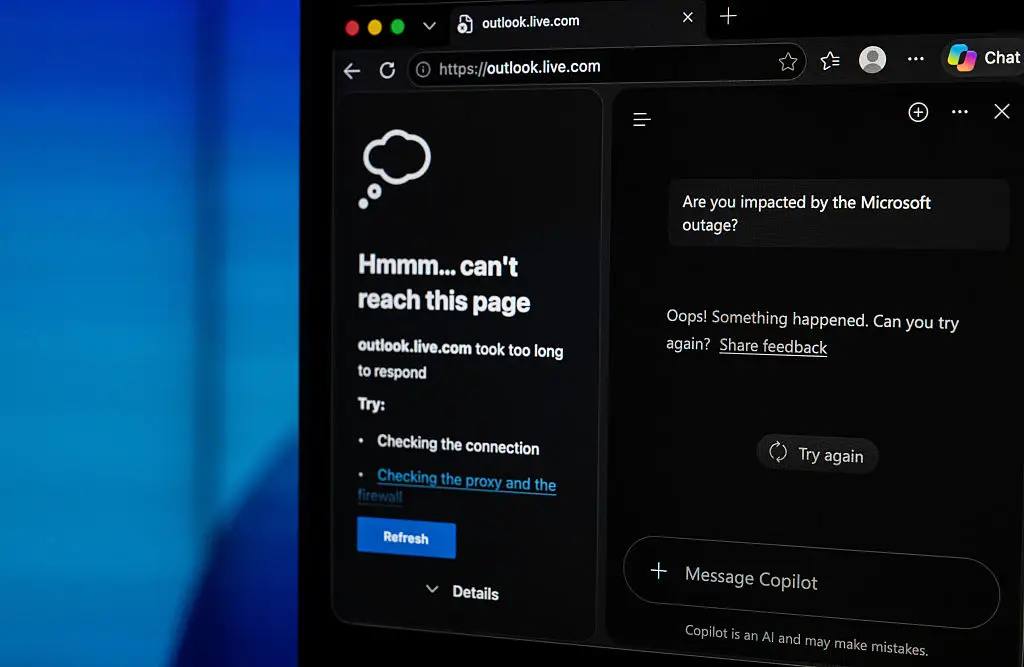
Millions of workforces ground to a halt on November 12, with a massive disruption knocking out Microsoft 365 services around the globe.
While some sat back and enjoyed a lazy day without access to their Outlook emails or Microsoft Teams, it was panic stations for Microsoft engineers and others.
Away from Microsoft Live sign-in issues affecting gamers, Bing suffered massive degradation. The fact that ChatGPT uses parts of Bing for its searches had a knock-on effect on the chatbot, while administrative bottlenecks caused chaos for everything from the healthcare industry to emergency services.
As time went on and the Microsoft outage extended to nearly 24 hours, there have been some major learnings in the aftermath.
Advert
With this, the tech giant has issued a 'Code Red' alert to try and prevent a similar situation from happening again.
What is Microsoft's 'Code Red' alert?
Planned as an overhaul of Microsoft's engineer systems, the Code Red mobilization was revealed via internal memos from Microsoft 365 Core President Jason Henderson and Corporate VP Amanda Silver.
With Henderson saying that people have never been without access to email for so long, he reiterated: "Code Red means that this is the highest priority work for our team."
Telling staff to pause routine tasks to focus on major reliability and operational flaws, the Code Red protocol comes amid reports that responders shared over 11,000 messages over 11 separate chats, as Silver says fragmented internal tracking systems made things hard to track. A running call throughout the outage is said to have peaked with over 1,000 participants, but still, it took far longer than expected to get everything back online.
Even as servers started to return to some sort of normality, this had to be done in stages to stop everything overloading.
Following Microsoft CEO Satya Nadella's public apology for the disruption, Microsoft's Code Red alert aims to resolve future incidents within an hour. It also vows to try and deploy urgent security fixes on a global scale within 60 minutes.
Moving forward, Silver has outlined plans for engineers to restructure systems so that they can divide traffic by region and reduce server loads during strain. Hopefully, this will stop a failure in one area from pulling everything down.
As part of this, Microsoft plans to deploy internal AI agents that will assist human engineers in locating root causes much faster.
In general, there should be increased executive oversight, with daily progress meetings between leaders and the Substrate engineering team that manages the underlying M365 infrastructure, as well as weekly executive reviews in an attempt to track systemic fixes. Hoping to nip issues like this in the bud, Henderson concluded: "In a separate recent incident, an urgent production fix took five to six days to reach worldwide saturation. For our most urgent security issues, we need to get from detection to safe worldwide deployment in an hour. Needless to say, we aren't here yet."
What caused the Microsoft outage?
While tech experts have been warning us to brace for an increase in tech outages and potential cyberattacks, Microsoft has reiterated that its November 2026 incident wasn't the result of bad actors. Earlier this year, Cloudflare's critical PHP update led to a spike in cyberattacks, showing just how vulnerable things can be when an increasing number of sites become reliant on a decreasing number of infrastructures.
Tech experts have weighed in on what they think caused the Microsoft outage, although the company has since confirmed it as an undetected Windows scalability bug that overwhelmed network gateways. Supposedly introduced in July 2026, the scalability bug was triggered by a sudden surge in traffic and reduced server capacity.
Microsoft's post-incident report refers to the dormant software defect running on servers for three months because Microsoft tested the update on older hardware. This became a severe flaw when running on newer servers with higher processor core counts.
When a heavy load caused gateway servers to become unresponsive and fail automated heal checks, Microsoft's automated resilience systems diverted traffic to healthy servers that were still online. In turn, this caused them to become overwhelmed, knocking out everything from Outlook to Copilot.
While Microsoft's Code Red action plan should hopefully stop an outage as devastating as this from happening again, there are obvious concerns about how something like this happened in the first place.