NASA issue statement as 22-year-old space telescope is careening back to Earth


A NASA telescope that was sent to space in 2004, is now spiraling down to orbit after a botched attempt to retrieve it back in July.
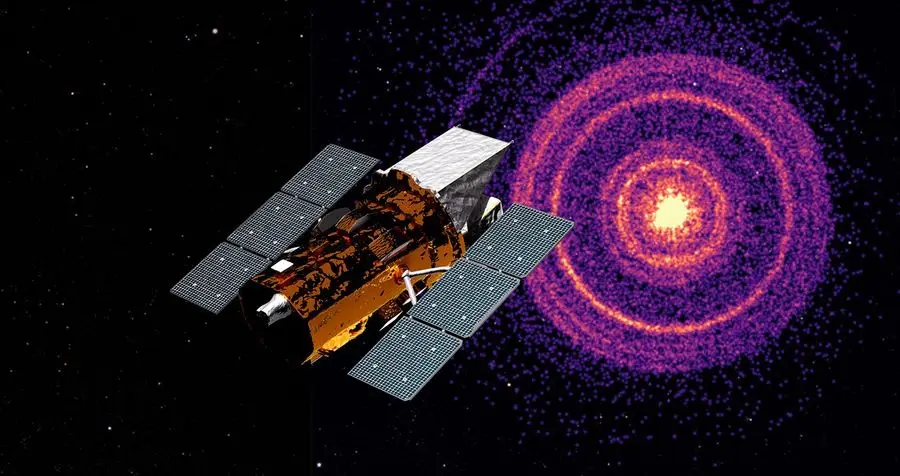
The Burst Alert Telescope was sent up on November 20, 2004, as NASA’s Swift Gamma-ray Observatory, and at the time, was the first-of-its-kind multiwavelength observatory dedicated to the study of gamma-ray bursts.
According to NASA, these bursts are the ‘most powerful explosions in the universe’ which are ‘triggered by the catastrophic deaths of massive stars’ and more.
With that, Swift’s three instruments were tasked to work together to monitor these bursts and their ‘afterglows in gamma-ray, X-ray, ultraviolet, and visible light’.
Advert
In the end, the telescope did its job, and did it well, with it still transmitting data in August 2026.
But NASA’s attempt to help it on its way after noting it had been orbiting Earth at approximately 200 miles, which could drop below 185 – making it harder to collect observations.
In an effort to get more out of its observations until then, NASA turned on one of its three scientific instruments, the Burst Alert Telescope, which previously was shut off in April to conserve power during the repositioning of the spacecraft’s solar panels.
With the Swift able to automatically point its telescopes at new gamma ray bursts, it has since began spiraling, with reentry through the atmosphere a very real possibility.
If this happens, it could ruin the observatory, and anything unfortunate enough to get in its way.
“The return to science has caused Swift to resume its rapid sinking. It is now located around 200 miles (325 kilometers) above Earth,” said NASA in a statement. “Below 185 miles (300 kilometers), spacecraft operations become more difficult and science observations will likely cease. The team estimates Swift will reach this threshold sometime in early to mid-October.”
If it sinks enough, it could simply drop from space, although experts say it’s unlikely.
“While it’s possible some hardware from the Swift spacecraft may survive re-entry due to its size, the probability of debris causing significant property damage or physical harm to anyone is very small,” space tracking company LeoLabs told CNN. “More likely, as is the case with most debris that survives re-entry, it will fall into the ocean or on land that’s uninhabited.”
Katalyst, the contracting company which sent up a craft to nudge Burst and service the craft, spoke out.
“While we did not accomplish every objective we set out to achieve, in less than a year we went from mission concept to launching and operating the first commercial space robot. This is a foundation we can build on,” Katalyst Space CEO Ghonhee Lee in a statement.
“The future of space will require spacecraft that can do more once they get there,” he added. “We’re building toward that future.”
In September, Katalyst Space conducted ‘in-space tests and maneuvers to exercise the capabilities of its robotic servicing spacecraft, LINK’, but could only get as close as 7.5 to 9 miles (12 to 15 kilometers) of Swift before it encountered issues.
In its attempt to boost Swift to a higher altitude, its own altitude control issues meant it couldn’t complete its mission and is set to deorbit soon.