Huge asteroid that could destroy entire city set to pass Earth tonight and you can watch it happen


Earth is thankfully not being hit by a massive asteroid this evening, but the incredibly close call also allows some people to see the massive space rock soar past our planet in an event you won't want to miss.
There have been a number of close calls with asteroids and other threatening space objects in the past year, as not only did some fear that an alien invasion was on the way thanks to an unknown comet soaring through the solar system, but the threat of asteroid 2024 YR4 was very real for a brief moment.
We're still here though and experts over at NASA don't currently have any immediate threats they're observing for the time being, yet one close call is set to visibly pass by our planet this very evening.
What asteroid is passing by Earth tonight?
As reported by the Daily Mail, the asteroid in question is referred to by scientists as 2026 JH2, and its immense size – estimated between 16 and 35 meters (52 to 115 feet) – would give it enough power to wipe out an entire city upon impact.
Advert
Tonight (May 18, 2026), the asteroid is set to make a close pass by Earth at a distance that's a little too close for comfort for some people, although it will hopefully make for quite an impressive spectacle.
At its closest, the asteroid will be only around 56,000 miles (90,000 kilometers) from our planet, which is roughly a quarter of the distance between Earth and the Moon, showing quite how much of a narrow miss this was in actuality.
How to spot 2026 JH2 passing by
The biggest benefit of 2026 JH2's close proximity is that we can see it flying by, although you will still need some form of special equipment as it's not close enough to be spotted with the naked eye.
2026 JH2 will be visible at around 21:23 p.m. GMT (2:23 p.m. PDT), and you'll need at least an amateur telescope in order to see the faint dot soaring through the sky at roughly 20,000 miles per hour (32,000 kilometers per hour).
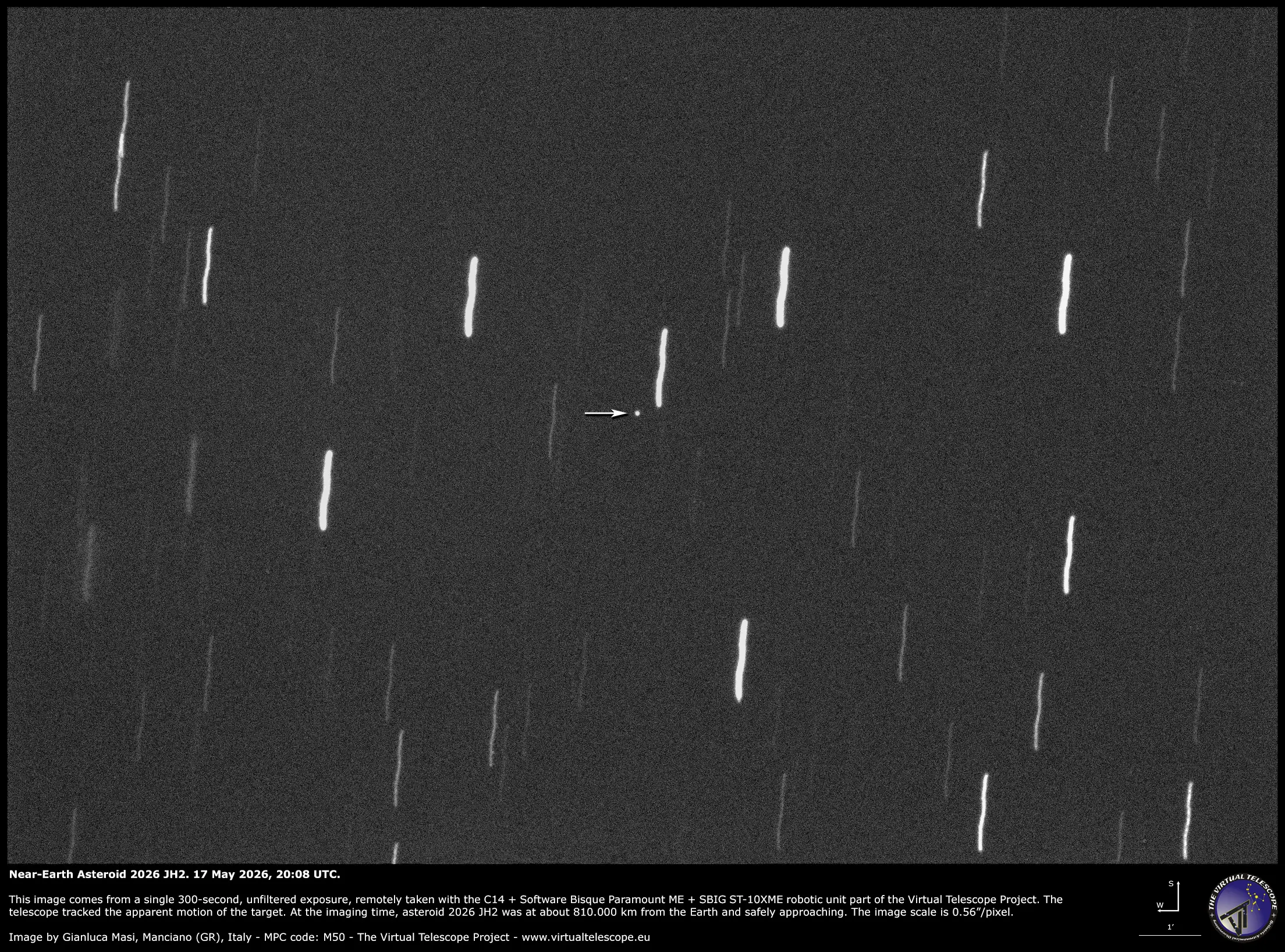
If you've not got the right equipment – as even a pair of binoculars likely won't be enough – you can also watch a livestream of the event on YouTube through The Virtual Telescope Project, who will start their own broadcast around two hours before the asteroid is likely to come into view.
The threat of this particular asteroid won't emerge again for at least another 100 years, so this could be your only opportunity to witness it passing by — and who knows, it might collide with Earth next time around.