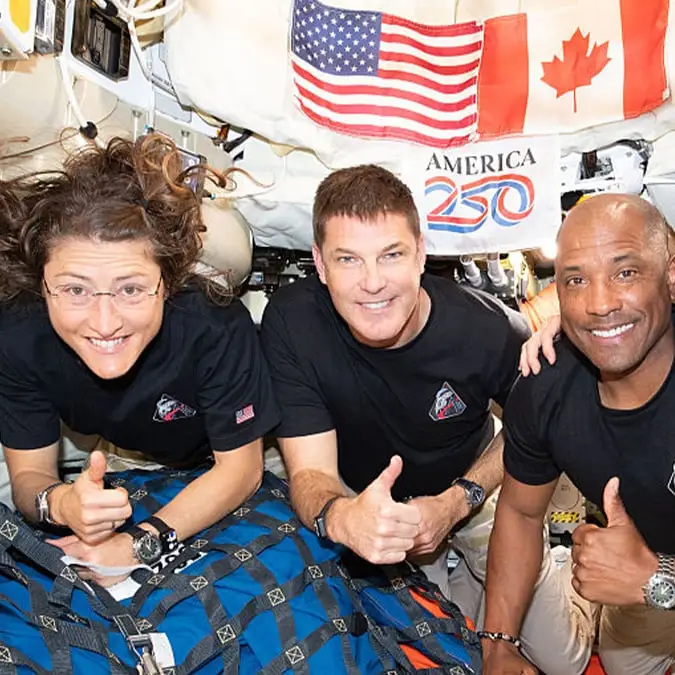
Artemis 2 astronauts share 56-year-old piece of history carried on board NASA's Orion craft


The astronauts aboard the Orion capsule have shared the historical pieces they carried with them on their trip around the Moon.
The Artemis II mission saw a crew of four astronauts embark on the first human lunar flight in over half a century.
After successfully completing their lunar flyby on Monday (April 6), the crew used the Moon’s gravitational pull to slingshot themselves back towards Earth.
Now, the group is expected to splashdown just off the coast of San Diego later today (April 10).
Advert
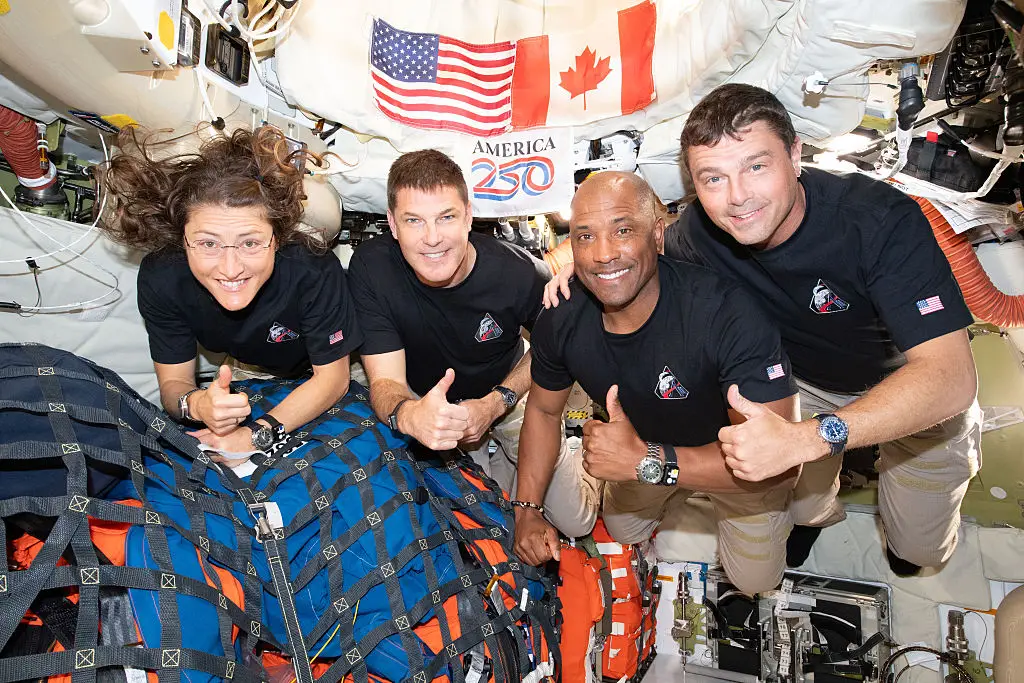
The mission is made up of NASA’s Reid Wiseman, Victor Glover, Christina Koch, and CSA (Canadian Space Agency) astronaut Jeremy Hansen.
As they make their way back home, the team took to a live broadcast to share a special piece of history which has joined them onboard.
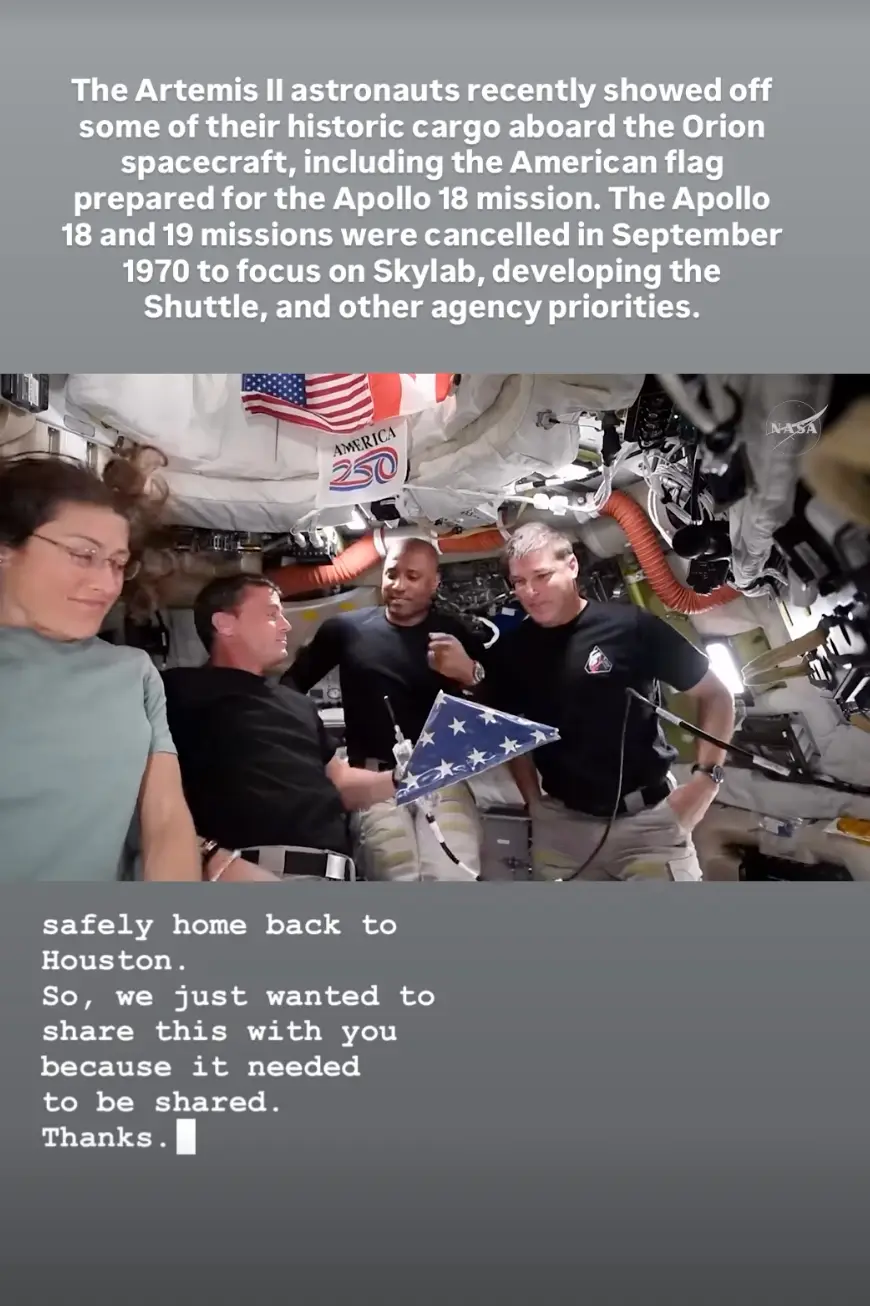
The crew shared that they had brought an American flag with them which was originally made 56 years ago for the Apollo 18 mission, which never went ahead.
Apollo 18 and 19 were missions that ultimately ended up being canceled by NASA as focus shifted towards other priorities for the space agency.
The final human trip to the Moon before Artemis II was Apollo 17, which took place in 1972 and saw astronauts Gene Cernan and Harrison Schmitt become the last humans to step foot on the Moon up to now.
While the astronauts taking part in Artemis II did not land on the lunar surface, we could soon see humans landing back on Moon.
This is because if this mission proves to be successful, then Artemis III is scheduled to go ahead next year, which will involve a lunar landing.
What happens when the Artemis 2 astronauts land back on Earth?
The crew aboard the Orion capsule are officially Earthbound and are expected to arrive home later today.
NASA has revealed that the tream will be retrieved by helicopters for an immediate medical evaluation upon arrival.
On the NASA website, it details how the crew are scheduled to land just off the coast of San Diego just after 8pm.
Following their splashdown, the astronauts will be picked up by helicopters to take them to the USS John P. Murtha where they will ‘undergo post-mission medical evaluations in the ship’s medical bay before traveling back to shore to meet with an aircraft bound for NASA’s Johnson Space Center in Houston’.
What is the purpose of the Artemis II mission to the Moon?
According to NASA, the team are performing ‘a series of planned tests to evaluate systems, procedures, and performance in deep space’.
The space agency continued: “They will conduct manual spacecraft operations and monitor automated activities; evaluate Orion’s life-support, propulsion, power, thermal, and navigation systems; perform proximity operations activities; assess habitability and crew interfaces; and participate in science activities, including lunar surface observations and human health studies, that will inform science operations on future Moon missions.
“They also will practice mission-critical activities, including trajectory adjustments, communications at lunar distances, and piloting Orion during key phases of flight, culminating in a re-entry and splashdown to further validate the spacecraft’s performance with crew aboard.”
The team also broke the record for the furthest distance traveled in space by humans.
This was previously set by the Apollo 13 crew who went as far as 248,655 miles away from Earth, but now Artemis II has beaten them after their capsule reached the 252,756-mile mark.