
uniladtech homepage
  • News
    • Tech News
    • AI
  • Gadgets
    • Apple
    • iPhone
  • Gaming
    • Playstation
    • Xbox
  • Science
    • News
    • Space
  • Streaming
    • Netflix
  • Vehicles
    • Car News
  • Social Media
    • WhatsApp
    • YouTube
  • Advertise
  • Terms
  • Privacy & Cookies
  • LADbible Group
  • LADbible
  • UNILAD
  • SPORTbible
  • GAMINGbible
  • Tyla
  • FOODbible
  • License Our Content
  • About Us & Contact
  • Jobs
  • Latest
  • Archive
  • Topics A-Z
  • Authors
Facebook
Instagram
X
TikTok
Snapchat
WhatsApp
Submit Your Content
Mind-blowing reason 10 days are missing from your phone calendar in October 1582

Home>News
Published 17:17 4 Oct 2024 GMT+1

Mind-blowing reason 10 days are missing from your phone calendar in October 1582

The date jumps from October 4 straight to October 15

Rikki Loftus

Rikki Loftus

google discoverFollow us on Google Discover
Featured Image Credit: Apple/Munro/Getty Images
History
Science
News

Advert

Advert

Advert

If you find yourself killing time and for some reason decide to scroll all the way back on your phone calendar to the year 1582, you might be surprised by what you find there.

In fact, if you go to October of that year in particular, you will notice that bizarrely there are 10 whole days missing from the month.

No, this is not a glitch or a bug with your iPhone, those days actually don’t exist at all.
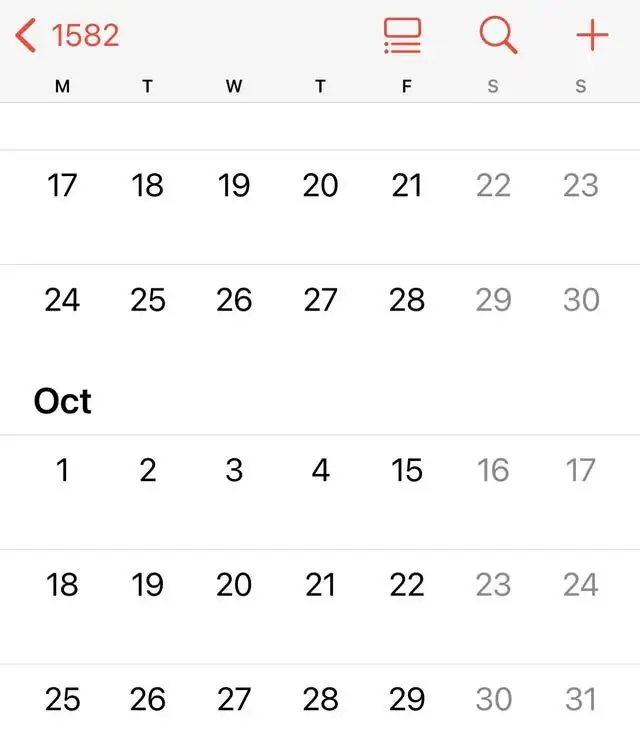
The calendar misses 10 whole days (Apple)

Advert

The day of October 4 1582 followed directly into October 15 - and there’s an interesting reason why.

In October 1582, the Catholic church made the switch from the Julian calendar to the Gregorian calendar.

Both are solar calendars with 12 months in them that range from 28 to 31 days and both have leap years but the main difference between them is when the leap year takes place.

While both calendars add a day to the calendar once every four years, the Gregorian calendar doesn’t do it if the year is divisible by 400.

This might not sound like a big deal but for the Catholic church, the Julian calendar messed up when Easter would be.

This is because since 325 CE, Easter has been observed on the first Sunday after the first full moon after the spring equinox on March 21.

But as time went on, the spring equinox started to drift from the original date and in the 1500s, it fell on March 11.


That’s when Pope Gregory XIII stepped in and introduced the Gregorian calendar in order to make sure that the dates aligned with the motions of the sun.

So this meant that we had to lose a few days.

The Cultural Tutor explained the event on X, formerly Twitter, writing: “And in 1582 Gregory issued a decree called ‘Inter gravissimas’.

“It stated that the new, modified version of the Julian Calendar was to be adopted that year.

“The change would happen in October, when Thursday 4th would be followed by Friday 15th, to correct the 10 days of drift.”

It was decided that October would be the month to lose 10 days as it didn’t clash with any major events in the Christian calendar.

The people of 1582 went to sleep on October 4 and awoke to October 15.

As for the reason why our iPhones go back that far on the calendar app? That’s another mystery.

  • Bizarre reason weight-loss jabs are changing how you use your phone
  • Mind blowing 'man from Taured' leaves people in disbelief as the most convincing 'proof' of a parallel universe
  • Scientists discover mind-blowing 'proof' of ancient civilization living in Louisiana 13,000 years ago
  • Harvard doctor reveals exactly what happens to your body when you quit sugar for 30 days and it's mind-blowing

Choose your content:

2 hours ago
3 hours ago
  • Aaron Schwartz/CNP/Bloomberg via Getty Images
    2 hours ago

    Donald Trump says he's seriously considering making country with population of 30 million the 51st state

    The US captured Venezuelan president Nicolás Maduro earlier this year

    News
  • Westend61 / Getty
    2 hours ago

    Common symptom 'you shouldn't ignore' when watching TV could be early dementia sign

    It's a commonly dismissed symptom

    News
  • CHRISTOPH BURGSTEDT/SCIENCE PHOTO LIBRARY / Getty
    3 hours ago

    Groundbreaking fertility trial sees man regain viable sperm from tissue frozen as a child in world first

    An anonymous patient was previously deemed azoospermic

    Science
  • JOAO LUIZ BULCAO / Contributor / Getty
    3 hours ago

    Three more cases of deadly hantavirus confirmed as final passengers leave cruise ship

    This only increases the fear of a pandemic for some

    Science