Noisy car issue could land you a heavy fine in these US states as licence plate camera get upgraded


Drivers are warned to keep an eye on their clanging clunkers, as one noisy car issue could land you an unfortunate fine if you don't keep your vehicles in good order.
This comes as a number of states clamp down on noise pollution, now pairing those controversial automated license plate recognition (ALPR) cameras with noise detectors.
Big Brother apparently isn't just watching us now; it's also listening to us. If you weren't already worried about everything from major TV brands to your air fryers listening to you, it seems that even your morning commute isn't sacred anymore.
There's been a huge backlash against Flock Safety cameras, and while the police are supposed to use them to track down stolen vehicles or persons of interest, there are alarming reports about them being used for bias, to stalk people, and even being accessed online by bad actors.
Advert
With some taking their vendetta against Flock Safety as far as chopping down cameras, we're sure news that we're now being listened to will go down well.
What are Intelligent Instruments' noise-cameras?
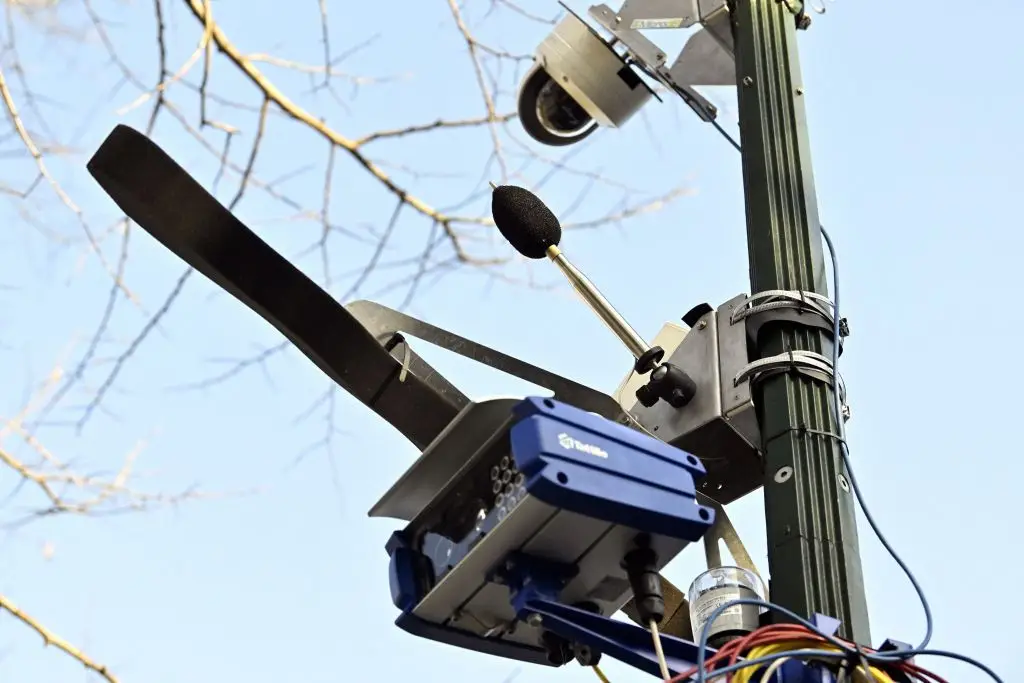
As noted by Fox News, license plate readers in New York are being paired with noise detection devices, with the scheme spreading across the USA.
The outlet claims that at least 10 U.S. jurisdictions have deployed or piloted noise-camera technology, with New York City having one of the most prevalent programs since it was piloted in 2021 and launched in 2022.
While hardly seeming like a pandemic, New York City's Department of Environmental Protection operated 12 devices in 2025 and supposedly recorded 15,994 noise events while generating 1,691 summonses. Designed to capture muffler or engine noise, a violation carries a minimum penalty of $800, soaring up to $2,625 at the maximum.
Microphones are used to detect noise, while standard ALPR cameras then try to pinpoint the vehicle the violation came from.
New York's scheme is operated by the UK-based Intelligent Instruments Ltd., which makes the SoundVue noise-camera system.
Intelligent Instruments isn't the only company on the market, with a Dutch acoustic tech company called Sorama making similar moves.
Importantly, there are concerns about how different cities handle this kind of tech. One might use noise-cameras to issue fines, while another might send warnings.
One might collect data without identifying drivers, and some might target different sounds.
Across the board, there doesn't seem to be a unified message on how these devices are being used.
What U.S. states have noise-cameras or are piloting them?
Knoxville, Tennessee, has apparently also been using cameras to support warnings, although it's currently not used to issue camera-generated citations. The tech originally came from UK-based 24 Acoustics, but Knoxville's city page says the city's camera tech now trades through Intelligent Instruments.
Miami Beach supposedly tested three systems from Intelligent Instruments, although Florida law has stopped the city from using camera evidence to issue automated noise citations.
More recently, Miami Beach has launched a year-long Quiet Zone pilot that tasks police officers with handling enforcement rather than automated noise-camera citations.
It's not just major hubs where musical mufflers can get you in trouble.
According to Fox News, Avoca in Iowa has installed noise-cameras along Highway 59 after a successful test in spring 2025. During a one-month pilot, there were 183 violations recorded from 83 vehicles. The issue of engine-compression braking from trucks is known as Jake braking, and with so many incidents being recorded in that short period, the city later announced a full implementation of noise-cameras from Intelligent Instruments.
The likes of Hawaii's Oʻahu and Washington's Kirkland have been trialling programs without fines, whereas Connecticut's West Haven plans to add four noise-detection devices to its shoreline. Here, a first violation involves a written warning, followed by a $100 fine, and a third violation carrying a $250 fine.
Boston City Council has approved a request to explore a noise-camera program, while Providence, Rhode Island, is seeking companies for a 16-month noise-camera pilot. Providence specifically wants a system that can produce evidence that can support citations.
In terms of places where such schemes are already live, Rhode Island's Newport is using Sorama's mobile tech to move between traffic hotspots and issue $250 citations for excessive vehicle noise.
New Mexico's Santa Fe has also moved to a full enforcement program after signing a five-year contract that's worth up to $4 million with Jenoptik Smart Mobility Solutions. Santa Fe has secured six mobile enforcement devices for automated speed and noise enforcement.