Scientists might have just proven that empty space actually isn't empty at all


A theory about empty space which was predicted almost 90 years ago might have now finally confirmed experts’ suspicions.
This comes after a team of scientists believe they might have just proven that empty space actually isn’t empty at all.
Researchers used NASA’s IXPE (Imaging X-ray Polarimetry Explorer) to conduct more than 140 hours of observations on a magnetar, which is part of a special class of neutron stars with ultra-strong magnetic fields.
In doing so, the scientists believe they may have proven a 90 year old theory first predicted by German physicist Werner Heisenberg, who believed that empty space isn’t truly void of anything.
Advert
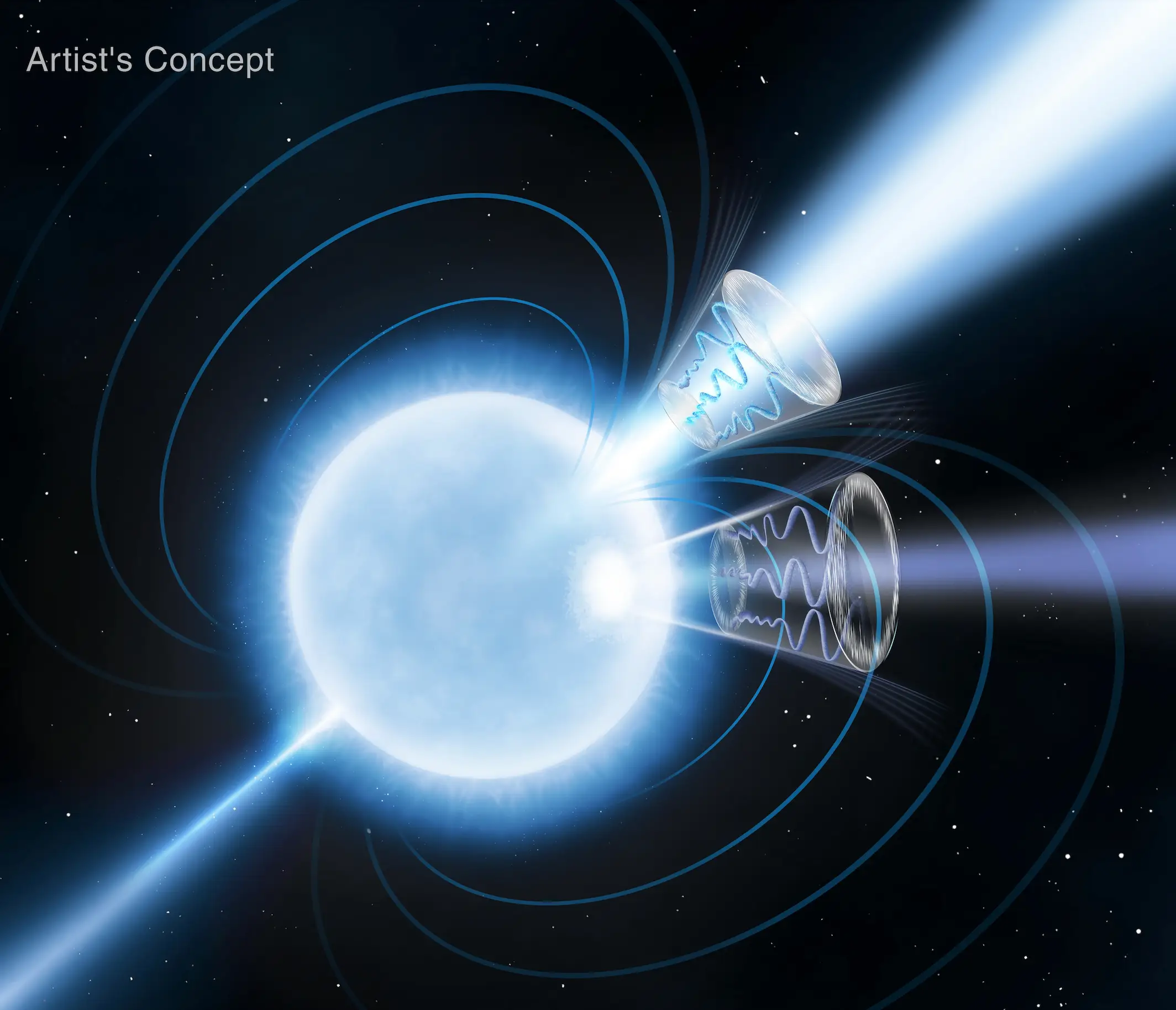
His theory suggests that the ‘vacuum of space can be altered by extreme magnetic fields, far higher than those humans can create on Earth’.
Empty space is filled with radiation and quantum activity
NASA explains: “Under such conditions, the vacuum acts like a lens or a prism, filtering light based on the direction it is traveling, therefore enhancing its total polarization. The IXPE mission’s ability to measure X-ray polarization was essential to test this theory.”
Further simulations conducted appear to support the idea that the vacuum is causing a ‘distinct signal’.
Hoa Dinh Thi, who is a postdoctoral associate at Rice University in Houston and the co-lead author of the paper detailing the results, states: “Our model suggests that reproducing the observed X-ray polarization signatures, while also satisfying the constraints set by radio observations, requires the presence of vacuum birefringence in the neutron star’s environment. This finding exemplifies how neutron stars enable us to test fundamental physics in environments not replicable in labs on Earth.”
Scientists prove a 90 year old theory about empty space
Rachael Stewart, a Ph.D. candidate at George Washington University and the lead author of the paper published in Nature, adds: “This result truly highlights the interdisciplinary power of the field of astrophysics. The information we obtained from looking at this distant star core also gives us clues about the nature of the fabric of reality as we know it, and I find that to be incredible.”
The quantum effect that was first predicted by Heisenberg is shown in an artist’s depiction, where the empty space alters the behavior of light, proving that it cannot truly be empty.
Instead of there being nothing, so-called empty space acts as an extreme vacuum which is filled with radiation, energy and subtle quantum activity.