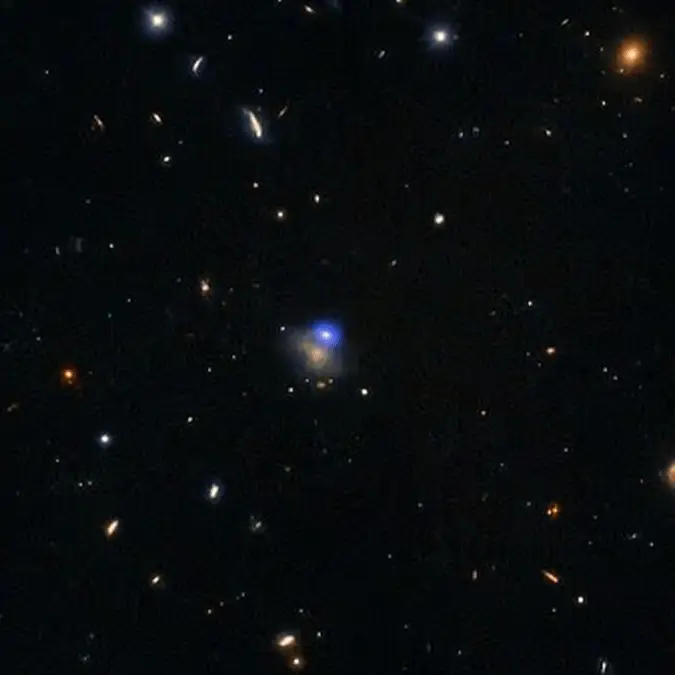
Scientists detect mysterious blue flashes erupting from deep space 'unlike anything seen before'


Since the first one lit up astronomers' telescopes in 2018, only 14 Luminous Fast Blue Optical Transients (LFBOTs) have ever been recorded.
They burn up to 100 times brighter than any other known stellar explosion, displaying an intense blue glow, and vanish within days.
Until now, scientists haven't been able to explain where they come from. Most stellar explosions take weeks or even months to peak and fade, but LFBOTs can do it in days.
Their bright blue colour suggests that temperatures remain extraordinarily high from start to finish, setting them apart from anything else in the known universe.
Advert

Dr Anya Nugent, from the Harvard & Smithsonian, and her team measured the rates of star formation, stellar mass, and levels of metallic elements in these galaxies to better understand them.
According to the researchers, LFBOTs are produced by the collision between an ultra-dense object, like a black hole or a neutron star, and an exceptionally hot type of star known as a Wolf-Rayet star.
Wolf-Rayet stars begin life as part of a binary system as two massive stars locked in orbit around a shared central point.
Over time, the larger of the two begins consuming the outer layers of its companion. If the conditions are right, this process strips away the companion's outer hydrogen shell without destroying it entirely, leaving behind a bright, dense helium core called the Wolf-Rayet star.
Meanwhile, the star doing the consuming grows so massive from all that hydrogen that it eventually collapses under its own weight, detonating in a supernova explosion that leaves behind either a black hole or a neutron star.
That compact remnant then continues feeding on its Wolf-Rayet neighbour over hundreds of thousands of years, until it spirals into the stellar core and destroys it. The final merger is what the researchers believe triggers an LFBOT.
Speaking to the Daily Mail, co–author Professor Brian Metzger, of Columbia University said: "When the compact object plunges into the Wolf–Rayet star, it can rapidly accrete the stellar [material] and release a huge amount of gravitational energy. Some of that energy drives powerful outflows or jets, which then collide with material around the star.
He added: "That interaction can produce a very hot, bright flash of light on a short timescale."
Dr Nugent argues that the binary systems that produce LFBOTs receive a powerful 'kick' from the supernova explosion that creates the compact object, which pushes them away from their birth site.
"Stars can get strong kicks from supernova explosions, and if LFBOTs do indeed come from compact object–Wolf–Rayet star mergers, it is more than likely that the star that created the compact object underwent a supernova that gave the binary system the kick," he noted.
However, the case is far from closed. The scientists need to conduct further research to understand what's driving these explosions.