
Rare substance present at the dawn of the universe is worth $62,000,000,000,000 per gram


When you think of the most valuable substance on Earth, you might tend to think of the likes of diamonds and gold. In reality, there's something much rarer, and it's worth a mind-boggling amount. Typically, the most expensive mineral found on Earth is rhodium, which was recently trading at $118 per gram. Instead of being mined from deep beneath the Earth's surface, the expensive substance everyone is after is tied to science. The price of rhodium is nothing compared to antimatter, which is the very stuff the universe is (not) made of and costs a cool $62 trillion per gram.
The modern theory of antimatter was proposed by physicist Paul Dirac in 1930 when he mused that the positron or antielectron has the same mass as the electron but an opposing charge. Antiprotons and antineutrons were later identified, with matter and antimatter supposed to cancel each other out.
Scientists have worked out that antimatter responds to gravity in the same way as matter, and as research continues, we're learning more about how the universe was created.
Advert
Speaking to the BBC, Dr Danielle Hodgkinson, researcher at Switzerland's CERN, said: "We don't understand how our Universe came to be matter-dominated and so this is what motivates our experiments."
Whether giving us an unlimited energy source or potentially helping power space travel at unimaginable speeds, scientists are looking at ways to make antimatter more efficiently and much cheaper.
The energy created when matter and antimatter try to annihilate each other is far bigger than even the biggest nuclear explosions we can comprehend, meaning the energy release has immense potential for the human race. It was only in 1995 that CERN was able to create antihydrogen atoms, and since then, scientists have been trying to figure out the secrets of antimatter.
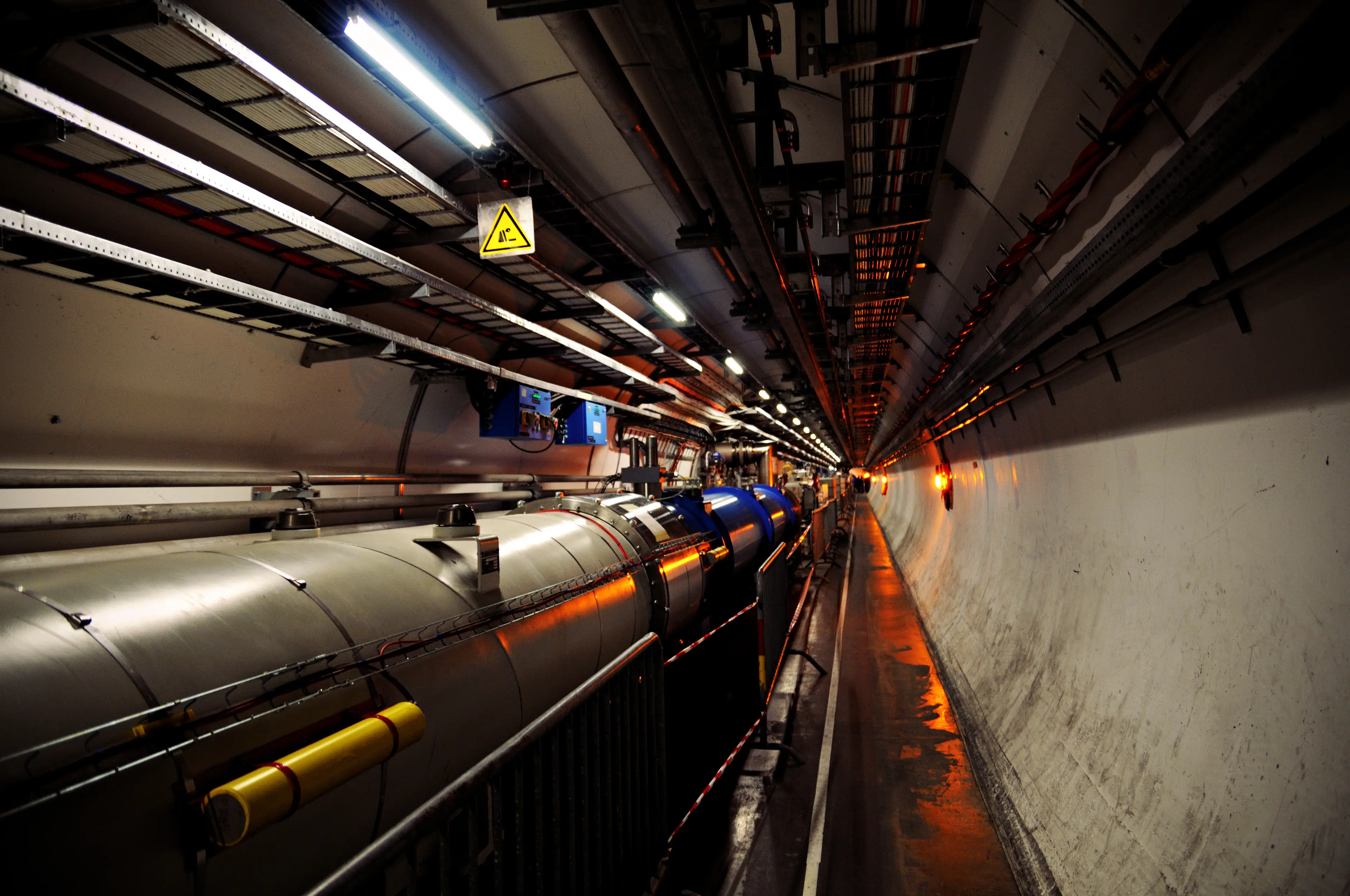
Antimatter is created when particles are slammed together at nearly the speed of light, causing a tiny amount of antiprotons and positrons. The antiparticles are carefully collected and stored inside a vacuum that's held together by electromagnetic fields. As the total amount of antimatter created in this way is only enough to light up a bulb for a few seconds, you can see why it's so rare and its price per gram is so high. CERN's 17-mile supercollider cost over $4.75 billion to build and runs at 9.99% of light's speed while consuming 120 megawatts of electricity.
Annual running costs of the supercollider are $1 billion, with the electricity bill alone coming to $23.5 million. With all the work that goes into it, you won't be surprised to learn that producing a gram of antihydrogen takes a mythical 100 billion years.
Despite its mysterious properties, antimatter has an exciting future ahead. CERN's Professor Jeffrey Hangst has spent 30 years trying to understand it and explained, "Antimatter is just the coolest, most mysterious stuff you can imagine."
"As far as we understand, you could build a universe just like ours with you and me made of just antimatter."
Even still, creating antimatter is a 'perfect storm' that we haven't quite mastered yet. If you've got a spare So, move over rhodium because antimatter is here to stay.