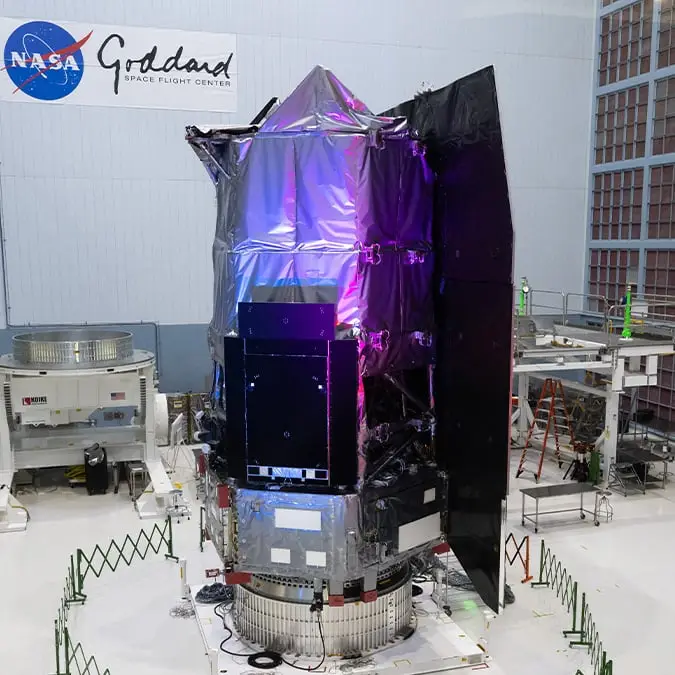
NASA’s new telescope will revolutionize our view of the universe forever


The new Nancy Grace Roman Space Telescope will lift off to space from the Kennedy Space Center in Florida this Sunday before beginning its operations at the start of 2027.
It will be Elon Musk’s space company SpaceX which will facilitate the launch, carrying the telescope aboard one of its rockets.
According to NASA, this new telescope ‘will settle essential questions in the areas of dark energy, exoplanets, and astrophysics’.
The space agency went on to explain: “Named after NASA’s first chief astronomer, the ‘mother of the Hubble Space Telescope,’ the Nancy Grace Roman Space Telescope will have a field of view at least 100 times larger than Hubble's, potentially measuring light from a billion galaxies in its lifetime.
Advert

“This observatory will also be able to block starlight to directly see exoplanets and planet-forming disks, complete a statistical census of planetary systems in our galaxy, and settle essential questions in the areas of dark energy, exoplanets, and infrared astrophysics.”
When will the new NASA Nancy Grace Roman Space Telescope launch?
The NASA telescope is set to lift off on Sunday, August 30, 2026 at 07:26 am EDT aboard a SpaceX Falcon Heavy rocket from Launch Complex 39A at the Kennedy Space Center.
In order to complete its work, the telescope will make its observations from a vantage point around 930,000 miles away from Earth in the direction opposite the Sun.
NASA detailed how this is a special place in space known as the ‘second Sun-Earth Lagrange point, or L2, gravitational forces balance to keep objects in steady orbits with very little assistance’.
NASA added: “Roman’s barrel-like shape will help block out unwanted light from the Sun, Earth, and Moon, and the spacecraft’s distant location will help keep the instruments cool. The thermal stability of an observatory at L2 will provide a ten-fold improvement beyond Hubble in much of the data Roman will gather.
“The amount of detail these observations will reveal is directly related to the size of the telescope’s mirror, since a larger surface gathers more light. Roman’s primary mirror is 7.9 feet across. While it’s the same size as the Hubble Space Telescope’s main mirror, it is less than one-fourth the weight. Roman’s mirror weighs only 410 pounds thanks to major improvements in technology.”