NASA makes shocking Big Bang discovery that astronomers say 'shouldn't exist'


NASA have made an incredible discovery dating back to the Big Bang.
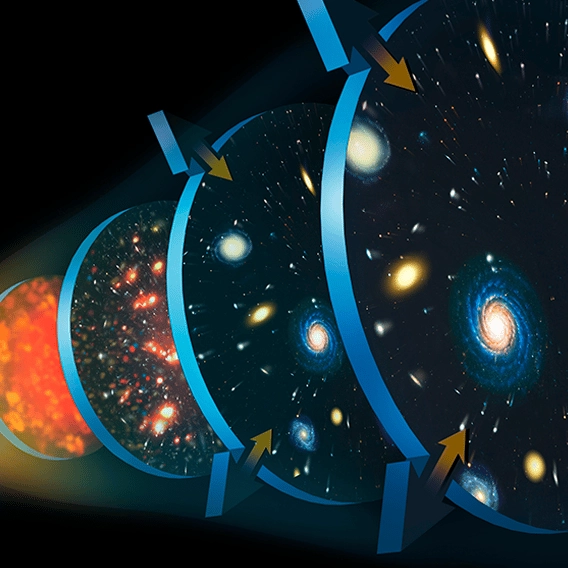
The cosmos is a strange and uncharted place, with astronomers making discoveries almost daily. Alongside asteroids that could make us all rich and ancient bodies of water floating in space, the National Aeronautics and Space Administration (NASA) claims it's found a shocking discovery at the end of the universe - arriving just after the Big Bang by a billion years.
With the Big Bang happening 13.8 billion years ago, what's a spare billion between friends?
NASA's James Webb Telescope (JWST) found three 'Red Monster' galaxies at the edge of the universe, with astronomers astounded because they simply shouldn't exist.
Advert
The Red Monster galaxies earn their name due to their fiery appearance and the fact they hold 100 billion times the mass of our Sun.
Each Red Monster is supposedly capable of forming its own stars quicker than an average nebula by converting nearly 80% of its gas.
In a statement from the University of Bath, Professor Stijn Wuyts explained: "Many processes in galaxy evolution have a tendency to introduce a rate-limiting step in how efficiently gas can convert into stars, yet somehow these Red Monsters appear to have swiftly evaded most of these hurdles."
Researchers noted that the generally accepted Lambda Cold Dark Matter (LCDM) model suggests Red Monster galaxies shouldn't exist because the Universe's first galaxies wouldn't have enough time to grow to that size.
It was previously thought that galaxies were slowly formed inside large halos of dark matter, but the emergence of Red Monsters so early in the Universe's development spins all of this on its head.
Wuyts added: "Finding three such massive beasts among the sample poses a tantalizing puzzle."
Using the JWST's Near Infrared Camera (NIRCam), researchers were able to probe deeper into dust-obscured areas.
As for what these findings mean, Dr Mengyuan Xiao, lead author of the new study and postdoctoral researcher at the University of Geneva, said: "These results indicate that galaxies in the early Universe could form stars with unexpected efficiency.
"As we study these galaxies in more depth, they will offer new insights into the conditions that shaped the Universe’s earliest epochs. The Red Monsters are just the beginning of a new era in our exploration of the early Universe."
The JWST continues to surprise, and in February 2023, it found six galaxies that had been formed between 500 and 700 million years after the Big Bang. Given that they're 100 times bigger than astronomers expected them to be, it's clear we've got a lot to learn.
While one of Einstein's most famous theories has just been proven, the discovery of these Red Monsters has us questioning what (little) we thought we knew about the Universe.
Still, as some scientists call for us to re-examine our current cosmological models, some think these observations are mere optical illusions.