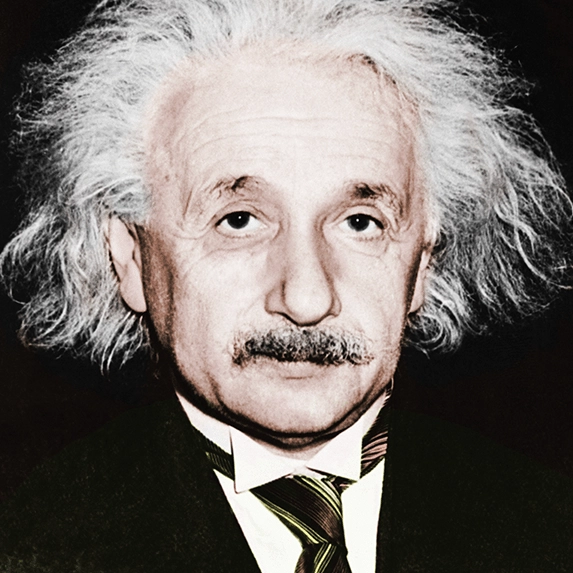
Einstein's most famous theory just passed its biggest test in 13,000,000,000 year history


Einstein's theory of relativity has just passed one of its biggest challenges yet.
He's dubbed one of the smartest people that ever lived, and while Albert Einstein passed away in 1955, he's still making wives in 2024. Alongside his research into wormholes and the universal speed limit, Einstein is known best for the general theory of relativity.
Putting together the general theory of relativity in 1915, Einstein proposed that space and time are effectively one giant blanket that are woven together. Refining Newton's law of universal gravitation, Einstein mused that something as massive as the Sun bends this space-time blanket. This led to correct predictions about black holes and the Sun delaying radio signals, but now, the general theory of relativity has faced its biggest test yet.
In fact, it's a test that's been in the works for 13 billion years.
Advert
A team of astronomers looked at the distribution of nearly six million galaxies across 11 billion years of the Universe's history. Using the Dark Energy Spectroscopic Instrument (DESI) in conjunction with the Berkeley National Laboratory, the astronomers found that gravity behaves exactly how Einstein’s theory of general relativity predicted. Importantly, the findings limit theories about modified gravity, which some have proposed as explanations for anomalies like the Universe's accelerating expansion.
Hyping the importance of the latest findings, Pauline Zarrouk, a cosmologist at the French National Center for Scientific Research (CNRS) working at the Laboratory of Nuclear and High-Energy Physics, said: "General relativity has been very well tested at the scale of solar systems, but we also needed to test that our assumption works at much larger scale.
"Studying the rate at which galaxies formed lets us directly test our theories and, so far, we’re lining up with what general relativity predicts at cosmological scales."
A simulation shows that the Universe has behaved as expected. Basically, add or subtract gravity and it wouldn't look the same.
According to Mustapha Ishak-Boushaki from the University of Texas at Dallas, even though there are some uncertainties with the measurements, nothing is able to capture the state of the Universe better than Einstein's general theory of relativity.
Although Einstein's theory has held up well under precise tests in laboratories, a test like this across the cosmos is important to prove it at scale.
It's also hoped that the study can lift the lid on how dark energy fits our theories of gravity. Dark energy is a mysterious force that's supposedly responsible for the Universe's accelerating expansion, and back in Einstein’s early theorizing, he referred to an anti-gravitational force that played a similar role. Instead, previous DESI research suggests that dark energy has also changed as the Universe has aged.
The DESI has been operating since 2019, and by the time it's finished its work, it should've collected data on over 40 million galaxies and quasars. Yet again, Einstein's theory of general relativity lives another day to fight the test of time.