uniladtech homepage
  • News
    • Tech News
    • AI
  • Gadgets
    • Apple
    • iPhone
  • Gaming
    • Playstation
    • Xbox
  • Science
    • News
    • Space
  • Streaming
    • Netflix
  • Vehicles
    • Car News
  • Social Media
    • WhatsApp
    • YouTube
  • Advertise
  • Terms
  • Privacy & Cookies
  • LADbible Group
  • LADbible
  • UNILAD
  • SPORTbible
  • GAMINGbible
  • Tyla
  • FOODbible
  • License Our Content
  • About Us & Contact
  • Jobs
  • Latest
  • Archive
  • Topics A-Z
  • Authors
Facebook
Instagram
X
TikTok
Snapchat
WhatsApp
Submit Your Content
Volcano on ‘tormented’ moon has 80,000,000,000,000-watt eruption making it 'biggest ever volcanic eruption in our solar system'

Home>Science>Space
Published 01:00 6 Feb 2025 GMT

Volcano on ‘tormented’ moon has 80,000,000,000,000-watt eruption making it 'biggest ever volcanic eruption in our solar system'

The moon is home to over 400 active volcanos

Rikki Loftus

Rikki Loftus

google discoverFollow us on Google Discover
Featured Image Credit: MARK GARLICK/SCIENCE PHOTO LIBRARY/Getty Images
Space
Nasa
Science

Advert

Advert

Advert

A extraterrestrial volcano on a ‘tormented’ moon has whopping 80 trillion watt eruption.

This makes it the ‘biggest ever volcanic eruption in our solar system’.

The Icelandic eruptions emitted from the volcano Eyjafjallajökull was so large that it grounded flights across Europe in 2010.
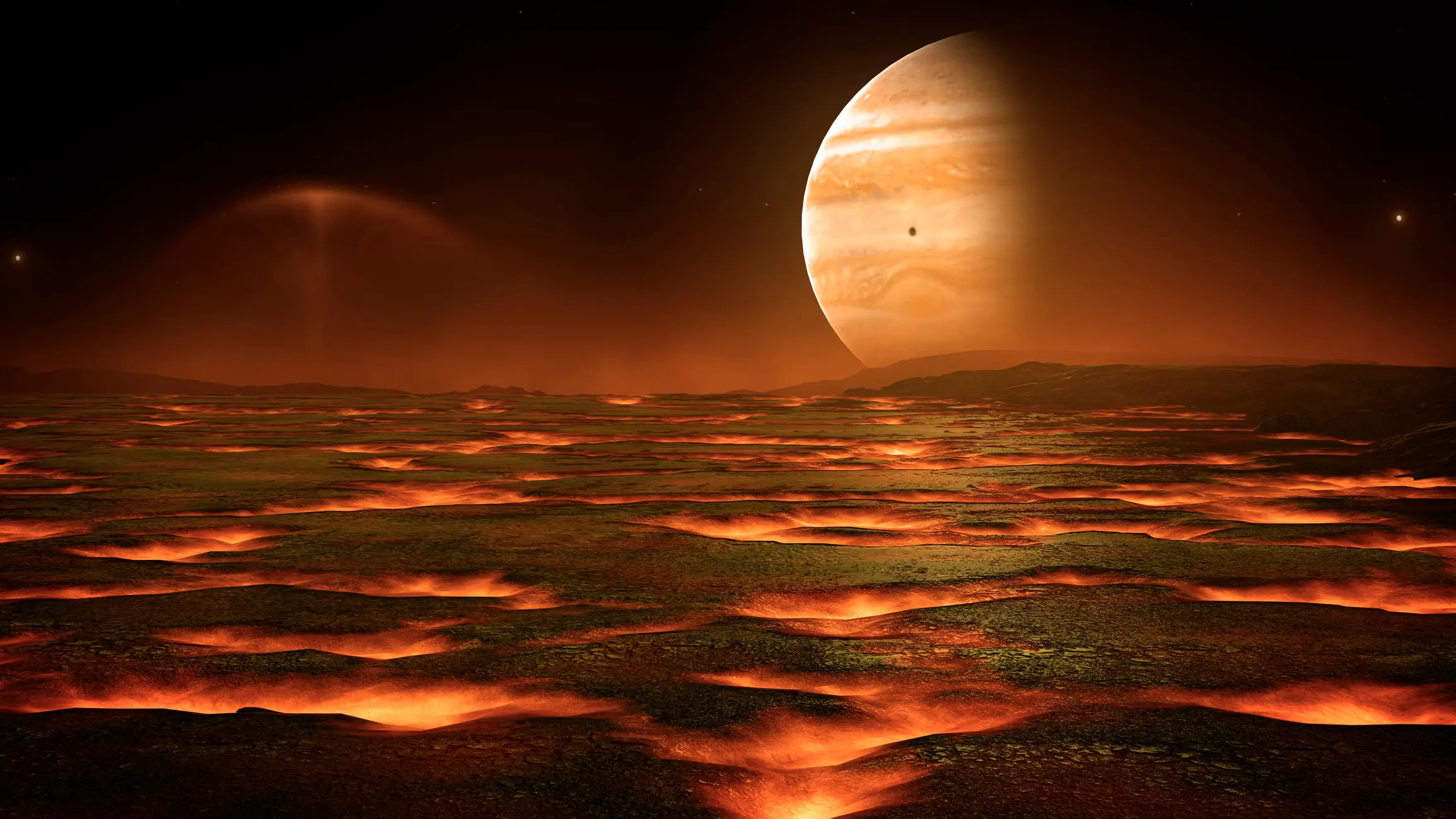
One of Jupiter's moon has had a 80,000,000,000,000-watt eruption (MARK GARLICK/SCIENCE PHOTO LIBRARY/Getty Images)

Advert

However, there is another volcano in outer space that puts anything we have on Earth to shame.

It was first detected by NASA’s spacecraft Juno when it noticed a giant lake of fire on a moon in our solar system.

Io, which is the second smallest of Jupiter’s four moons is home to over 400 active volcanoes.

The area of the fire took up an incredible 100,000 sq km (62,137 sq miles), breaking a previous record set by another volcano on Io.

And it’s thought that the power of the eruption is ‘well over’ 80 trillion watts.

Scott Bolton, who is the Juno spacecraft’s primary investigator, shared that the data from the eruption ‘really blew our minds’.

He said: “This is the most powerful volcanic event ever recorded on the most volcanic world in our solar system — so that’s really saying something.”

The Juno spacecraft has been orbiting around Jupiter for the past nine years after it took five years to make the journey from Earth.
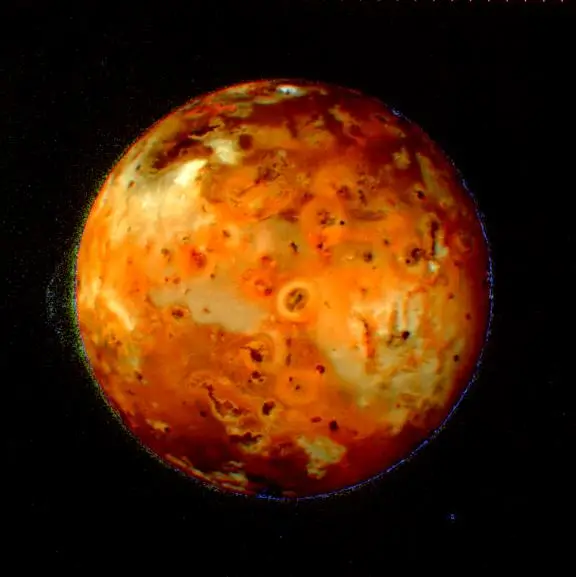
The Juno spacecraft is studying the volcanic activity on Io (NASA)

Since then, it has been sending information about the largest planet in our solar system and its four moons back to Earth.

Alessandro Mura, who is a Juno co-investigator, said: “We have evidence what we detected is actually a few closely spaced hot spots that emitted at the same time, suggestive of a subsurface vast magma chamber system.”

The reason while volcanic activity is so abundant on Io is because of its close orbit around Jupiter.

The gas giant’s huge gravitational pull causes the moon to be ‘relentlessly squeezed’ according to NASA, which causes volcanic eruptions.

On the space agency’s website, it revealed that Juno will be using an upcoming, more distant flyby of Io on March 3 to look at the hot spot again and search for changes in the landscape.

Earth-based observations of this region of the moon may also be possible.

Bolton went on to say: “While it is always great to witness events that rewrite the record books, this new hot spot can potentially do much more.

“The intriguing feature could improve our understanding of volcanism not only on Io but on other worlds as well.”

Choose your content:

a day ago
2 days ago
  • zpagistock/Getty Images
    a day ago

    Scientists offer stark prediction for how global warming will redefine life by 2100

    Scientists have warned that these themes could impact communities around the world

    Science
  • Melissa Weiss/Center for Astrophysics |Harvard & Smithsonian
    2 days ago

    Rocky Earth-like planet discovered 48-light years away could be closest to support 'alien' life

    It has been described as a 'Super Earth' planet

    Science
  • RJ Sangosti/MediaNews Group/The Denver Post via Getty Images / Contributor
    2 days ago

    Symptoms of 'valley fever' as horrifying fungal storms sweep southern US states

    Dust storms bring out fungal spores from the dirt and spread them across America

    Science
  • Heather Paul / Getty
    2 days ago

    These countries will go completely dark during the next major solar eclipse

    Europe's last full solar eclipse ocurred in 1999

    Science
  • NASA will pay you to spend a year on the Moon and Mars without ever leaving Earth
  • NASA delivers 11,000,000lbs rocket ready for history-making Moon mission
  • Reason why NASA has halted 2027 moon landing mission
  • NASA announce official date for the longest solar eclipse in 100 years