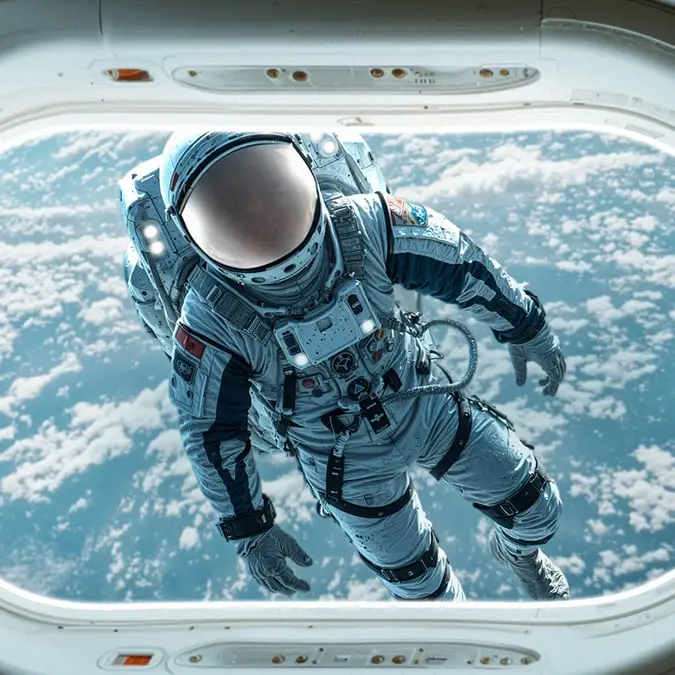
Experts share truly terrifying reason astronauts can’t be allowed to have 'space babies'


Experts have shared the terrifying reason why astronauts can’t be allowed to have babies in orbit.
While many people dream of taking to the stars, very few will ever experience life beyond our atmosphere.
This means that a lot of us have questions about real-life scenarios that could technically happen in space.
But one common query has now been answered after experts lifted the lid on why astronauts can’t have ‘space babies’.
Advert
A new study shared information about the possibility of babies one day traveling on commercial space flights, with the report having been produced by an international expert group consisting of reproductive medicine, aerospace health, and bioethics experts. After previously covering the idea of sex in space, it's another fascinating insight into what goes on in the stars.

Published in Reproductive BioMedicine Online, the research was led by Giles Palmer from the International IVF Initiative Inc, who explained that “two scientific breakthroughs reshaped what was thought biologically and physically possible - the first Moon landing and the first proof of human fertilisation in vitro.”
He continued: “Now, more than half a century later, we argue in this report that these once-separate revolutions are colliding in a practical and underexplored reality.
“IVF technologies in space are no longer purely speculative. It is a foreseeable extension of technologies that already exist.”
Much more is now accessible thanks to technological change.
Still, there are certain risks that need to be considered for astronauts and space travelers.
Calling space ‘a hostile environment’ for human biology thanks to its altered gravity, radiation exposure, and circadian cycle disruption, the nine authors wrote that despite animal models showing short-term exposure to radiation messes with female menstrual cycles, there is no such data available when it comes to astronauts and their fertility.
What they do know is that women from the Shuttle missions went on to have pregnancy rates and complications around the same amount as women on Earth.
But this doesn’t include data from women who were exposed for long times to space, nor does it know how women would fare if they spent years in space.
The authors revealed that to find out if it’s safe, they need this information 'to guide diagnostic, preventive, and therapeutic strategies in extraterrestrial environments'.
“As human presence in space expands, reproductive health can no longer remain a policy blind spot,” said Dr Fathi Karouia, senior author of the study and a research scientist at NASA.
“International collaboration is urgently needed to close critical knowledge gaps and establish ethical guidelines that protect both professional and private astronauts - and ultimately safeguard humanity as we move toward a sustained presence beyond Earth.”
The report claimed that “extended time in space poses potential hazards to the reproductive function of female and male astronauts, including exposure to cosmic radiation, altered gravity, psychological and physical stress, and disruption to circadian rhythm,” which needs to be researched before making ‘space babies’.