
Scientists build world's most accurate atomic clock so precise it could redefine the second


Time passes whether we measure it or not, but most people are unaware of quite how much the readings can fluctuate, making what's seen as an ever-reliable constant something that can be improved upon.
That's exactly what scientists at the Centre for Quantum Technologies (CQT) in Singapore have aimed to do, as they believe that they've created the most accurate atomic clock to ever exist — with some rather lofty consequences emerging from its operation.
As reported by the Daily Mail, the clock itself has been built solely from the element lutetium, which could prove to be the defining factor as it reigns supreme over multi-elemental devices that previously held the accuracy records.
Quite how consequential this will end up being remains to be seen, but the researchers behind the discovery believe that it could do as much as redefine the second as we know it as we have a reading that's more accurate and consistent than ever before.
How accurate is this new atomic clock?
The researchers at CQT have explained that this new atomic clock is able to measure time up to 19 decimal places, which stands tall as the lowest of anything recorded in history.
Advert

This results in a clock that would take more than 260 billion years to 'lose' a second, which refers to the process where minuscule inaccuracies would build up to the point where an entire second is effectively passed over — with the average mechanical or automatic watch losing as much as 10 seconds per day, equating to 94,963,050,000,000 seconds across the same time period.
Murray Barrett, the scientist leading the team behind this atomic clock's creation at CQT, remains 'confident' that the new device is "the most accurate clock in the world," adding that "in the future, I just don't see how this clock can be beaten.
"The properties mean that high accuracy can be achieved even in a wide range of environments. The lutetium clock would be stable even if you went from the hottest place recorded on Earth in Death Valley to the coldest place in the Antarctic plateau," he continued.
How do atomic clocks work?
While the process behind the creation of an atomic clock is obviously incredibly complex, the unbelievably accurate devices rely on monitoring an atomic transition, which occurs when an atom's electrons change energy levels.
This is most commonly using the Caesium-133 atom – which is the only stable and naturally occurring isotope of its corresponding element – with one second officially deemed to be the duration of 9,192,631,170 periods of radiation emitted between two hyperfine energy levels.
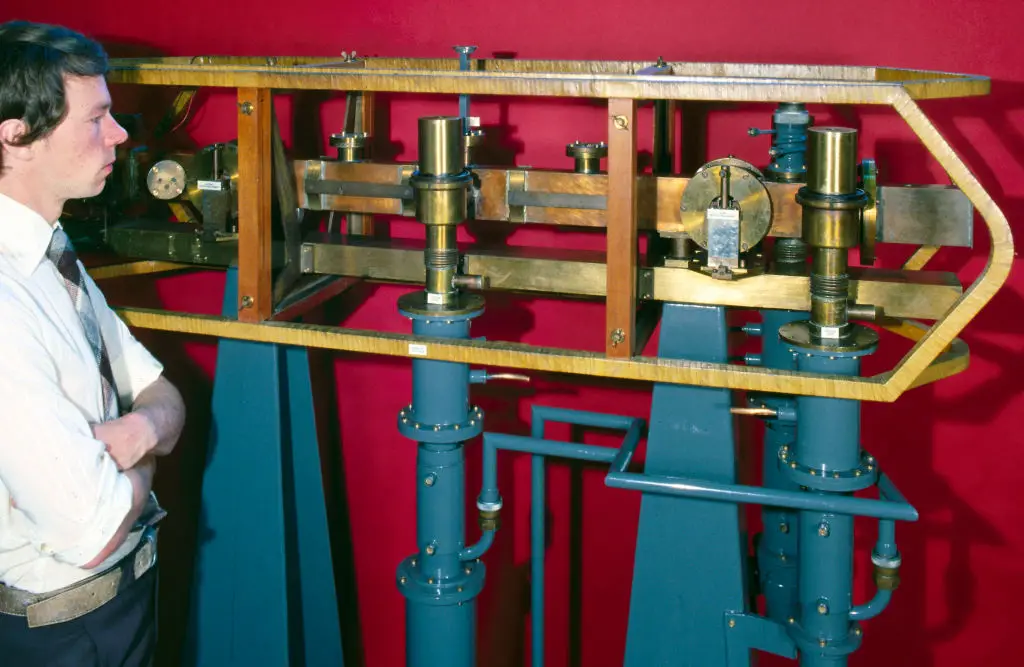
Detectors present within the atomic clock then count the cycles of tuned radiation within the atom until it reaches the aforementioned 10-figure amount, and its at this point that a second is officially registered.
Elements like ytterbium, strontium, and aluminium have all been understood to be better suited for timekeeping than cesium due to their faster rate of oscillation, yet the researchers at CQT believed that they were on for a winner with lutetium — and it's certainly paid off.
As Barrett explained, lutetium's reliability comes from the fact that it's unaffected by temperature shifts or changes in magnetic field, which is often what causes inaccuracies and shifts in time in other more popular elements.
That's what allows this to be the most accurate clock ever created, and makes the challenge of crafting a better alternative something that's unlikely to be achieved — for a very long time, at least.