Why scientists just switched off the world's most powerful particle smasher


Scientists just switched off the world's most powerful particle smasher at CERN.
Much like when we see the demise of the International Space Station, it's a huge deal when a chapter closes in science and in history. Since its first beams circulated back in September 2008, the Large Hadron Collider (LHC) spent close to two decades pushing the boundaries of physics. Now CERN is bidding farewell as its switch-off signals the start of a whole new phase.
The LHC delivered its first proton collisions in 2009 and quickly proved itself to be a discovery machine unlike anything before it. Over three operational periods, it generated a remarkable volume of data for scientists to analyse.
Advert
Then its defining moment came on 4 July 2012, when the ATLAS and CMS collaborations announced the discovery of the Higgs boson, confirming a theory first proposed nearly fifty years earlier.
In its lifetime, the LHC enabled hundreds of other breakthroughs, including the discovery of more than 85 new hadrons, the imbalance between matter and antimatter, deeper exploration of quark-gluon plasma, and influential data within astrophysics.
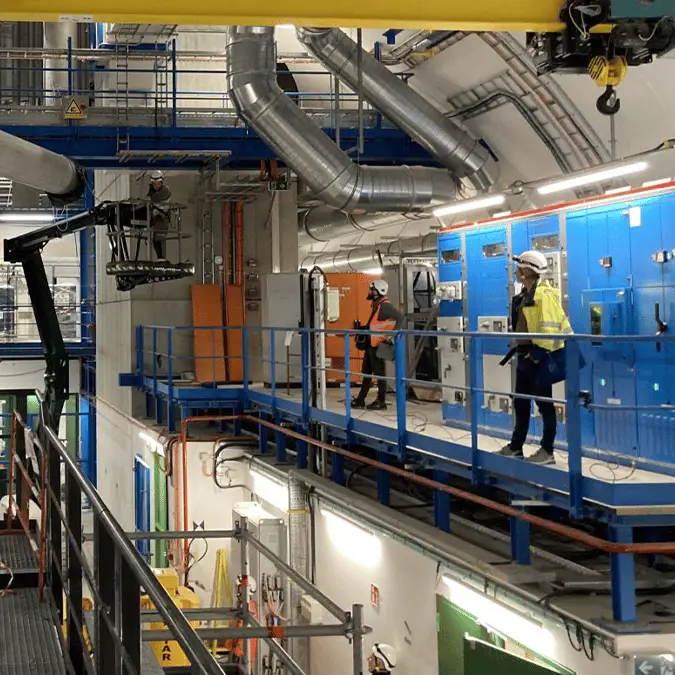
Now, the accelerator has been powered down to make way for CERN's Long Shutdown 3, a multi-year project that will prepare the laboratory for the next stage of its mission.
“The LHC has exceeded every expectation,” said Oliver Brüning, CERN Director for Accelerators and Technology. “For nearly two decades, it has transformed our understanding of the Universe and inspired generations of scientists, engineers and citizens around the world.
"Today we say goodbye to the LHC as we have known it, while preparing to welcome its successor: the HiLumi LHC, which will extend this scientific adventure far into the future.”
Running until 2030, thousands of specialists from CERN and global partner institutions will work to transform the LHC, its injector systems, and its experiments into their upgraded HiLumi versions.
“The LS3 represents a huge and complex logistical and engineering undertaking,” says Jean-Philippe Tock, Head of the LS3 Coordination Team. “In the LHC alone, 1.2 km of magnets and components will be removed and replaced with new equipment, and across the whole complex, dozens of projects are planned, involving thousands of engineers, physicists, technicians and support personnel.”
To handle the higher collision rates expected from the HiLumi LHC, between 140 and 200 proton-proton collisions per bunch crossing compared to around 60 during the most recent run, both experiments will need to completely replace their trigger systems. The ATLAS and CMS detectors will also undergo extensive upgrades.
Once operational in 2030, the HiLumi LHC will boost the collider's luminosity by up to ten times its original design specification.
From this, researchers can gather far larger datasets, conduct more precise studies of the Higgs boson and new physics beyond the current Standard Model, and tackle some of science's most unanswered questions.