
CERN receives $1,000,000,000 to replace 'death machine' people feared would end humanity


CERN receives major funding to replace the 'death machine' that people feared would end humanity.
Remember all those wild predictions about how the world might end? Mystic prophecies pointing to the final wipeout in 5079, to scientific observations mapping out Earth's potential fate, we've essentially heard it all.
Then there's the infamous machine some people genuinely believed might destroy humanity.
Well, that controversial facility is now getting an upgrade.
Advert
CERN, the particle physics laboratory near Geneva, has just secured $1 billion in private funding to help build what's called the Future Circular Collider (FCC).
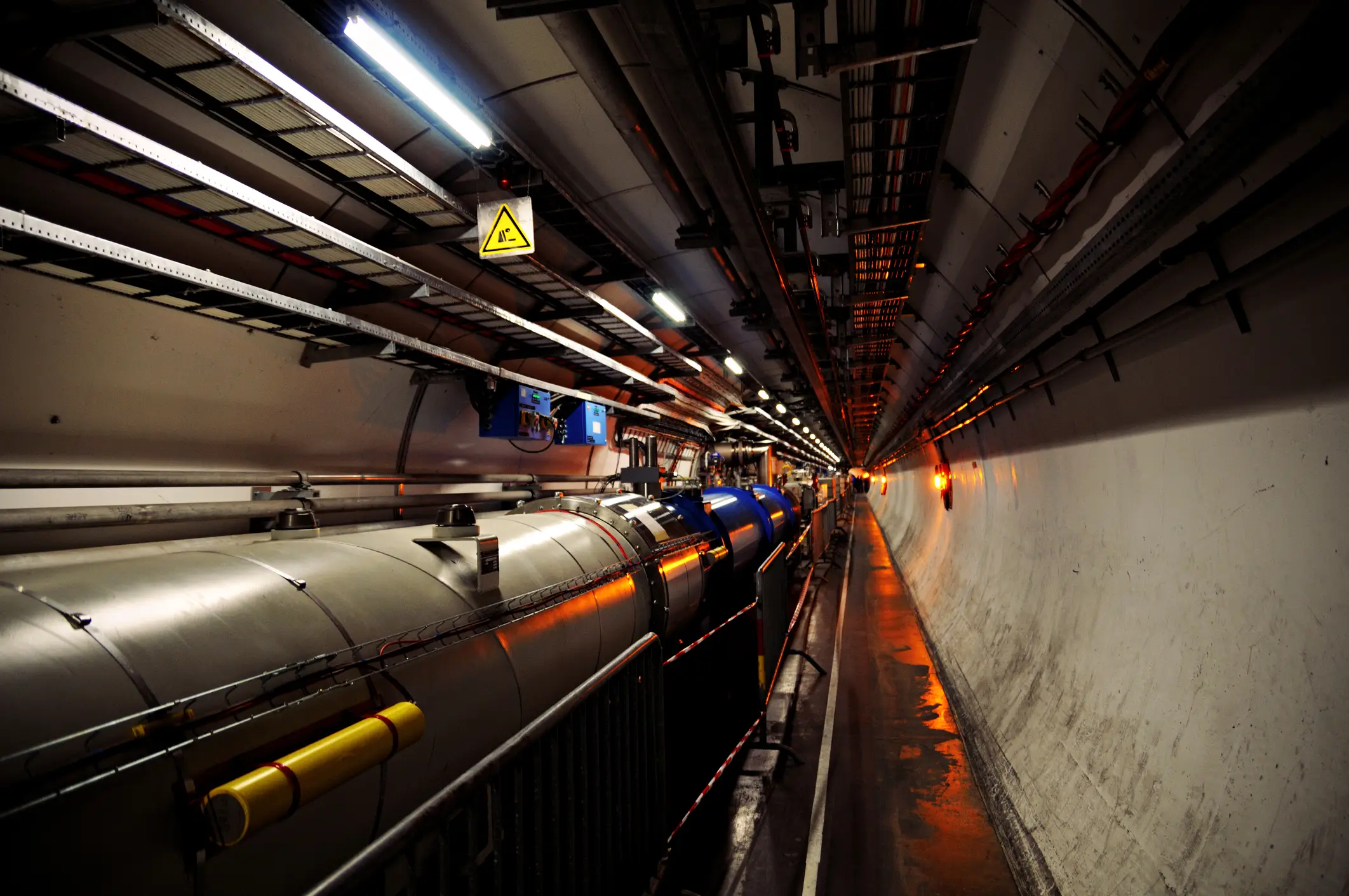
If everything goes to plan, the FCC will take over from the Large Hadron Collider (LHC), which famously discovered the Higgs boson particle.
So what exactly are they building?
CERN first laid out their vision for the FCC back in early 2019 with a hefty four-volume design report.
Last year, they followed up with an even more detailed three-volume feasibility study. The proposal calls for constructing an enormous 90.7-kilometre-long underground tunnel, roughly triple the size of the current LHC. This circular tunnel would sit an average of 200 metres below ground.
If the CERN Council approves the updates by 2028, construction of the FCC electron-positron machine (FCC-ee) would begin in 2030, with the goal of starting operations in 2047.
Experts hope the machine will run for about 15 years, until the early 2060s.
The FCC-ee is designed to produce around a million Higgs particles, giving physicists the chance to study this fundamental particle with ten times the precision possible with today's equipment.
Meanwhile, the hadron machine (FCC-hh) would act as a 'discovery machine' and replace the FCC-ee in the existing 91 km tunnel.
The FCC-hh would smash protons at about 85 TeV, creating new particles.
Scientists hope that the FCC-hh will begin operations in 2073 and keep running until 2100.
The FCC-ee phase alone is expected to cost somewhere around $18 billion. While the funding plan is still being worked out, current estimates suggest that at least two-thirds will come from CERN's 24 member countries, with the remainder needing to be raised from other sources.
Costas Fountas, president of the CERN Council, says the organisation is 'extremely grateful' for the level of interest and support.
“This once again demonstrates CERN’s relevance and positive impact on society, and the strong interest in CERN’s future that exists well beyond our own particle physics community,” he stated.
Google founder Eric Schmidt claims that he and Wendy Schmidt were 'inspired by the ambition of this project and by what it could mean for the future of humanity.' He believes the FCC is an instrument that 'could push the boundaries of human knowledge and deepen our understanding of the fundamental laws of the universe.'
Schmidt added that it could eventually lead to technological 'profound' breakthroughs with real-world applications, everything from medical advances to computing innovations to sustainable energy solutions.
“It’s the first time in history that private donors wish to partner with CERN to build an extraordinary research instrument that will allow humanity to take major steps forward in our understanding of fundamental physics and the universe,” CERN director-general Fabiola Gianotti said. “I am profoundly grateful to them for their generosity, vision, and unwavering commitment to knowledge and exploration.”