Leading scientists identify 17 catastrophic threats to humanity with 2100 warning


As if we didn't already have enough to worry about, the Lancet Commission on 21st Century Global Threats to Health has issued a public service announcement about a new set of threats we need to watch for. While some of these are old concerns like childhood malnutrition, a new technological threat could supposedly lead to the end of the human race by 2100.
While most of us reading this will presumably be long gone by then, the idea that mankind could only have 74 years left is quite an alarming one.
Baba Vanga pencilled in 3797 for life on Earth's destruction, although we mere humans are supposed to reach a population peak in 4674 before being wiped out in 5079.
What are the 17 global threats the human race faces?
According to Professor Christopher Murray, Lancet Commission co-chair and the director of the Institute for Health Metrics and Evaluation, University of Washington, that's not the case.
Advert
Calculating the expected cumulative amenable disease burden, Murray and co. measure it as disability-adjusted life years (DALYS) from 2025 to 2100. DALYS compares how many healthy years could be lost due to sickness, disability, or early deaths.
The report suggests that we need a "fundamental shift in how governments and multilateral institutions approach long-term risk and points towards three areas of action."
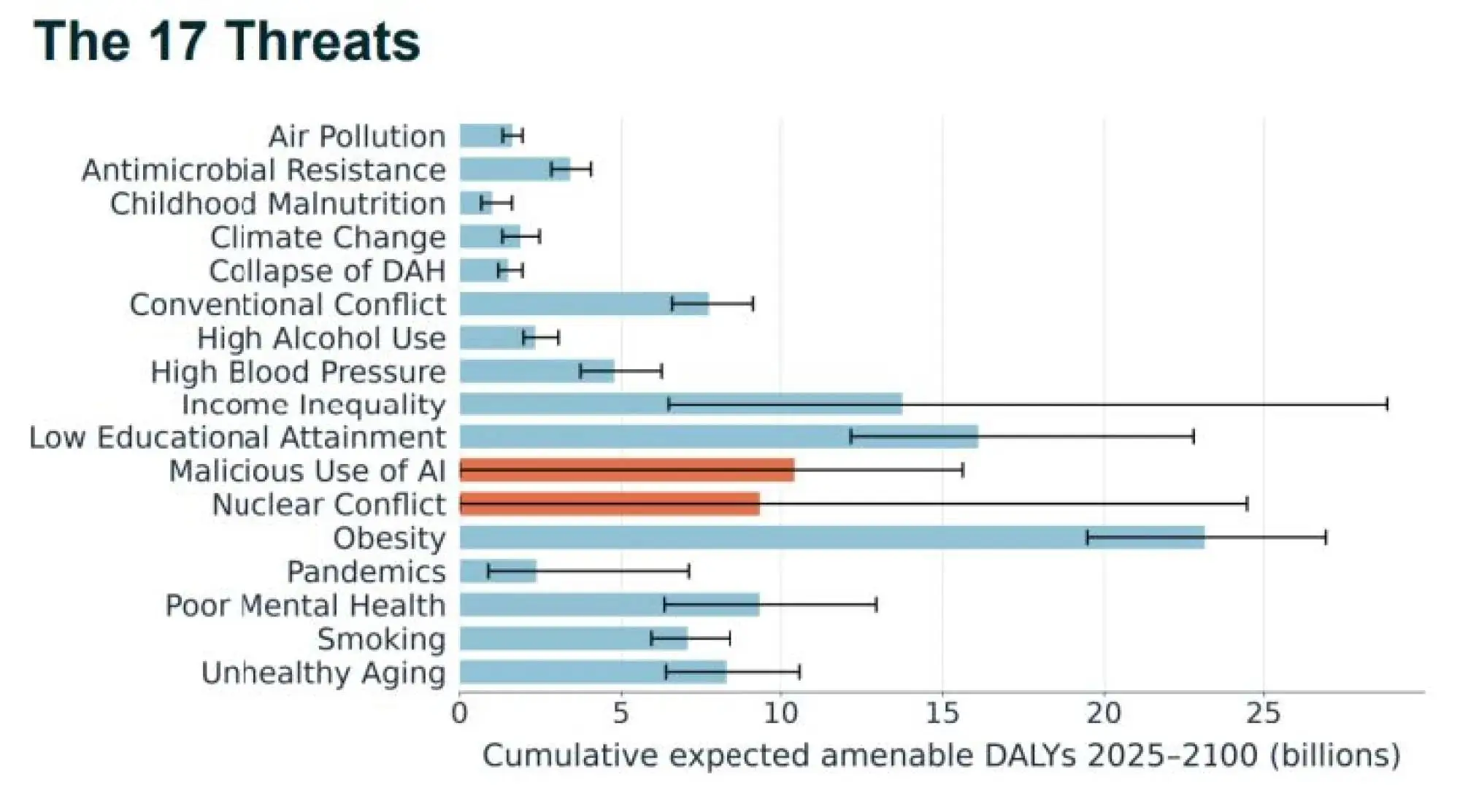
There's a list of 17 major threats that will supposedly cost us more than one billion cumulative DALYS over the next 74 years, highlighting the following as potential reasons for our own preventable demise:
- Air pollution
- Antimicrobial resistance
- Childhood malnutrition
- Climate change
- Conventional conflict
- Declining overseas aid
- High alcohol use
- High blood pressure
- Income inequality
- Low educational attainment
- Malicious use of AI
- Nuclear war
- Naturally occurring pandemics
- Obesity
- Poor mental health
- Smoking
- Unhealthy ageing
We've covered many of the above before, with climate change leading to more extreme weather, there being a large debate over aid in the aftermath of Elon Musk's DOGE cuts, and the threat of nuclear war looming larger than ever. In 2026 alone, we've seen increased fears about nuclear war as the USA butted heads with Iran over its own apparent capabilities. But what about AI?
The dangers of AI in the 21st Century
One major standout is a mention of "malicious use of AI," amplifying fears that artificial intelligence could be our undoing.
The so-called godfathers of AI have spoken out numerous times about the dangers we face, with some claiming artificial superintelligence will be the last thing we invent.
In a report shared by the Institute for Health Metrics and Evaluation, we're reminded that malicious use of AI accounts for an estimated 10.4 billion years of health loss, but it could be avoided with targeted action. This is just the lower end of the spectrum, with a graph showing an upper limit of over 15 billion years of health loss.
Importantly, malicious use of AI and nuclear conflict with nuclear famine were the only two out of 17 threats that were classed as having extinction potential. Whereas threats like climate change use established scenarios and health modelling, AI and nuclear conflict lack comparable historical health records, meaning they have to draw on experts and superforecaster evidence.
The Commission calls for a "dramatic increase in investment in breakthrough innovation where existing tools are insufficient," although it reiterates there's a difference between AI being used as a tool and the deliberate use of AI as an extinction-potential threat.
Adding a final sting of doom and gloom, we're warned that the kind of capabilities that could accelerate vaccine development are also what make malicious use dangerous. The Commission implores governance to keep pace with innovation.
Commission co-chair Dr. Natalia Kanem said: "Recent global events show us just how quickly stability can give way to crisis, and how costly it is to respond only after disaster strikes. And the global threats to health risk amplifying existing inequalities, with the greatest burden falling on the most vulnerable communities."
Still, she concluded that the future isn't yet inevitable, with a small silver lining: "The Commission makes a compelling case for reshaping the future by embedding foresight into decision-making. Governments and communities must act decisively starting today, to protect health and build a fairer, more peaceful and more secure future for the coming generations."