
Fresh 'evidence' could finally solve mystery of how The Great Pyramid was built


There are few architectural structures across the world that have simultaneously stunned and mystified researchers more than the Great Pyramid of Giza, as this Ancient Egyptian structure remains standing thousands of years after it was built.
While it might 'only' be a triangular mass of stone blocks, it stands as one of the ancient wonders of the world and one of the most important historical artifacts globally — yet nobody seemed to truly understand how it was actually built.
There have been countless theories over the decades and centuries that scientists have spent trying to decipher the structure, yet it's seemingly only now that a concrete explanation has finally emerged thanks to the discovery of new 'evidence'.

Advert
Revealed in a study published in npj Heritage Science, it's likely that the Ancient Egyptians utilized what's known as a multi-ramp Integrated Edge-Ramp (IER) system to move roughly 2.3 million blocks onto the Great Pyramid within a reasonable timeframe, which is established as roughly 20 to 27 years.
This would have required every single block to be moved across the project every three minutes on average, with the time constraint provided by an operable waterway within the nearby River Nile.
The study called this projection "an extreme throughput whose logical and structural feasibility remains unresolved," yet the discovery of the IER system revealed a possibility that "could achieve the documented construction rate within the Old Kingdom's material and technological constraints, and derive testable field predictions."
What has left many researchers so confused for such a long period of time is the historical context of the Old Kingdom, which "precluded iron tools, wheeled heavy transport, and compound pulleys," giving little means to transport so many massive stone blocks — let alone within such a short period of time.
This new IER system, however, not only provides a probable hypothesis for the transportation of these blocks but also the speed at which they were able to build, using "copper chisels, water-lubricated sledges, ropes, levers, earthen works, and Nile barges" to do so.
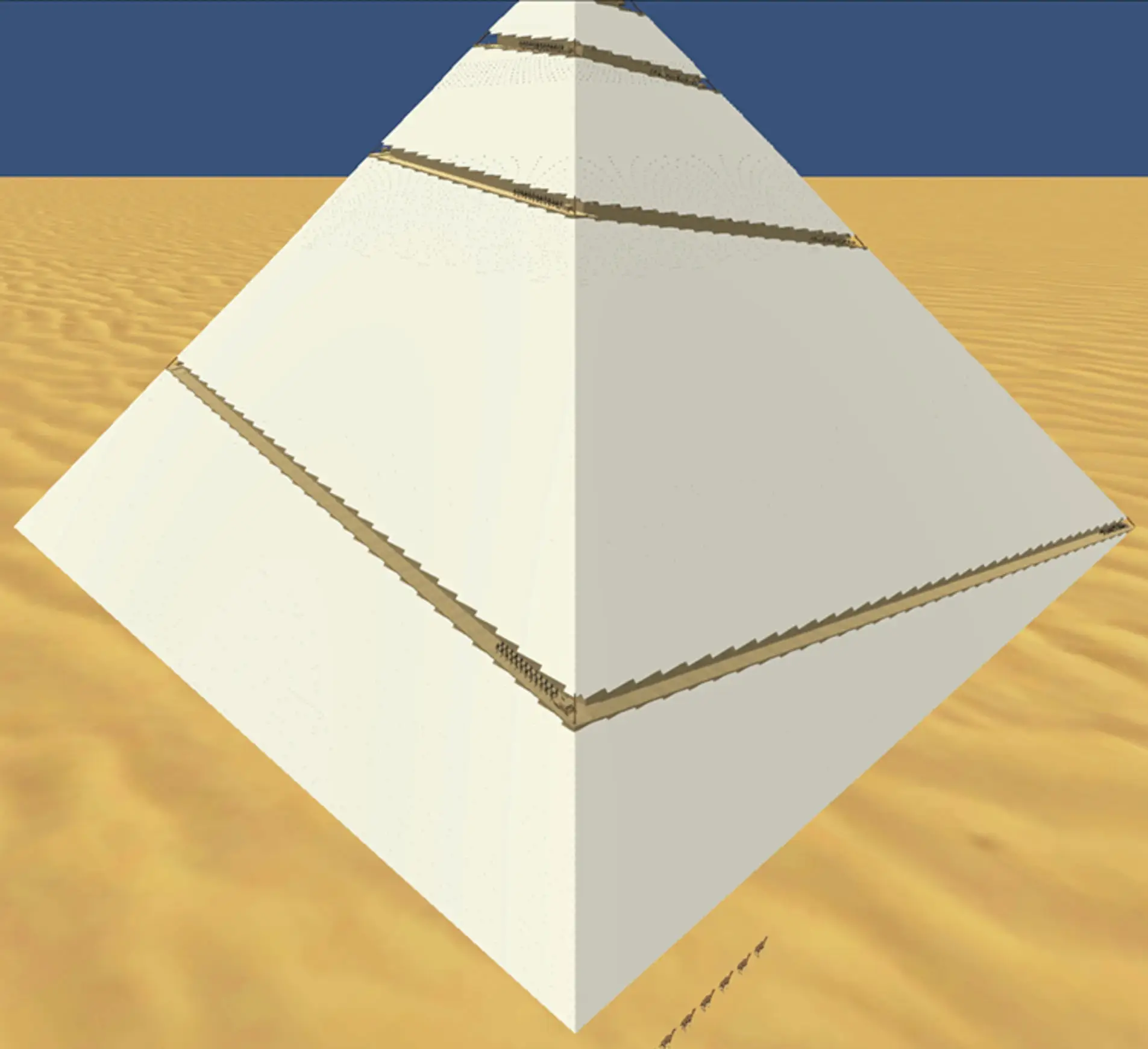
Simulating the procedure during the study, the scientists "bound ramp slope, lane width/clearance, and friction (μ) and evaluate the dispatch headway (time between placing successive blocks) required to satisfy the 20-27-year window, encoding these constraints as model parameters."
Additionally, the study "provides a transferable, open-data/code framework for testing construction hypotheses for ancient megastructures," potentially unlocking further secrets among the world's biggest architectural mysteries in the near future.
While the secrets behind the Great Pyramid's construction are likely 'solved' now, that still doesn't diminish how impressive it was for the Old Kingdom to build such a monumental structure within the short period of time — perhaps only enhancing it within the context of history.