
Millions of Americans could face unexpected health consequences if Trump's Sunshine Act passes


President Donald Trump is proposing a Sunshine Protection Act which would establish a permanent daylight saving time across the US in a bid to combat ‘ridiculous’ early sunsets.
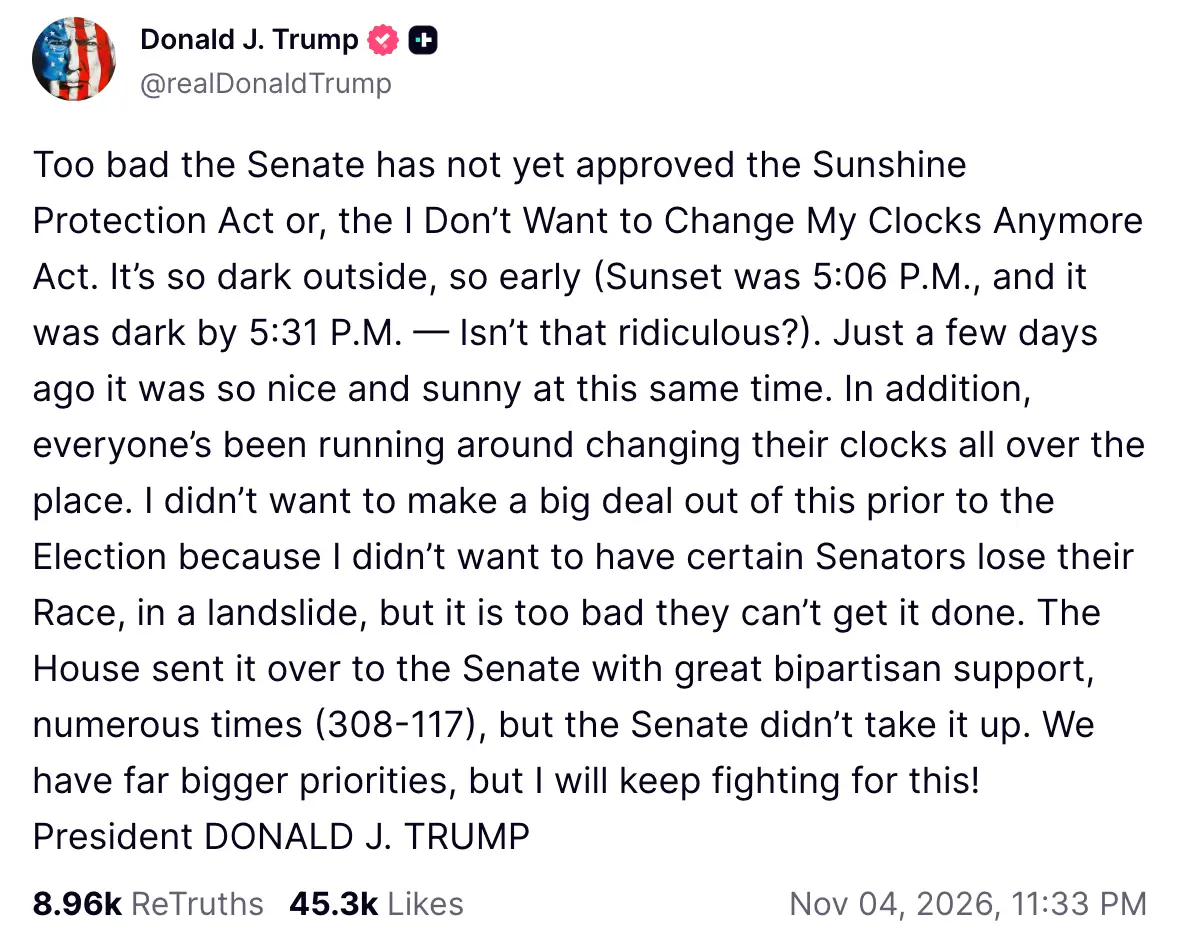
Last week, the US leader urged Congress to pass his act, taking to his social media platform Truth Social to complain about the issue.
Trump wrote: “Too bad the Senate has not yet approved the Sunshine Protection Act or, the I Don’t Want to Change My Clocks Anymore Act. It’s so dark outside, so early... Just a few days ago it was so nice and sunny at this same time. In addition, everyone’s been running around changing their clocks all over the place.”
While this proposal from the president might sound like a minor change to life in the US, the move could end up having serious consequences for the entire country if the act passes.
Advert

Increased risk of sleep deprivation
One of the biggest issues people have raised is the impact permanent daylight savings could have on their internal clock, as people will face being exposed to less light in the mornings.
This could disrupt circadian rhythms, which can contribute to sleep deprivation and other associated health problems. Anyone prone to seasonal depression might also experience negative effects as darker mornings might make it harder for people to wake up naturally.
Instead, the American Academy of Sleep Medicine and the Coalition for Permanent Standard Time are asking Congress to ‘adopt year-round standard time, the option that best aligns with human biology and supports healthier sleep, improved safety, and overall well-being’. This means that winter time would become the norm year-round.
Higher risk of heart disease and strokes
Tiredness isn't the only result of sleep deprivation as it can lead to more serious health issues. This is because circadian disruption can also impact blood pressure, heart rate and other cardiovascular functions, and sleep deprivation can be associated with an increased cardiovascular risk.
Researchers have linked the spring clock change to increased rates of heart attacks and strokes, with experts warning that by permanently moving to daylight savings could create ongoing circadian misalignment.
Risk of obesity and metabolic issues
Because body clocks help to regulate metabolism, changes to this can impact the system, leading to weight gain.
This is down to circadian disruption affecting how our bodies process food and manage blood sugar.
A study published Sept. 15 in the journal PNAS, points towards the impact contributing towards weight gain, obesity, insulin resistance, and issues with regulating blood sugar.
In more serious cases, this can lead to metabolic syndrome, which increases the risk of heart disease and diabetes.

Mental health can decline
People who are prone to seasonal depression might be impacted by a move to implement permanent daylight savings.
This is due to morning sunlight playing a significant role in our biological rhythms. If you’re struggling to regulate your sleep then this can cause changes in your mood and energy levels.
It could lead to or worsen mental health problems such as depression.