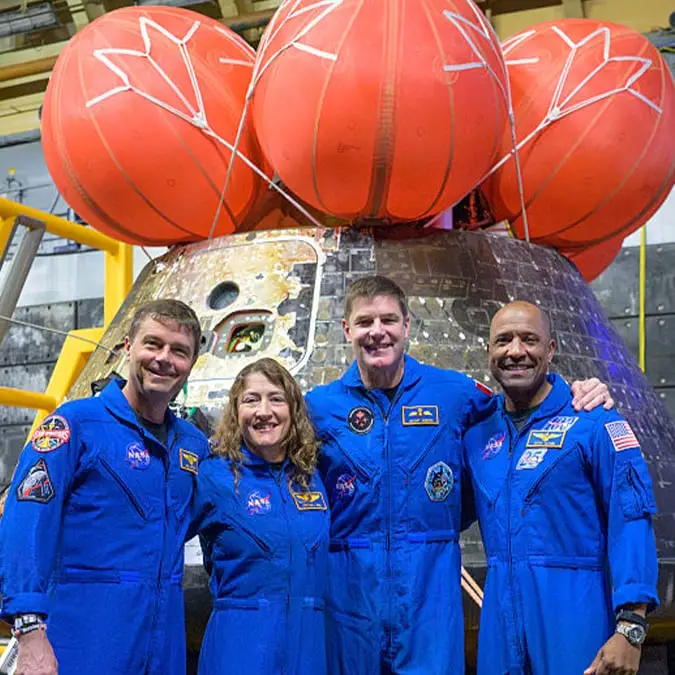
NASA responds after social media users notice bizarre missing part on Artemis 2's heat shield


NASA has cleared up questions raised by users on social media who all noticed there was a missing part of the Artemis II team’s capsule.
The astronauts splashed down back on Earth last Friday (April 10) after embarking on a 10-day trip around the Moon.
While the crew did not land on the lunar surface, they performed a flyby, using the Moon’s gravitational pull to slingshot themselves back towards Earth.
The world collectively held its breath last week when the Orion capsule, which the team had been traveling in, embarked on its homeward journey to re-enter the Earth’s atmosphere - arguably the most dangerous part of the mission.
Advert
The mission was a success, with NASA astronauts Reid Wiseman, Victor Glover, Christina Koch, and CSA (Canadian Space Agency) astronaut Jeremy Hansen all landing safe and sound.
While many took to social media to share their own reactions to the splashdown, some raised concerns over a missing part of the capsule’s heat shield.
Clearing things up, the head of NASA, Jared Isaacman, wrote on X, formerly Twitter: “I am hesitant to get ahead of a proper data review, but I understand the space community’s curiosity, especially when imagery can give the impression of a problem.
“As you would expect, engineers were eager to inspect the heat shield, starting with diver imagery shortly after splashdown and continuing with the review aboard the ship. No unexpected conditions were observed. I suspect when the images are released, it will be pretty obvious the stark difference between Artemis I and Artemis II head shield performance.”
He went on to explain: “As to the question specifically, the discoloration was not liberated material. The white color observed corresponds to the compression pad area and is consistent with the local geometry, AVCOAT byproducts, and transitional heating environments. We observed this behavior in arc jet testing and expected it in this compression pad area.

“We will complete a full data review across all systems, including the thermal protection system, and make the results publicly available.”
This prompted a response from others, with one person saying: “That’s a relief to hear, and this entire post is why you’re the [goat emoji].”
Another wrote: “Good to know that there was a difference and it seems for the better!”
A third commented: “The head of NASA directly addressing the public’s questions on social media in a fairly timely manner? It’s not possible!”
And a fourth added: “NASA always has good stuff.”