Mind-blowing discovery suggests our world could be trapped inside a black hole


The James Webb Space Telescope (JWST) has been shaking up everything thought about the universe since it began its deep-space observations in 2022.
However, its latest find is wild enough that it could completely rewrite our understanding of the cosmos.
This is because scientists have stumbled upon a bizarre pattern in the way galaxies rotate, and one surprising theory suggests our entire universe could be trapped inside a black hole.
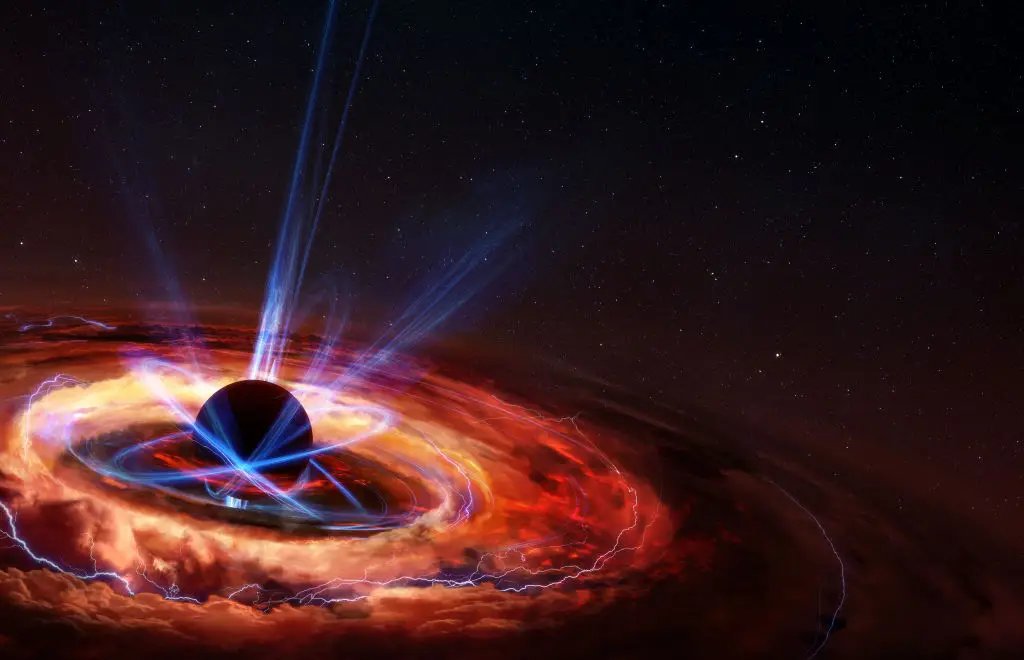 A star collapsing on itself to form a black hole (Getty Images)
Published in Monthly Notices of the Royal Astronomical Society, it turns out that most galaxies in the far-flung universe are spinning in the same direction, which is odd because we would expect a random split — 50% clockwise, 50% counterclockwise. Instead, the data shows that around two-thirds of galaxies rotate the same way.
Not just being a minor anomaly, it’s a significant statistical outlier that has left researchers puzzled. The most intriguing explanation for this pattern suggests that the entire universe may have been born with a rotation. If true, this discovery could alter our current understanding of cosmology altogether.
Advert
According to K-State News, Lior Shamir, an associate professor of computer science at the Carl R. Ice College of Engineering said: “It is still not clear what causes this to happen, but there are two primary possible explanations”.
“One explanation is that the universe was born rotating. That explanation agrees with theories such as black hole cosmology, which postulates that the entire universe is the interior of a black hole. But if the universe was indeed born rotating, it means that the existing theories about the cosmos are incomplete, he added.
The theory of black hole cosmology, though not new, has gained renewed attention in light of this discovery. It suggests that our universe could in fact reside inside the event horizon of a black hole.
This means that everything we know could be contained within a black hole in a much larger universe.
The theory around this suggests that when a black hole forms, the matter inside doesn’t collapse into a singularity, as previously believed.
Instead, said matter rebounds and expands — creating a new universe on the other side of the event horizon. It’s quite the expansive concept, but one that might explain some of the universe’s most fundamental mysteries.
 An illustration of the Big Bang (Pixabay)
Nikodem Poplawski, a theoretical physicist at the University of New Haven and a strong advocate of this theory, explains: “It produces a finite period of cosmic inflation, which explains why the universe that we observe today appears at largest scales flat, homogeneous, and isotropic”.
Simply put, the Big Bang we’ve always thought was the beginning of our universe might actually have been the result of a black hole forming in another universe.
If the theory is correct, it could offer answers to some of the biggest questions in physics. According to Poplawski, the rotation of black holes might influence the structure of the universes they create. This could mean that the unusual rotation pattern observed in galaxies by JWST is a leftover imprint from the black hole that birthed our universe.
Poplawski added: “I think that the simplest explanation of the rotating universe is the universe was born in a rotating black hole.”
“A preferred axis in our universe, inherited by the axis of rotation of its parent black hole, might have influenced the rotation dynamics of galaxies, creating the observed clockwise-counterclockwise asymmetry”, he explained further
On the other hand, a caveat of the evidence backing all of this is that the data could be skewed by the rotation of our own Milky Way — making it appear as though there is a larger, universal pattern than there actually is.
If that ended up being the case, astronomers may need to rethink how they measure cosmic distances, overall having added implications to our understanding of the universe’s expansion.
Regardless, this discovery is more than enough to spark significant excitement among scientists. Researchers are closely monitoring future data to confirm, but if the black hole theory proves accurate, it could drastically alter our perception of reality.