Scientists asked 50 people to map their near-death experience and they found eerie similarities

Participants of a study have drawn what their near-death experience looked like, and researchers have identified some peculiar similarities.
This comes after a team of scientists looked into how near-death experiences ‘challenge conventional research methods, as they are often described as exceeding the limits of verbal expression’.
In a paper published in Frontiers in Psychology, it explains: “While most studies rely on narrative accounts, little attention has been given to graphic representations as a complementary mode of investigation. This study employs a hybrid approach combining a semi-structured digital questionnaire with a graphic reconstruction task.”
It continues: “Exploratory analyses indicated variation in chromatic perceptual qualities across these configurations, although evidence for differences among configurations was not uniform across statistical analyses. The reported emergence of Visual Mental Imagery also appeared to vary across Visual-Field configurations.
Advert
“This dual-method design was intended to capture experiential features of OBEs (out-of-body experiences) and NDEs (near-death experiences) that may not be conveyed through verbal reports alone. Notably, OBEs have rarely been examined in terms of their independence from, or conjunction with, NDEs. In the present study, their temporal placement was defined operationally by the sequencing protocol to permit isolation of the NDE Core.”
Study participants draw their near-death experiences
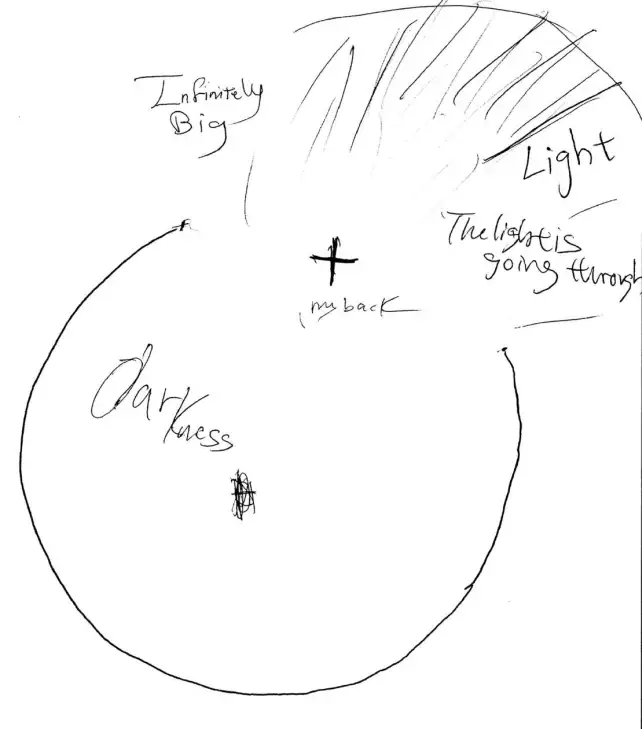
With participants asked to map out a visual interpretation of their near-death experience, one person drew a space divided up into dark and light, with their own position marked by a cross, describing the area as ‘infinitely big’.
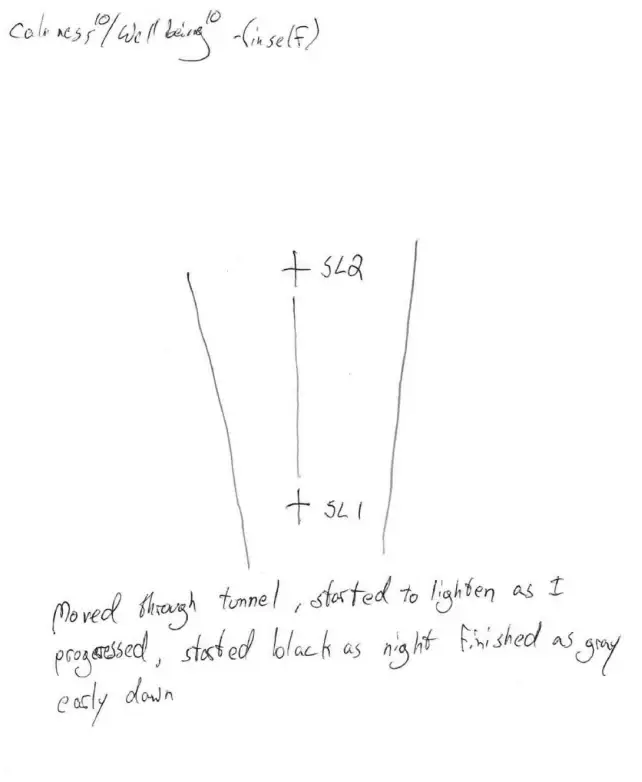
Another participant drew a tunnel, which they recalled grew lighter the further they traveled, adding: “Moved through tunnel, started to lighten as I progressed, started black as night, finished as grey early dawn.”
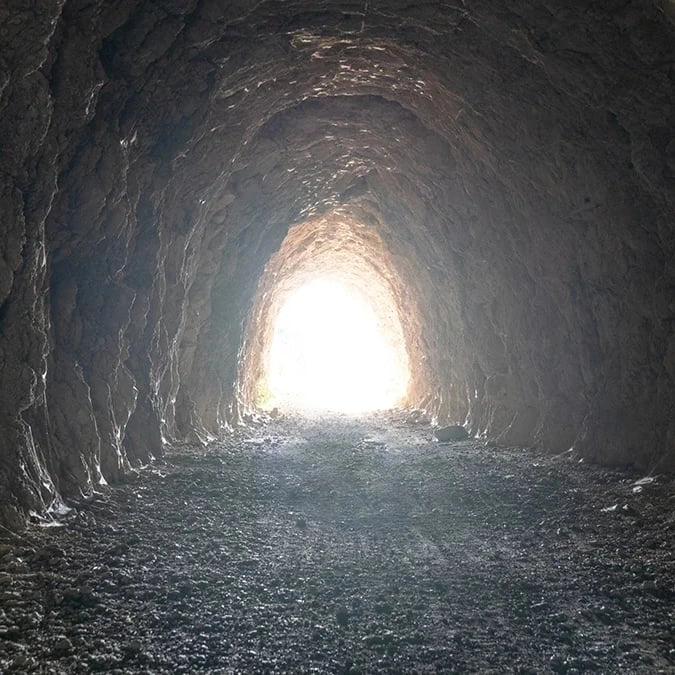
The experts noticed how many people seemed to have experienced similar situations, with it often being a tunnel or a curved space that gets progressively lighter the further they move.
Some recalled seeing loved ones or their life, both in the past or the future.
The study concludes: “Taken together, these findings suggest that some perceptual qualities observed across the identified Visual Field configurations show descriptive similarities with alterations of Visual Field organization reported in perceptual and neurological research, including constricted or partially restricted visual fields. However, the present findings remain descriptive, phenomenological, and retrospective in nature.
“Accordingly, the proposed framework should be understood as an exploratory methodological approach for systematically describing, reconstructing, and comparing recurrent visuo-spatial characteristics reported across NDEs, rather than as evidence for universal geometric invariants.”