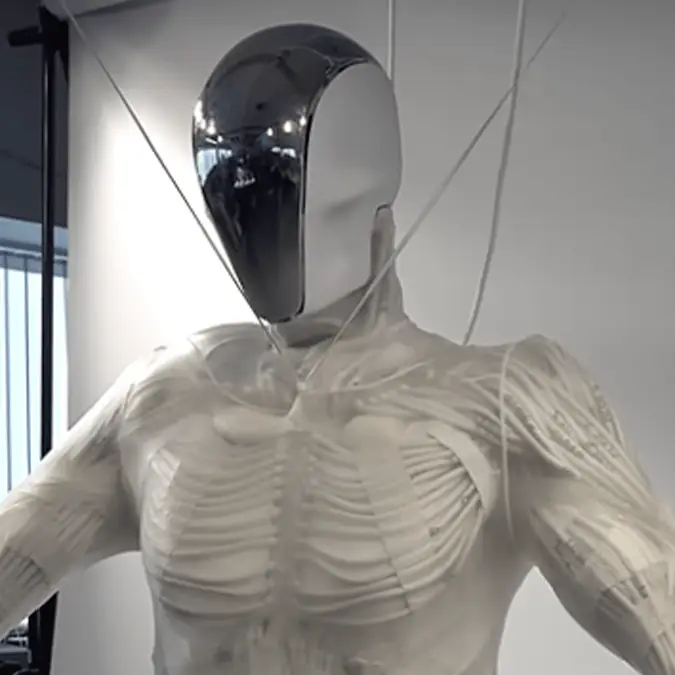
Incredibly eerie footage shows 'most anatomically complete humanoid ever created' flexing its 1,000 muscles


If you thought we'd already seen the peak of what humanoid robots could achieve then prepare to be shocked, as one robotics startup has revealed what they're calling the 'most anatomically complete humanoid ever created', and it's fitted with 1,000 muscle-like fibers.
With the rise of artificial intelligence and advancements in the robotics field, it's only natural that we'd start seeing closer representations of humans in newly developed technologies.
Tesla's Optimus robots have already shown eerily human-like movements that you wouldn't necessarily expect from an 'artificial' creation, and certain engineers have used new humanoid technology to create robot 'artists' who have even sold paintings for hundreds of thousands of dollars.
Of course, there's also a significant market for robots with romantic capabilities, as Elon Musk has suggested that we're mere years away from the release of advanced sex robots, and you can pay 'just' $175,000 for your own dystopian 'AI girlfriend'.
Advert
If you're simply looking for the most advanced humanoid of its kind though, Polish startup company Clone's newest offering might just be the one for you - even if it's hard not to be creeped out by it's complex technology.
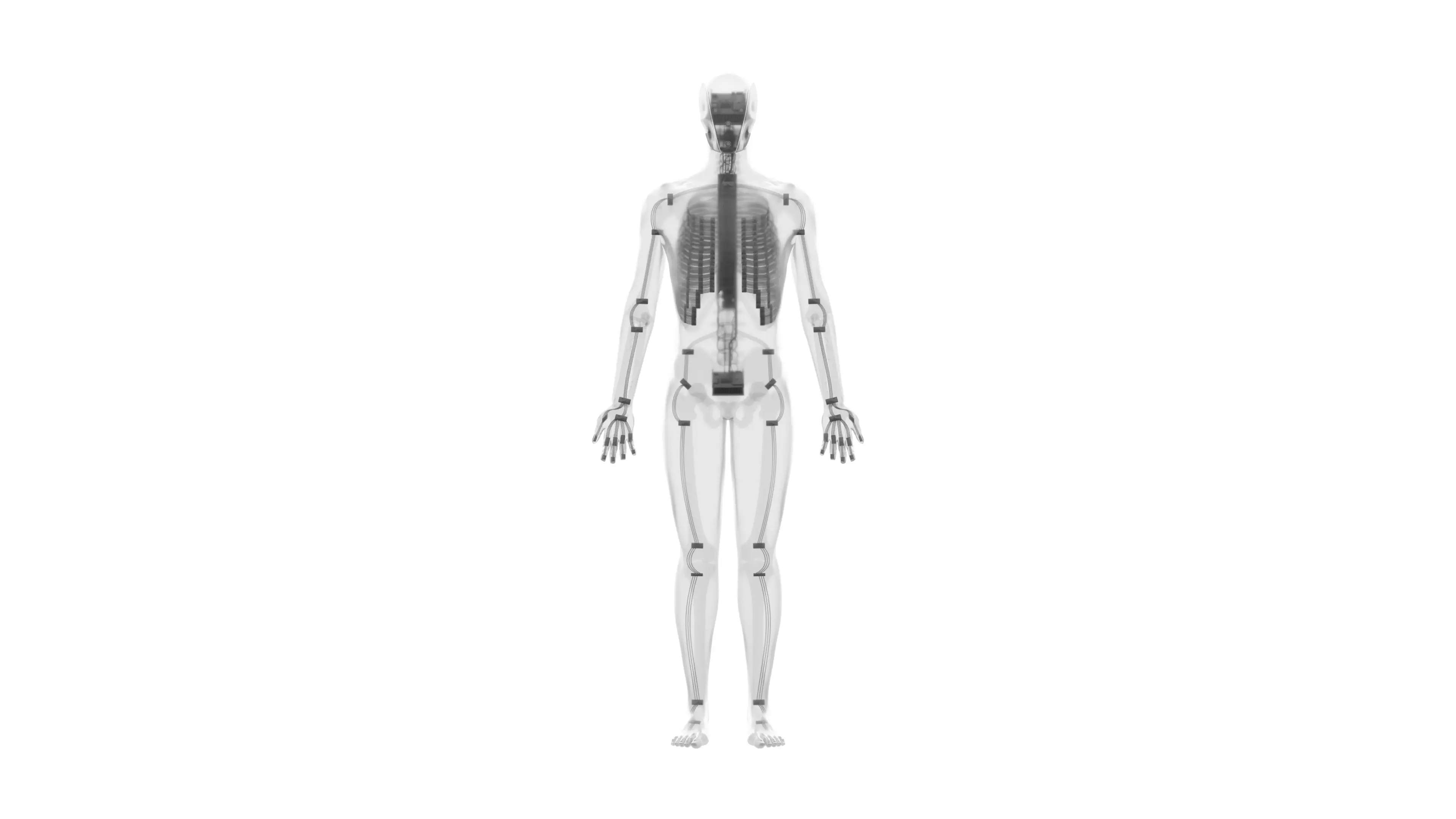
As reported by Interesting Engineering, Clone's 'Protoclone' humanoid robot has achieved what no other has so far by recreating the human body down to the bone and muscle.
It features over 200 degrees of freedom, 1,000 Myofibers meant to replicate the body's muscular system, 500 different sensors, and a complete recreation of all 206 bones within our human body, alongside a 'small number of bone fusions'.
Clone has the faceless humanoid off on YouTube, and you're able to see its eerily realistic movements in action, alongside the hundreds of wires and connections veiled by a skin-like outer coating.
This new presentation is certainly a shade less dystopian that their first unveiling on X too, which showed the Protoclone suspended in the air while it jolted its body parts about - a bit too creepy if you ask me.
"Damn 5 minutes of seeing our world and it already hung itself," one user remarks in the replies, whereas countless others have posted memes referencing 'sweet man-made horrors beyond my comprehension'.
If you fancy your very own Protoclone then you're in luck, as you can actually opt to reserve one on Clone's website right now. Now named the 'Clone Alpha', it's limited to just 279 units, although the expansive feature set will surely make it a desirable choice.
They list a large number of 'pre-installed skills', most of which boil down to servant or butler-like tasks, although the reveal that it's "equipped with the Telekinesis training platform to let you teach your Clone Alpha new skills" is certain to raise some eyebrows.
However, while it's currently advertised as a supportive humanoid in your house, many are begging Clone to adapt their technology into a different, more meaningful field.
"I've said this over and over again. This tech needs to be moved into prosthetics as soon as possible," one comment boldly argues. "Can you imagine a prosthetic arm or leg made with this tech? No more hooks and straps, just a fully functional arm or leg that precisely mimics the human anatomy."
Other users echo this request, with one adding that it's "a bit scary looking, but these artificial muscles can sure make for some sick prosthetics. You can even build [a] lower body for someone who lost their legs."
It certainly would provide a positive impact for a tech that many perceive to be dystopian or even scary, so let's hope that's where the future takes as opposed to a world full of robot servants.