
Unsettling new research shows dead internet theory is one step closer to becoming reality


The likelihood of reading something created by AI or bots is growing as the dead internet theory becomes a more immediate reality, with new research pointing towards the concerning state of the internet right now.
You might have heard people talking about the 'dead internet theory' for a number of years now, but anyone who even casually spends time on social media will find it hard to ignore quite how bot-ridden the web has become in recent years.
Originating on message board like 4chan, the dead internet theory refers to the point at which the web is overwhelmingly populated by bots and content created by bots, either through automated systems or generative AI.
It was formulated before ChatGPT and other rapidly evolving LLM tools became available, and their release has only accelerated the speed at which the internet is hurtling towards becoming a human-ridden space.
New research suggests dead internet theory might be true
As reported by CNET, new research published by data science experts at Pew Research has sought to discover exactly how much content shared on the internet is now written by AI instead of humans, effectively putting the dead internet theory to the test.
Advert
They did this by using the Common Crawl web archive to access over 500,000 English-language web pages published in the last five years alone, which obviously includes the roughly three years before ChatGPT's November 2022 release.
These pages were then processed through an AI detection tool known as Open Pangram, and while these models aren't always perfect – especially considering the proficiency of modern AI results – its current models boast an accuracy rate of around 92%.
Across a sample of 10,000 webpages from this data pool, the analysis observed 10% of these showing signs of significant AI authorship — a trend that has rapidly increased post-ChatGPT.
Even looking at the last 12 months there has been a significant jump, with the middle of 2025 still showing 'only' 5% whereas it has doubled now, suggesting that the share will continue to grow in the near future.
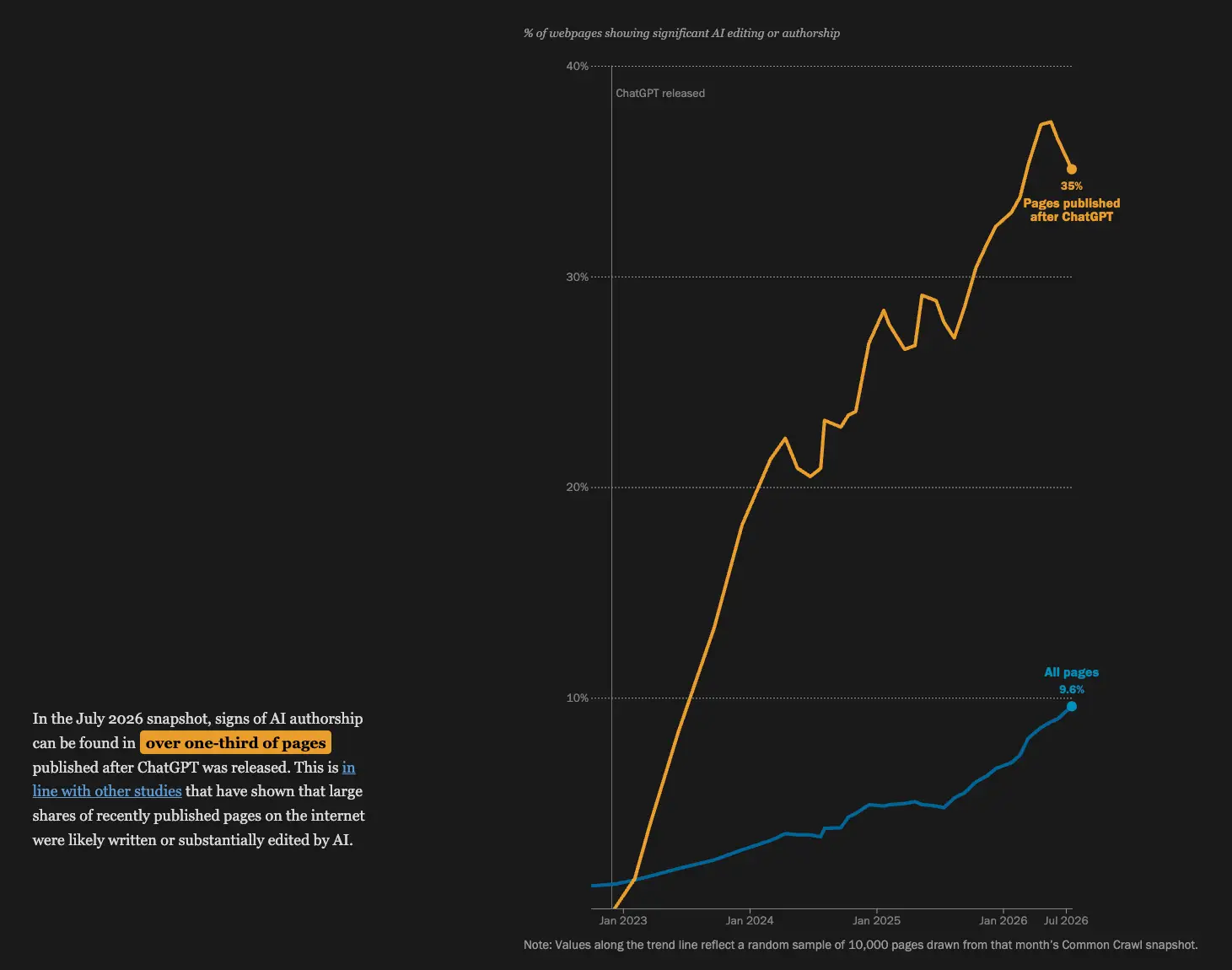
"One-in-ten webpages as of July 2026 may seem modest," the study explains, "but the internet includes a mix of new and old material. A lot of pages in these random samples couldn't have been written by AI."
Filtering out old webpages and only including content produced after ChatGPT's release increases that number significantly to a jaw-dropping 35%, with similar growth over the last year.
Is this something that can be stopped?
All signs point towards the inevitability that this will continue to grow in the years to come, and the only way that this could be reversed would be significant restrictions over AI usage and greater detection of AI-generated content online.
Anthrophic has taken small steps towards that by including invisible watermarks in all text produced by Claude – and that even persists across edits – but whether that impacts content produced and shared on the web is unclear.
Some leading figures in the world of social media have suggested that humans will migrate to platforms that better value content produced by actual people, but the past decade has shown how inert people remain in their online activity, making it difficult to convince many to jump ship even with a deteriorating level of content.
Some studies have shown the broader 'bot-produced' content share numbers are above half already, indicating that you're more likely now to read something generated by a bot than made by a human, begging the question of who really wants this as the future for the tech that connected us all in the first place?