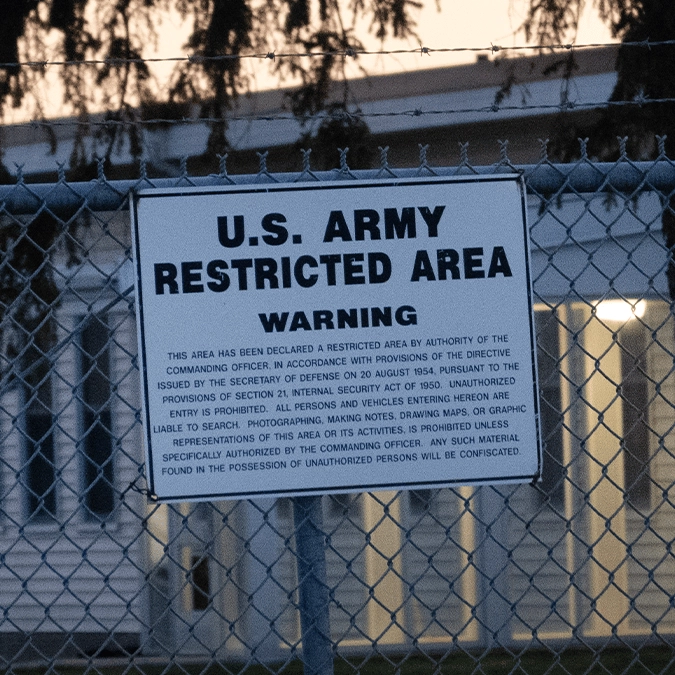
48-hour warning issued to locals as US Army prepares for 'controlled detonation' of unstable explosives


Concerns over health risks have seemingly been overruled by the US Army, with officials issuing a 48-hour warning to Iowa locals ahead of a controlled detonation despite action previously being paused indefinitely.
Federal courts recently issued a stay on a planned detonation of 'unstable explosives' in Iowa on Friday, November 20, after community backlash highlighted concerns over the health risk of toxic lead particles spreading throughout the state.
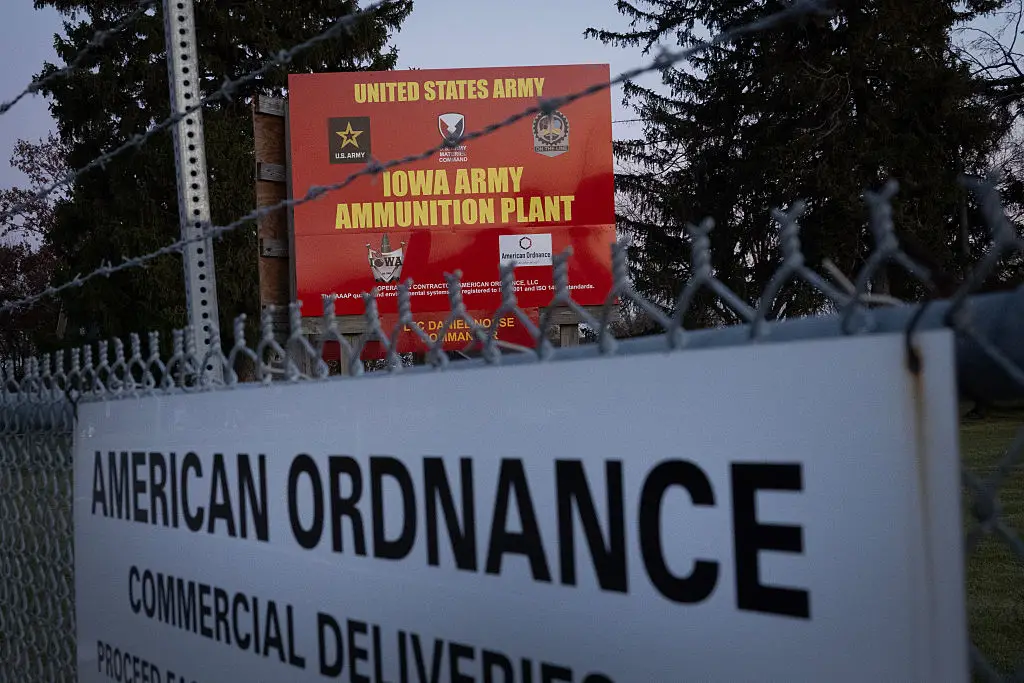
Targeted by the military are several tons of explosives deemed to be unstable at the Iowa Army Ammunition Plant, with roughly 9,500 lbs of degraded lead azide currently situated at the location.
While the Army itself argues that the continued presence of these explosives create a significant risk of unplanned detonation – which would bring about understandable issues – the act of conducting a controlled explosion isn't without its own dangers, leading to a clash of opinion.
Advert
It appears as if the Army has disregarded the ruling of federal courts, however, planning now to go ahead with the controlled explosion and has given residents of the midwestern state just 48 hours to prepare.
US Army issues a warning ahead of controlled detonation
As reported by CBS News, the Army previously had scheduled two controlled explosions for November 20 before the courts stepped in, yet have now decided to continue plans on Wednesday, November 25.
An emergency motion, granted by the 8th US Circuit Court of Appeals, was given following a lawsuit from environmental activists, but the military claims that it is working with both the Environmental Protection Agency (EPA) and Department of Health and Human Services to conduct the explosion in the safest way possible.
Reasoning for the decision to go ahead with the explosion is "to allow for optimal weather conditions and all mitigation measures to be emplaced," according to a statement shared on the US Army's official X account.
"The Army and our interagency partners have been working around the clock to safeguard all Americans in the region," the post continues. "Additional details on this situation will be forthcoming. The health and safety of all Americans has and always will be our first priority."
Recommendations issued for Iowa residents
An additional fact sheet from the Department of Health and Human Services in Iowa has outlined what residents in the state should do to best protect themselves following the controlled explosion, with a long list of practices to stay safe including:
- Staying indoors wherever possible for 24-48 hours following the explosion, limiting unnecessary travel.
- Taking advantage of indoor air recirculation and indoor filtration.
- Cleaning your surfaces as much as you can following the airborne exposure period, avoiding dry sweeping that would redistribute dust.
- Practicing good hygiene, including washing your hands before eating or drinking, and removing your shoes upon entering your home.
- Seeking medical guidance, including testing for lead exposure in your blood.
How have people responded?
Both residents of Iowa and the wider American population have criticised the US Army for putting the health and safety of individuals at risk, with many fearing for the long-term repercussions that this could cause not just for human exposure, but for farms, wildlife, and the land itself.
"So you're going to poison entire populations of our own people because of your own negligence and incompetence," wrote one angry commenter in response to the Army's statement, with another accusing the military of "trying to sneak it in while everyone is busy with travel and holiday activities."
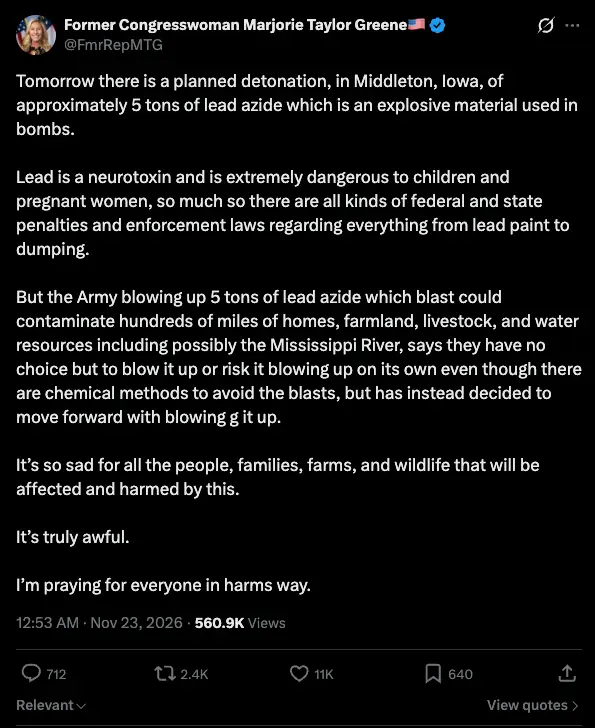
There has even been pushback from those within politics, with former Congressswoman Marjorie Taylor Greene speaking out against the decision to enact the controlled explosion.
She outlined that lead is 'extremely dangerous' to humans, especially children and pregnant women, yet "the Army [is] blowing up 5 tons of lead azide which blast could contaminate hundreds of miles of homes, farmland, livestock, and water resources."
Greene highlighted the availability of chemical methods "to avoid the blasts," calling the Army's decision to continue plans "truly awful."