uniladtech homepage
  • News
    • Tech News
    • AI
  • Gadgets
    • Apple
    • iPhone
  • Gaming
    • Playstation
    • Xbox
  • Science
    • News
    • Space
  • Streaming
    • Netflix
  • Vehicles
    • Car News
  • Social Media
    • WhatsApp
    • YouTube
  • Advertise
  • Terms
  • Privacy & Cookies
  • LADbible Group
  • LADbible
  • UNILAD
  • SPORTbible
  • GAMINGbible
  • Tyla
  • FOODbible
  • License Our Content
  • About Us & Contact
  • Jobs
  • Latest
  • Archive
  • Topics A-Z
  • Authors
Facebook
Instagram
X
TikTok
Snapchat
WhatsApp
Submit Your Content
Doomsday Clock moves closer to oblivion than ever before in worrying 2025 update

Home> News

Updated 15:21 28 Jan 2025 GMTPublished 15:13 28 Jan 2025 GMT

Doomsday Clock moves closer to oblivion than ever before in worrying 2025 update

The Doomsday Clock has spoken for its 2025 prediction

Rikki Loftus

Rikki Loftus

google discoverFollow us on Google Discover
Featured Image Credit: Anna Moneymaker/Getty Images
Climate change
News
AI

Advert

Advert

Advert

The Doomsday Clock has had its annual update and things are looking pretty unstable for 2025 and beyond.

The clock has been updated every year since 1947 and shows us just how close we are to suffering a global catastrophe caused by ourselves.

Humanity could be at risk for a number of reasons including climate change, nuclear war and now even artificial intelligence.
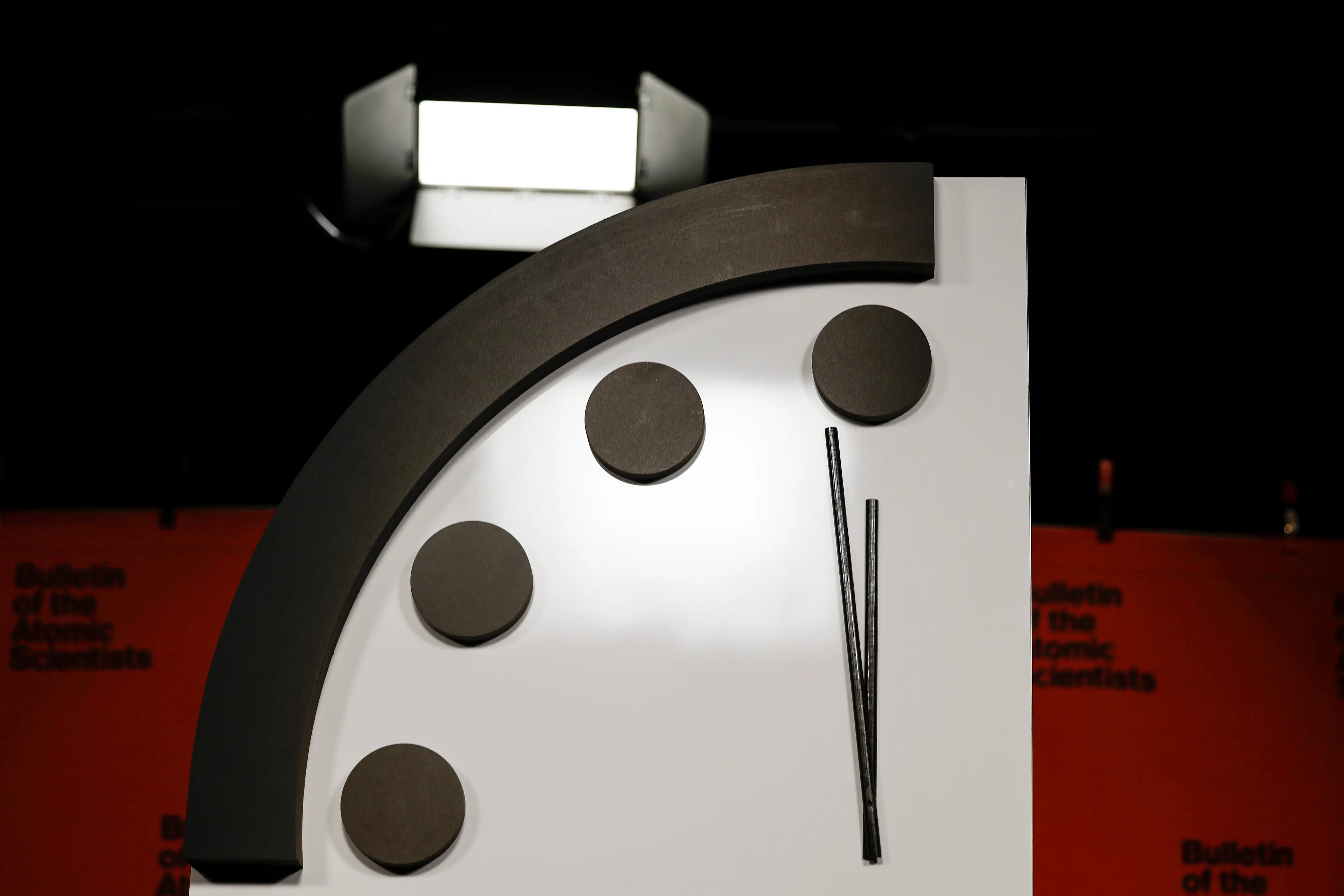
The Doomsday Clock is updated every year (Anna Moneymaker/Getty Images)

Advert

The Bulletin of the Atomic Scientists (BAS) are the ones who set the Doomsday Clock each year.

Their aim is to ‘equip the public, policymakers, and scientists with the information needed to reduce man-made threats to our existence’.

How it goes is that they give the clock a time and the closer it is to midnight, the more at risk we are.

Now, its 2025 prediction has been unveiled and for this year, the clock is now set at 89 seconds.

Revealing the result, Daniel Holz, who is the chair of the science and security board, said: “This is the closest the world has ever been to midnight.”

The reason for the time being brought closer to midnight is due to nuclear risk, biological threat and advances in disruptive technologies.

In 2023, the clock was worryingly set at 90 seconds to midnight after Russia invaded Ukraine.

For last year’s update of the clock, the outcome remained the same as we are in ‘a time of unprecedented danger’.

In 2024, Rachel Bronson, PhD, president and CEO of BAS, said: “Countries with nuclear weapons are engaged in modernisation programmes that threaten to create a new nuclear arms race.
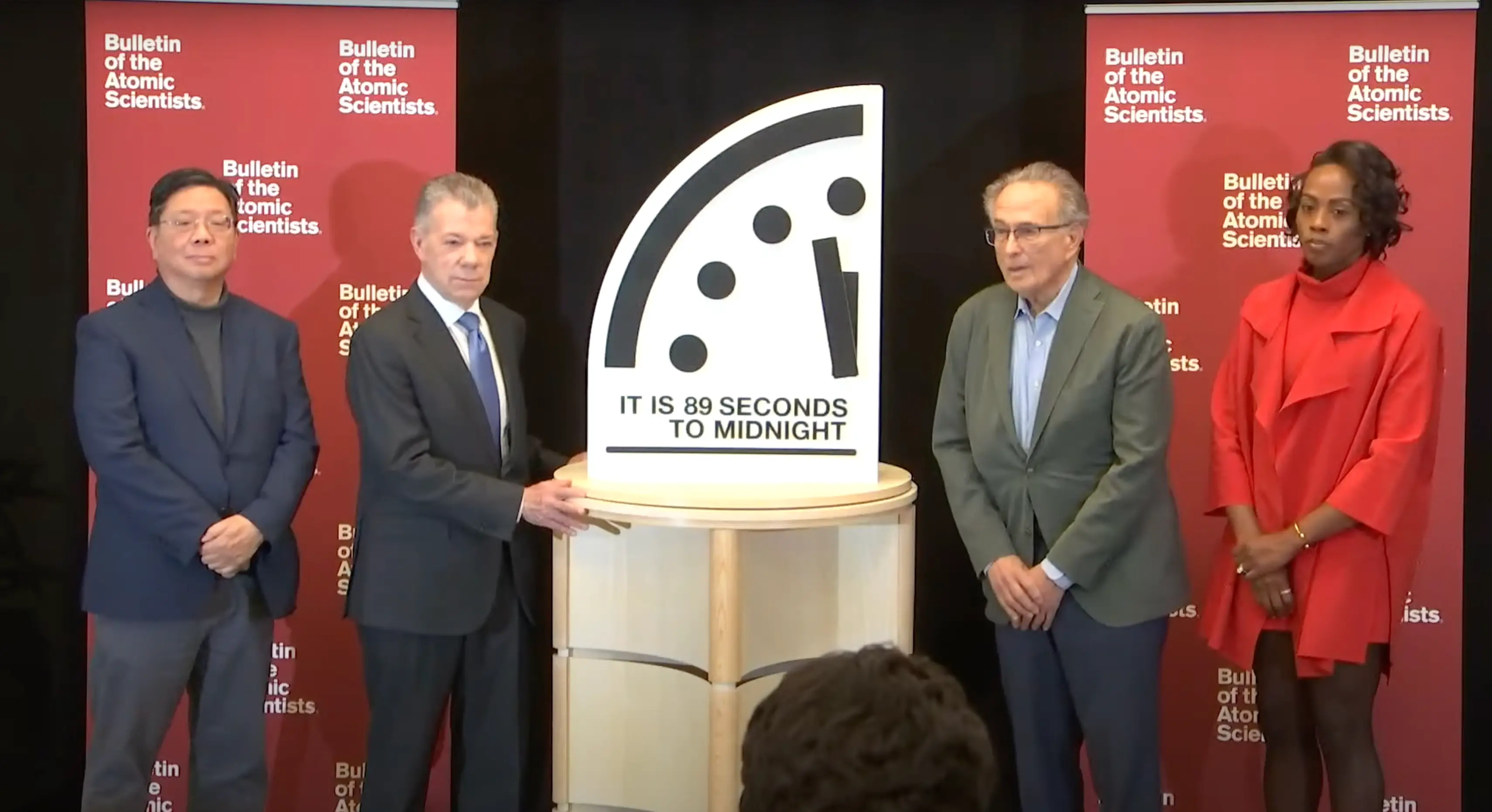
The clock is now set to 89 seconds to midnight (Youtube/@BulletinAtomic)

“Earth experienced its hottest year on record and massive floods, fires, and other disasters have taken root.

“And lack of action on climate change threatens billions of lives and livelihoods.

“Preventing future pandemics has proven useful but it also presents the risk of causing one.

“And recent advances in recent artificial intelligence raise a variety of questions about how to control a technology that could improve or threaten civilization in countless ways.”

Dr Bronson went on to add: “Make no mistake: resetting the clock at 90 seconds to midnight is not an indication that the world is stable.

“Quite the opposite. It’s urgent for governments and communities around the world to act.

“And BAS remains hopeful—and inspired—in seeing the younger generations leading the charge.”

People have taken to social media to react to the news, with many commenting under the Doomsday Clock livestream on YouTube.

One user wrote: “This was too generous.”

Another said: “So how bad did we s*** the bed this time?”

And a third person added: “2026 will be scary.”

  • What Doomsday Clock approaching closer to midnight than ever means for society
  • Researchers warn 'Doomsday Glacier' is closer than ever to catastrophic collapse
  • How much water ChatGPT's outage could have saved puts environmental impact of chatbot into horrifying perspective
  • Bizarre side effect of solar panels causes rainstorms in the driest place on Earth

Choose your content:

2 mins ago
19 hours ago
21 hours ago
22 hours ago
  • Bloomberg / Contributor via Getty
    2 mins ago

    How to get your money from Capital One's $425M lawsuit impacting 5M customers

    Capital One's switch from its 360 Savings account to its 360 Performance Savings in 2019, was listed as being deceptive

    News
  • Spencer Platt / Staff / Getty
    19 hours ago

    Grindr set to launch $500 AI feature as they host first White House Dinner party

    The popular hookup app has vowed to become an AI-first company.

    News
  • MARTIN BUREAU / Contributor via Getty
    21 hours ago

    Topics set to be discussed at unlikely Grindr White House Correspondents' Dinner as gay hookup app hosts for first time

    The inaugural event is a big step for the LGBTQ+ community

    News
  • Daniel Tamas Mehes via Getty
    22 hours ago

    How controversial drug ibogaine was discovered accidentally by heroin-addicted scientist

    Ibogaine supporters maintain it can be used to treat disorders like PTSD and depression

    Science