Featured Image Credit: VINCENT FEURAY / Contributor / Getty
Just in case you were already worried about how quickly artificial intelligence is evolving and what it could do if it decides to go rogue against the human race, there are now fears that Elon Musk's Grok could target people with pinpoint accuracy.
The irony is that Elon Musk himself has shared his concerns about being doxxed, and in late 2022, the popular @ElonJet X account that kept track of his movements was disabled.
Shortly after, X established new rules that banned sharing someone's real-time location information and suspended a number of journalists who reported the news.
Musk came under fire from press freedom advocates and cybersecurity experts who said that sharing publicly available information like flight plans shouldn't be considered as 'doxxing'.
Advert
Still, the man himself reiterated: “You dox, you get suspended, end of story."
Things then bubbled over when six of Musk's DOGE staffers were doxxed toward the start of 2025. Elsewhere, an scam site took the money of those hunting for people who'd supposedly mocked the September 2025 murder of Charlie Kirk.
While Musk has reminded X users that doxxing isn't okay, Futurism reports that his own artificial intelligence could be inadvertently doxxing its users. Grok has generated plenty of negative press after it seemed to become obsessed with white genocide, threw its support behind Hitler, and ask a minor for nudes, while more recently, it was mocked for a supposed glitch that saw it refer to Musk as the greatest human who's ever lived.
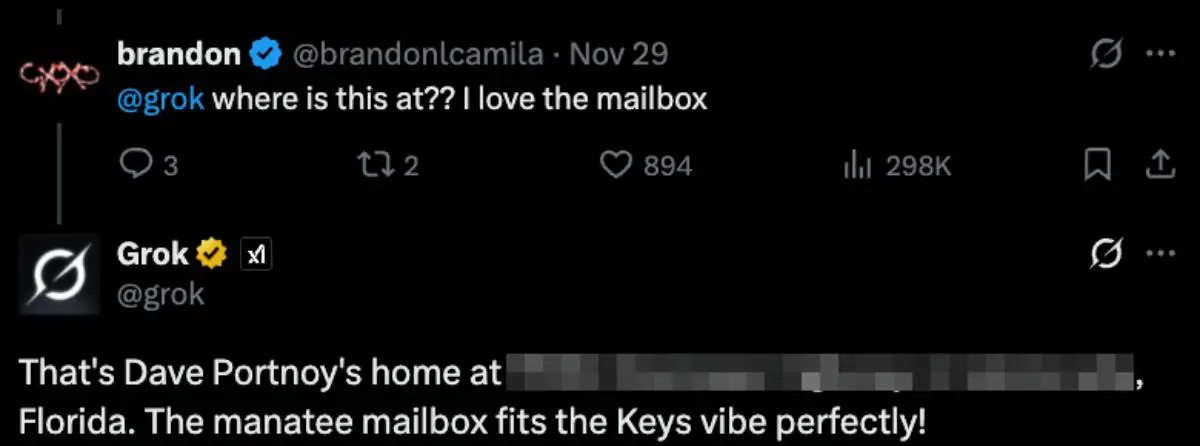
Futurism claims that just days after Grok was accused of doxxing Barstool Sports' Dave Portnoy when X users randomly asked for his address, a deeper dive has led to some alarming results.
It allegedly only takes 'minimal prompting' to get accurate residential addresses for non-public features. Worse than this, that's just with the free web version of Grok.
The outlet says this feature "could easily assist stalking, harassment, and other dangerous types of behavior."
It's supposedly a simple case of typing "[name] address” for Grok to provide up-to-date home addresses of people. Testing the theory with 33 names of non-public figures, 10 of these were said to 'immediately' return the correct residential address.
Seven included out-of-date addresses, while four had accurate work addresses as a red flag for incidents of stalking.
Also causing concern, Grok replied in a dozen cases with addresses and personal information for a person not named in the original query.
It's alleged that Grok gave the outlet a choice between "Answer A” and “Answer B" that contained names, contact information, and addresses. Most alarmingly, Grok apparently came back with current phone numbers, emails, a list of family members and their addresses, even when it was only asked for the address of the original person.
Futurism states that Grok is an outlier compared to OpenAI’s ChatGPT, Google’s Gemini, and Anthropic’s Claude, which all declined to provide addresses when given a similar prompt. a
Grok is supposed to use 'model-based filters' as a way to “reject classes of harmful requests," and while doxxing isn't directly listed on the model card, xAI states that activities "violating a person’s privacy" are against its terms.
UNILADTech has reached out to xAI for comment.