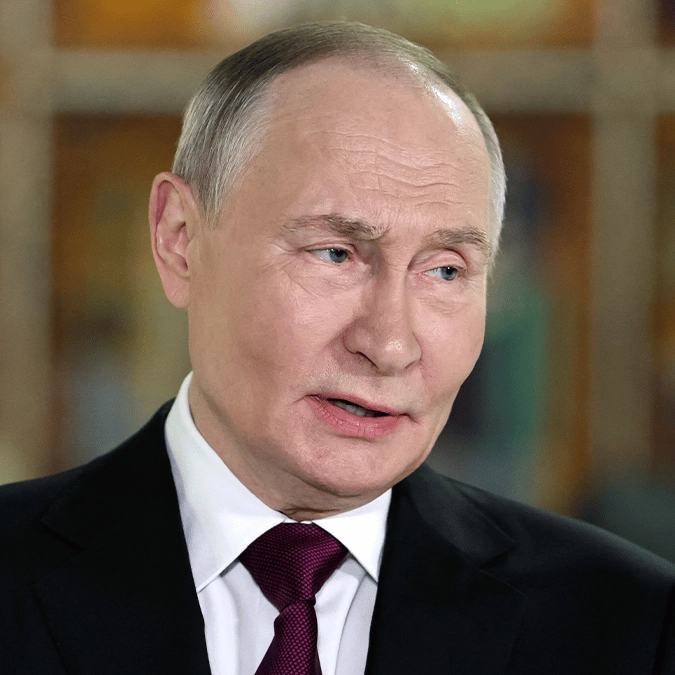
Putin bans one of Apple's most popular iPhone features in shocking move

There are fears that an IT Iron Curtain is being raised across Russia, with President Vladimir Putin once again clamping down on the country's communication network.
While not quite as restrictive as China's Great Firewall or having to smuggle smartphones out of North Korea, Russia's restrictions on social media and the internet are well-known. It largely comes down to the Service for Supervision of Communications, Information Technology and Mass Media (Roskomnadzor), which established its own internet blacklist in 2008 and has been slowly tightening the leash.
This includes complaints that it has 'throttled' the speeds of WhatsApp while trying to push its estimated 97 million Russian users to the state-backed MAX. More than this, there are concerns that WhatsApp could be banned altogether as Putin once again makes threats about escalating the conflict into a potential World War III.
Now, Apple is feeling the wrath of Putin, with its popular FaceTime service being blocked in Russia on iPhones and beyond. This comes in the aftermath of WhatsApp facing similar restrictions when the Kremlin claimed it was being used to help Ukraine organize drone attacks.
Advert

Alongside FaceTime being banned for Russia's 146 million citizens, Snapchat has also been shown the door. Although you might not think the largely Gen Z app known for putting dog filters on your face is the go-to for criminals, according to Roskomnadzor, it and FaceTime were being “used to organize and conduct terrorist activities on the territory of the country, to recruit perpetrators [and] commit fraud and other crimes against our citizens."
The Russian media regulator said it took action against Snapchat on October 10, but has only just made this public.
As reported by Reuters, Russians trying to use FaceTime have been greeted by a message that says "user unavailable" when trying to use the free video service.
There's also been a recent scandal involving Roblox, as Russia has blacklisted the popular children's game while claiming it's distributing 'extremist materials', 'LGBT propaganda', and serving as a hub where 'pedophiles' can meet online.
Russia continues to bang its gavel, as elsewhere, everything from YouTube to Instagram has also been called to task. Even the Russian-founded Telegram has faced call blocking and a potential stoppage of allowing new users to sign up by intercepting verification codes.
Social media, including Facebook and Instagram, have been blocked since Russia's invasion of Ukraine, with a March 2022 ruling branding Meta as 'extremist'. This extremism law had previously been used against the Taliban, Jehovah’s Witnesses, and a group run by anti-Kremlin Aleksei Navalny, but three years later, things only seem to be getting more draconian.
Despite Russia arguing this is all being done to curb attacks against the country, eyebrows have been raised over a list of government-approved 'whitelist' sites that are due to work even in the event of a communications blackout.
For many in Russia and looking in from the outside, Putin and Roskomnadzor are accused of funneling citizens into viewing and interacting only with messages that paint them in a good light.
At the same time, MAX's moniker as a 'national' messaging service has led to complaints that it's little more than a surveillance tool.