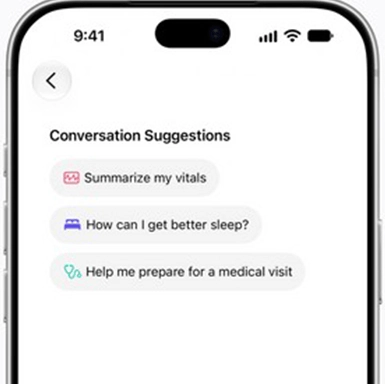
Apple is recruiting 200,000 people for a health experiment you can join from your iPhone


Artificial intelligence has already cemented itself in the daily lives of millions across the globe but its application is still thought to be expandable, with health advice being among the most-sought-after uses.
That's why Apple has launched a major new study aiming to investigate the potential of these two worlds colliding, calling on 200,000 iPhone owners to take part in research to understand how conversational AI tools could aid people's health-related queries.
Referred to by the tech giant as the 'Apple Health AI Usage Study', this United States-exclusive project looks to establish what would allow people to trust advice provided by generative AI tools, alongside the quality of the service that models can currently provide.
While the study itself remains primarily a tool to investigate the current state of services provided by AI, it presumably would be used to expand development towards a futuristic AI digital healthcare service that could revolutionise how people deal with their ailments and improve their health going forward.
What will the study evaluate?
According to Apple, the study is orchestrated in partnership with clinical AI platform OpenEvidence, using a model that can draw from reputable sources like The New England Journal of Medicine, the American Medical Association, and Nature to answer user queries.
Advert
Anyone taking part in the study will be encouraged to ask health-related questions to the AI tool on a daily basis, taking into account the advice given to provide feedback on how much they trust it and how useful it actually ended up being.

"Health is deeply personal," explained Sumbul Desai, Apple's vice president of Health and Fitness, "and conducting a dedicated research study is the most thoughtful way to understand how people engage with, comprehend, and evaluate health AI in everyday life."
Desai continued, adding that "insights from this study will help advance the broader scientific conversation and ensure that as technology evolves, we continue building trusted tools that genuinely support people wherever they are on their health journey."
University of California, San Francisco professor and Department of Medicine chair Robert M. Wachter also emphasized the importance of sharing the benefits of AI tools across both patients and doctors, arguing that when they "draw on versions of the same trustworthy tools, patients arrive prepared, conversations improve, and next steps happen seamlessly."
How to take part in the study
The study is only available to those currently in the United States, but if that does apply to you you'll want to head to the iPhone App Store and download the Apple Health AI Study App.
This app is completely free to use – although you do need to be above the age of 18 in order to take part – and it lets you not only take part in the study itself, potentially playing a key role in the future of AI-based health tools, but also gain advice yourself through the generated answers.

As mentioned, users are encouraged to ask health-related questions on the app as much as possible, engaging with the evidence that is provided with medical research sourced when necessary, and then rating the responses provided by AI in order to 'shape the future' of tools like this.
Some might rightfully also be concerned about the privacy of their conversations, but Apple has assured users that "the study is designed from the ground up with privacy protections, transparency, and clinical guardrails," adding that "study data will not be used to train AI models."