uniladtech homepage
  • News
    • Tech News
    • AI
  • Gadgets
    • Apple
    • iPhone
  • Gaming
    • Playstation
    • Xbox
  • Science
    • News
    • Space
  • Streaming
    • Netflix
  • Vehicles
    • Car News
  • Social Media
    • WhatsApp
    • YouTube
  • Advertise
  • Terms
  • Privacy & Cookies
  • LADbible Group
  • LADbible
  • UNILAD
  • SPORTbible
  • GAMINGbible
  • Tyla
  • FOODbible
  • License Our Content
  • About Us & Contact
  • Jobs
  • Latest
  • Archive
  • Topics A-Z
  • Authors
Facebook
Instagram
X
TikTok
Snapchat
WhatsApp
Submit Your Content
People brace for 'intense' solar flare coming to Earth that could cause chaos

Home> Science> Space

Published 14:57 3 Oct 2024 GMT+1

People brace for 'intense' solar flare coming to Earth that could cause chaos

There's increased activity on the sun as it reaches a pivotal moment in its cycle

Rikki Loftus

Rikki Loftus

google discoverFollow us on Google Discover
Featured Image Credit: MARK GARLICK/SCIENCE PHOTO LIBRARY/Getty Images/NASA/SDO
Sun
Nasa
Space
Science
Twitter

Advert

Advert

Advert

People are bracing for an ‘intense’ solar flare that’s coming to Earth and could cause chaos.

We are expecting to have the huge flare hit our planet later this week after an eruption occurred on the sun on Tuesday evening.

Solar flares are described by NASA as being powerful bursts of energy that have the ability to impact radio communications, electric power grids, navigation signals and cause risks to astronauts and spacecrafts.
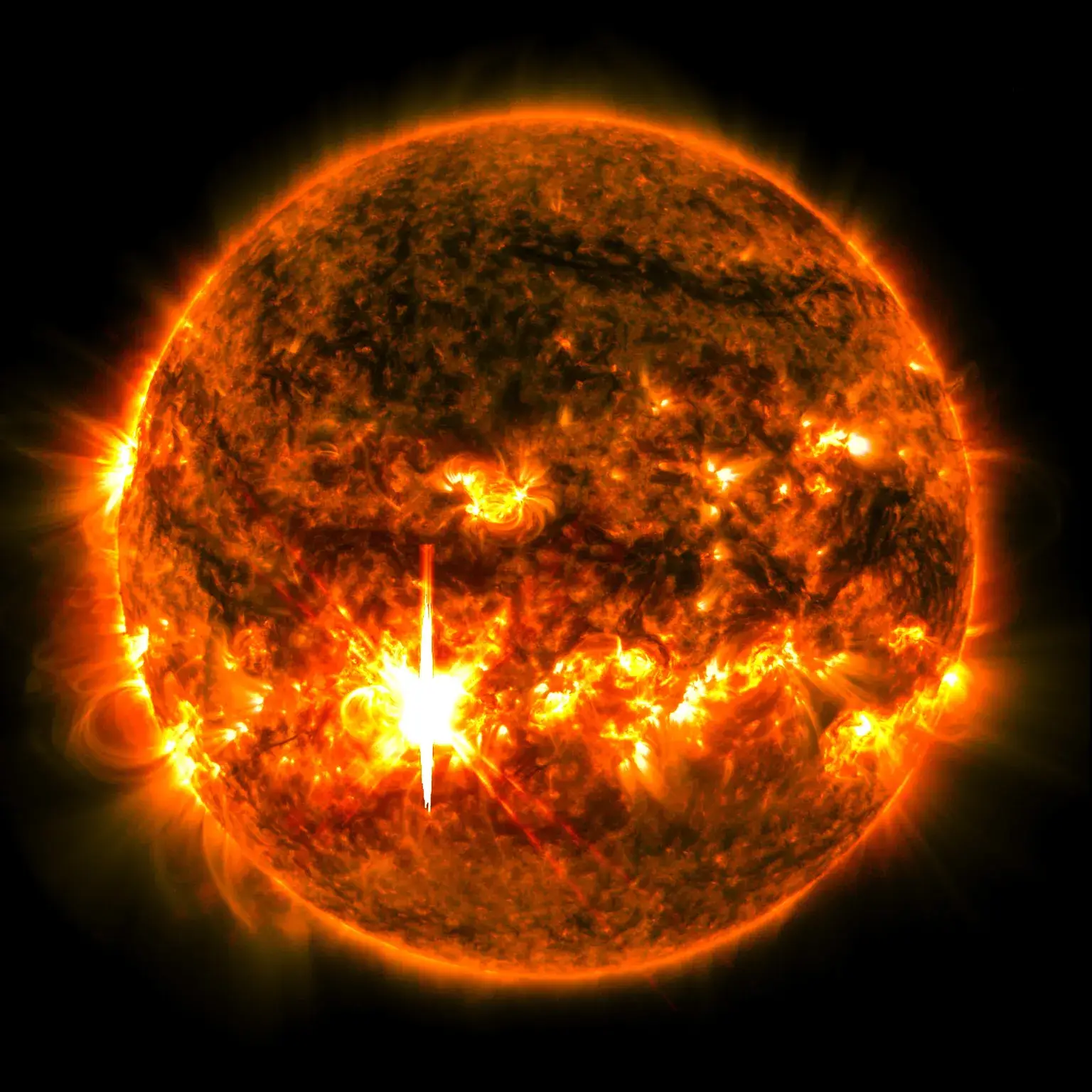
The solar flare can be seen as a bright light (NASA/SDO)

Advert

This flare has been categorized as an X-class, which is the most intense classification.

The largest flare from the sun in the last five years happened earlier this year in May, in an event that was classed as an X8.9 flare.

According to NASA, this week’s solar storm is a result of an X7.1 flare.

And it’s already reeking havoc - having caused a shortwave radio blackout across Hawaii.

Previous flares this year have resulted in visible aurora displays, including the Northern Lights, while disturbances to satellite communications and power grids being damaged are also a possibility.
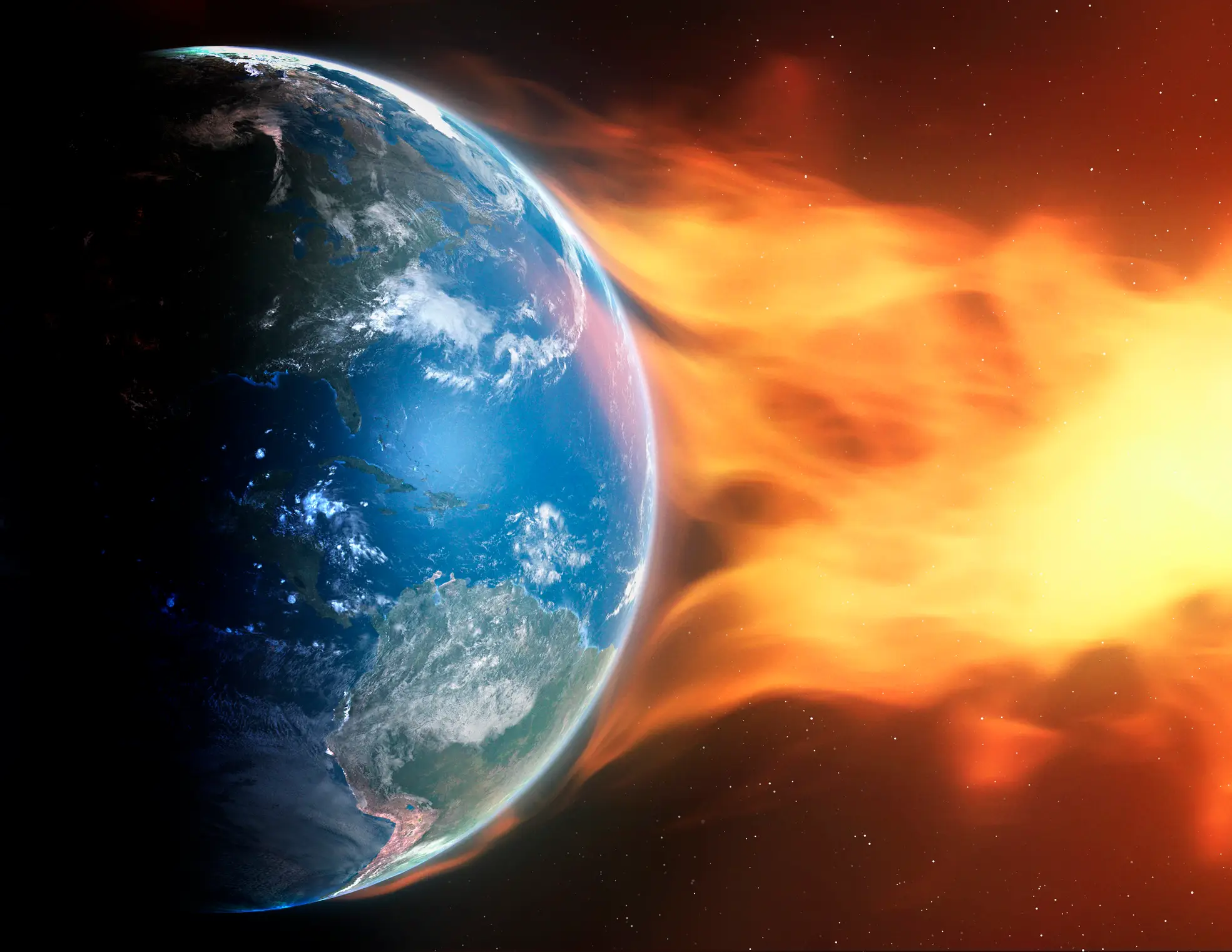
The sun has reached its solar maximum (MARK GARLICK/SCIENCE PHOTO LIBRARY/Getty Images)

With the incoming solar storm, it further proves that the sun has entered solar maximum, which is the period in its 11-year cycle when solar activity is at its most prominent and its magnetic field flips

Despite scientists predicting that this phase would take place in July 2025, activity on the sun has increased rapidly over the course of this year and has forced experts to reassess their predictions.

So far in 2024, 41 X-class solar flares have been shot out, which is more than the number of these in the last nine years, put together, according to spaceweather.com.

Usually, X-class solar flares only happen 10 times a year, but with solar maximum expected to last another year at the least, we can expect to see more of these powerful solar flares, CMEs and geomagnetic storms affecting Earth in the next year or so.


However, even though we are starting to see an increase in activity from the sun in recent months, this does not mean that it’s dangerous for humans.

NASA squashed any fears around the recent flare by taking to X, formerly Twitter, to clarify: “Solar flares are powerful bursts of radiation. Harmful radiation from a flare cannot pass through Earth’s atmosphere to physically affect humans on the ground.

“However — when intense enough — they can disturb the atmosphere in the layer where GPS & communications signals travel.”

  • Earth could be hit today by insane 600,000 mile-wide solar eruption that triggers extreme geomagnetic storm
  • Artemis 2 astronauts become first humans in history to witness 'indescribable' event in space
  • How to spot Artemis 2 astronauts as they head for splashdown back on Earth this Friday
  • Astronaut threatened to never return to Earth leading NASA to make life-saving change

Choose your content:

a day ago
  • NASA/Getty Images
    a day ago

    NASA paid $26.6M to families after seven astronauts died just 16 minutes from Earth after history-making mission

    The problem with the spacecraft was initially very small

    Science
  • Anna Moneymaker / Staff / Getty
    a day ago

    Sam Altman has signed up to procedure that is '100% lethal' but will preserve his brain forever

    One step closer to making billionaires immortal

    Science
  • Bill Ingalls/NASA/Getty Images
    a day ago

    How much Artemis 2 astronauts will get paid after making history with lunar mission

    Many wonder how well they'll be compensated for the history-making trip

    Science
  • Getty Stock
    a day ago

    Scientists discover 'world's oldest octopus' is actually something else entirely

    Researchers unveiled 'hidden anatomical characteristics'

    Science