uniladtech homepage
  • News
    • Tech News
    • AI
  • Gadgets
    • Apple
    • iPhone
  • Gaming
    • Playstation
    • Xbox
  • Science
    • News
    • Space
  • Streaming
    • Netflix
  • Vehicles
    • Car News
  • Social Media
    • WhatsApp
    • YouTube
  • Advertise
  • Terms
  • Privacy & Cookies
  • LADbible Group
  • LADbible
  • UNILAD
  • SPORTbible
  • GAMINGbible
  • Tyla
  • FOODbible
  • License Our Content
  • About Us & Contact
  • Jobs
  • Latest
  • Archive
  • Topics A-Z
  • Authors
Facebook
Instagram
X
TikTok
Snapchat
WhatsApp
Submit Your Content
NASA simulation showing a flight around a black hole leaves viewers with 'a fear they can't explain'

Home>Science>Space
Published 17:17 14 Oct 2024 GMT+1

NASA simulation showing a flight around a black hole leaves viewers with 'a fear they can't explain'

The videos shows what it would be like to get up close with a black hole

Rikki Loftus

Rikki Loftus

google discoverFollow us on Google Discover
Featured Image Credit: NASA
Science
Space
Simulation
Youtube
Nasa

Advert

Advert

Advert

A NASA simulation showing a flight around a black hole has left viewers with ‘a fear they can’t explain’.

The immersive visualization was produced on a NASA supercomputer and uploaded to YouTube earlier this year.

In the simulated footage, viewers can watch a scenario where a camera ‘just misses the event horizon and slingshots back out’.

Advert

The video shows a 360 degree view of what it would look like to fly right past the black hole, allowing viewers to look all around during the trip.

The simulation was created by Goddard scientists on the Discover supercomputer at the NASA Center for Climate Simulation.

In the video description, NASA explained: “The destination is a supermassive black hole with 4.3 million times the mass of our Sun, equivalent to the monster located at the center of our Milky Way galaxy. To simplify the complex calculations, the black hole is not rotating.

“A flat, swirling cloud of hot, glowing gas called an accretion disk surrounds the black hole and serves as a visual reference during the fall. So do glowing structures called photon rings, which form closer to the black hole from light that has orbited it one or more times. A backdrop of the starry sky as seen from Earth completes the scene.

“The project generated about 10 terabytes of data — equivalent to roughly half of the estimated text content in the Library of Congress — and took about 5 days running on just 0.3% of Discover’s 129,000 processors. The same feat would take more than a decade on a typical laptop.”
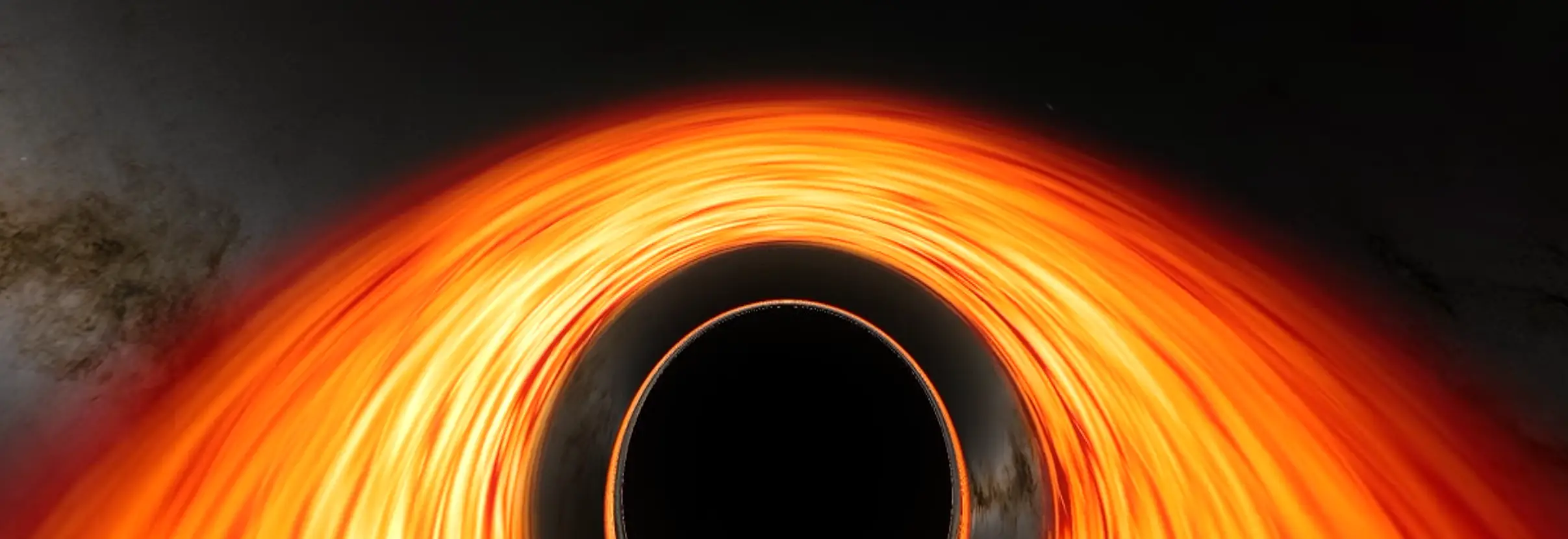
The simulation shows what it would be like to fly past a black hole (YouTube/@NASAGoddard)

People took to the YouTube comment section to share their reaction to the simulation, with people sharing their thoughts on how the video made them feel ‘uneasy’.

One user wrote: “That jet black darkness staring right at me is quite scary.”

Another said: “Why does this feel scary, like my instinct kicks in to avoid this.”

A third agreed, adding: “It strikes a fear I can't explain.”

And a fourth person commented: “Cool yet deeply unsettling.”

However, not everyone was freaked out by the video, with one user writing: “I think it’s a bit odd how people find this simulation scary. to me it’s quite comforting. black holes are friend shaped.”

And another person agreed, sharing: “There’s a lot of things I would do and give up to be allowed to go this way.”

  • Joe Rogan leaves NASA astrophysicist stumped after asking question she 'can't answer'
  • NASA is using a sneaky legal loophole to quietly carve up real estate on the Moon
  • Insane simulation shows actual speed of the International Space Station and viewers are amazed
  • Four people to go into 378-day Mars simulation on Earth in ground-breaking first

Choose your content:

a day ago
2 days ago
  • ISS / NASA
    a day ago

    ISS astronauts ordered to take shelter as they're put on 'evacuation alert' over 'air leaks'

    NASA has told astronauts to prepare for a potential evacuation

    Science
  • DrPixel/Getty Images
    a day ago

    UN warns AI will trigger a historic resource crisis for billions by 2030

    AI data centers could come with huge environmental costs

    Science
  • NASA / Handout via Getty
    a day ago

    Why NASA’s Artemis 3 mission will no longer land on the Moon

    NASA has changed the plans for its most important mission

    Science
  • SpaceX
    2 days ago

    Elon Musk hides apocalyptic 'extinction warning' inside official SpaceX legal documents

    We're long overdue for an event on a par with what wiped out the dinosaurs 66 million years ago

    Science