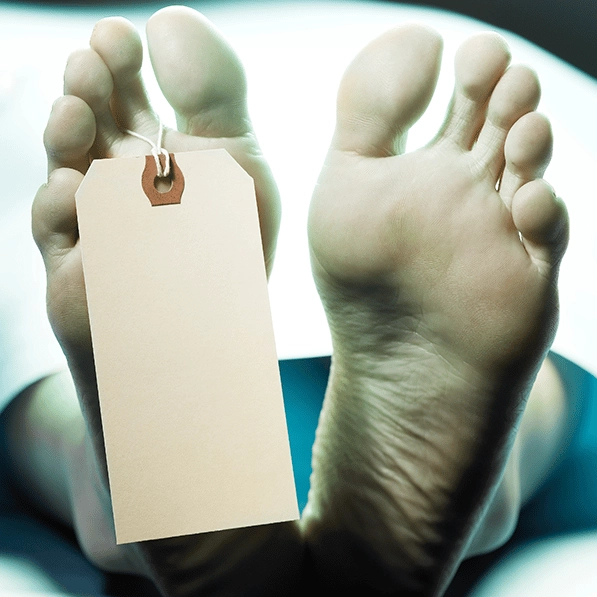
First ever recording of moment someone dies reveals what our last thoughts could be


We're all familiar with life flashing before our eyes when we die.
But it would be nice to understand the thoughts that will be with us in our final moments before we depart this world.
In an attempt to understand this more, scientists measured the brainwaves of an 87-year-old patient during his passing.
The elderly man had developed epilepsy, and the team was able to use an electroencephalogram (EEG) test to record his brain waves 15 minutes after he died from a heart attack.
Advert
Dr. Ajmal Zemmar, a co-author of the study, based in Vancouver, Canada at the time, said that the first-ever recording of a dying brain was purely by accident.
'This was actually totally by chance, we did not plan to do this experiment or record these signals,' he said.
The study revealed that in the 30 seconds leading up to death, the man's brainwaves followed similar patterns seen during dreaming or recalling memories.
Such brain activity could suggest a final 'recall of life' may occur in a person's final moments, as detailed in the study published in Frontiers in Aging Neuroscience.
Dr. Zemmar explained that by looking at the brain waves, the team noted an increase in 'gamma oscillations,' which connect different brain regions, for functions like perception, movement, memory and emotion.
The neurosurgeon at the University of Louisville explained: 'Through generating oscillations involved in memory retrieval, the brain may be playing a last recall of important life events just before we die, similar to the ones reported in near-death experiences.
'These findings challenge our understanding of when exactly life ends and generate important subsequent questions, such as those related to the timing of organ donation.'

However, like other major scientific breakthroughs, further conclusive evidence is needed to validate the theory.
For instance, the team pointed out that the data was gathered from a single case study. Moreover, the patient was epileptic with a bleeding and swollen brain which makes drawing generalisation extremely difficult.
Details of what exactly we think about before our time is up are still uncertain.
'If I were to jump to the philosophical realm, I would speculate that if the brain did a flashback, it would probably like to remind you of good things, rather than the bad things,' the neurosurgeon commented.
'But what's memorable would be different for every person.'