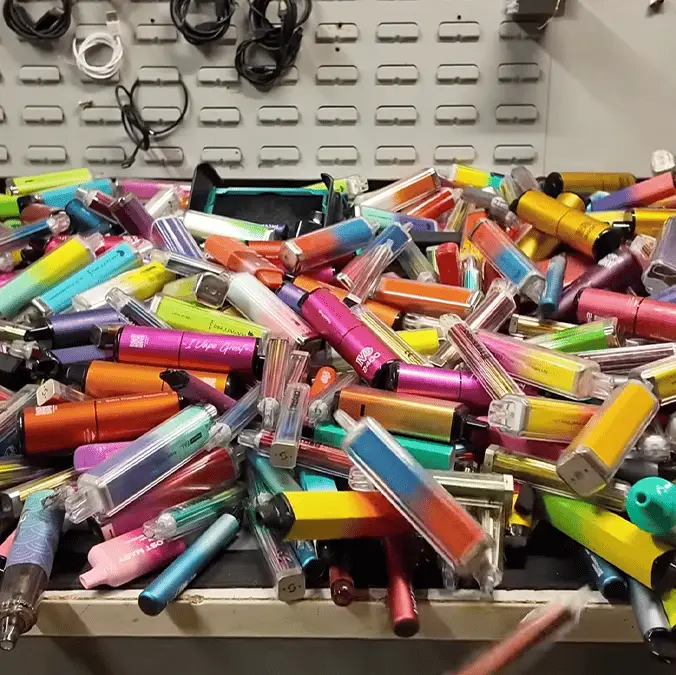
People horrified after YouTuber powers entire house using 500 disposable vapes in 'incredibly dangerous' experiment


If you’ve ever casually wondered whether disposable vapes could power a house, one YouTuber has taken that curiosity to the extreme—conducting a stunt that has been dubbed an ‘incredibly dangerous’ experiment .
In June it became illegal to sell single-use vapes in order to combat the damage they do to the environment, as well as their widespread usage by kids. Last year before the ban it was estimated that more than a million vapes were thrown away each day, according to research commissioned by Material Focus.
Disposable vapes contain a small lithium-ion battery. These devices can pose a fire hazard if they are not disposed of properly, as the batteries can self-combust. YouTuber Chris Doel noticed the large number of discarded vapes that are left on streets or thrown into bins, with each device containing a battery.
He wondered if the discarded vapes still hold power, and whether it could be utilised. Some disposable vapes have lithium-ion cells with just 1.8Wh, and sometimes closer to 5Wh.
Advert
Doel challenged himself to build a 2,500Wh battery pack that could power his workshop for days, or potentially his entire house for around eight hours. This meant he needed to acquire around 500 healthy big batteries.
He found and collected dozens of discarded vapes from streets, festivals, and vape shops.
However his experiment soon hit a roadblock when he discovered that around half the cells were already dead.
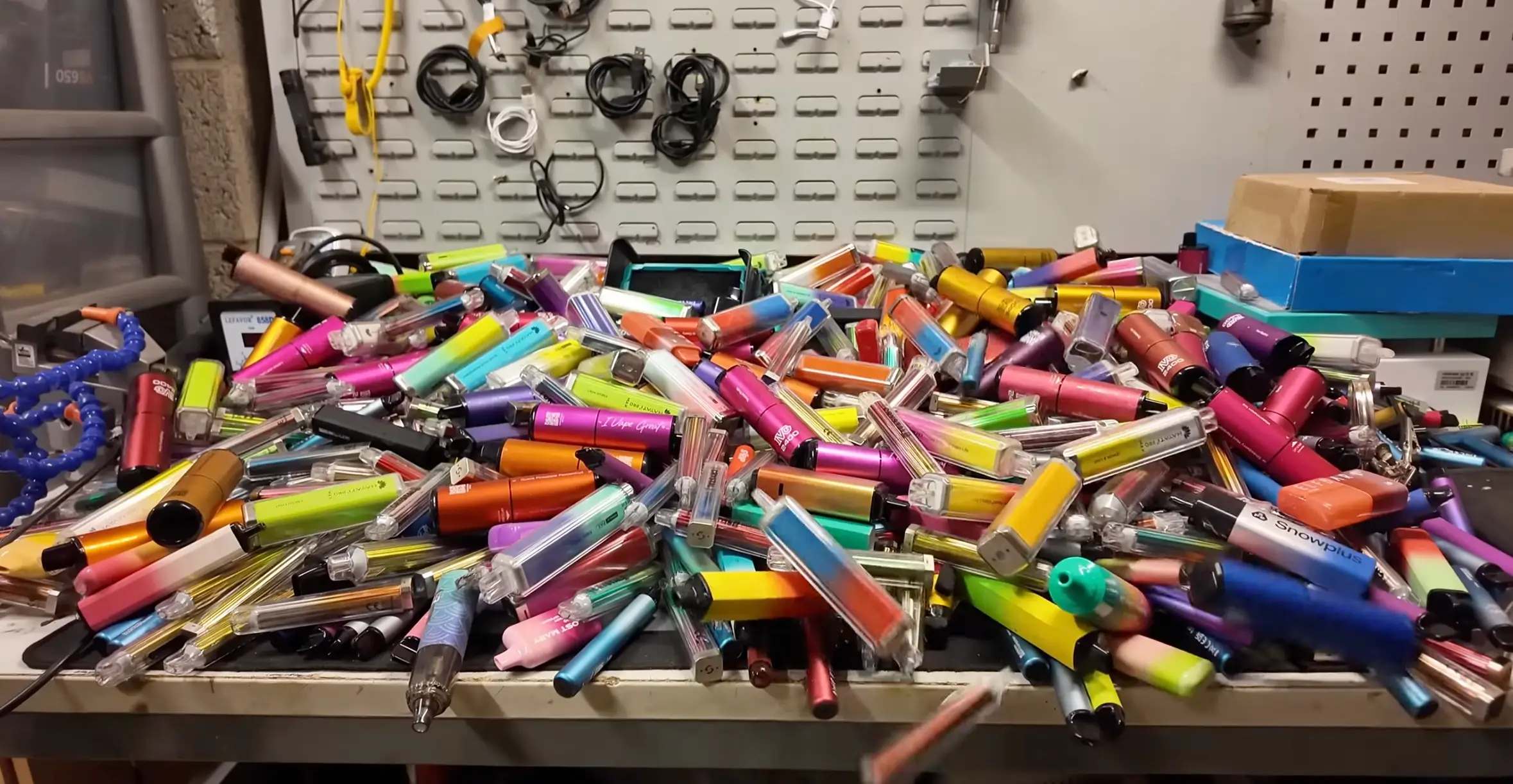
All lithium-ion batteries naturally lose a small amount of charge over time, even when they aren’t being used. If the voltage drops too far—typically below about 2.5 to 3.0v depending on the battery type, the built-in protection circuit may shut off charging to keep the battery safe. Letting a battery drain this deeply can damage its internal chemistry, which often leads to reduced capacity and higher internal resistance.
Checking each vape’s battery by hand would have taken too long, so Doel built a CPAP-powered rig that literally ‘vapes’ each device to check if its battery was still viable.
Once Doel had a batch of working cells, the next challenge was finding a way to process them efficiently. He 3D-printed holders that allowed him to test 24 cells at a time, then ran every viable battery through charging, measuring, and labeling.
This helped with matching the cells with similar capacities, to prevent weaker cells from dragging down the stronger ones. Once this process was done, he had recovered usable energy.
To turn a bunch of loose cells into a real home battery, the first step was grouping them into nine-cell packs wired in parallel.
Then those packs were stacked into 14 rows in series to reach about 50 volts. With the basic structure built, safety came next: each cell got its own tiny fuse, a small fail-safe inspired by how Tesla designs its battery packs.
Finally, the whole setup was mounted on sturdy aluminum rails to keep everything solid and secure.
With the battery pack finished, he still needed a way to turn it into something a home could actually use. That’s where the heavy-duty inverter came in, converting the roughly 50 volts of DC from the pack into the standard 230–240 volts of AC power that household appliances run on.
He first tested the vape power source in his workshop and once turning the inverter on, his lights, fans, and tools all ran on the power of vape.
Doel then cut off his house from the grid and powered his microwave, extractor fans, lights, and kettle on the recycled vapes.
He even edited his video using vapes.
The experiment has had a lasting impact on viewers who are startled by how much power is wasted in the disposable industry.
One comment said: “This is incredibly dangerous despite all the safety measures you put into place. But a fantastic project which demonstrates how insane the disposable economy is.”
Another shocked viewer wrote: “Its insane how this is even allowed, disposable vapes with fully intact batteries that are just discarded like that.”
And third impressed viewer said: “This is the guy who would survive the apocalypse by employing the most ludicrously creative methods.”