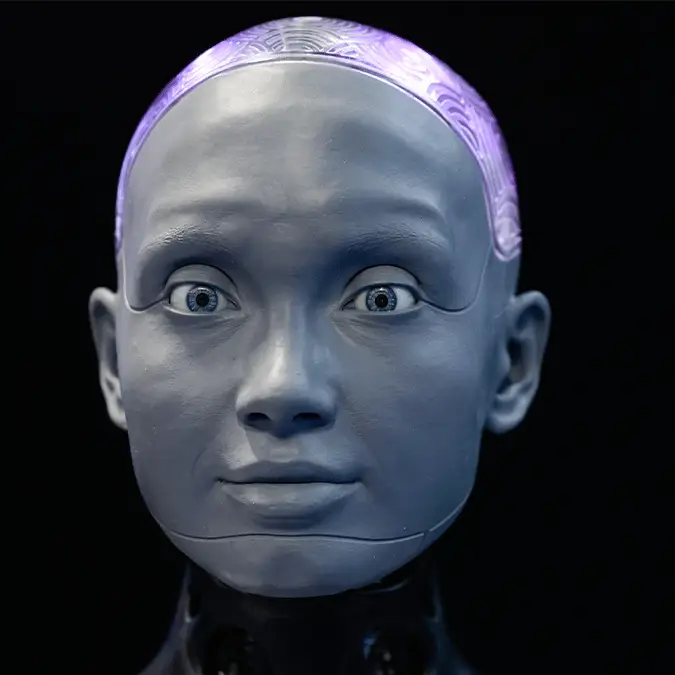
San Diego school spent $500,000 on two ChatGPT robots to use in classroom in costly experiment


AI has already found its way into how many people learn and work.
Before humanoid robots start handling household chores or Tesla's Optimus is flipping eggs in the kitchen, it seems the education sector is first in line to put them to work and is spending big money on it.
Altus Schools, which supports students working to recover credits and get back on track toward graduation, purchased two units of Ameca, a six-foot-two robot.
Developed by British company Engineered Arts, the ChatGPT-powered machine has a grey, silicone face, blue eyes and motors designed to simulate human emotion.
Advert
Each unit has been configured with four distinct personas including Sage the Teacher, Remi the Wellness Coach, Ari the College and Career Planner, and Lexi the Translator.
The robots are intended to operate at the school's in-person resource centres, where students already receive one-on-one academic support, and students are not left alone with them during interactions.
And while many might find the robots quite unsettling to look at, school officials have already described them as the 'world’s most advanced AI-powered humanoid robot.'
The machines are reportedly part of a pilot program exploring how AI and robots could help educate students in the near future.
Cathryn Rambo, Altus' dean of academic studies, wrote to families describing the project as an 'innovative opportunity for students to take part in a research-based learning experience.'
Writing to the Voice of San Diego (via the New York Post), she added: “We are thrilled to be the first school in the world researching the use of physical AI as a teaching partner.”
However, given recent headlines around the risks of children using AI, and the risk of AI-induced psychosis, the reaction has been more cautious than celebratory.
“There is no independent evidence at scale that the use of these tools is either effective or safe, or even has a positive impact on the classroom,” Wayne Holmes, a professor of critical studies of artificial intelligence and education at University College London, wrote to the Voice of San Diego. “What we are increasingly hearing are bits of evidence that demonstrate the opposite.”
He argued that it would be 'criminal' to believe Ameca could 'ever be within a million miles of the capabilities of a human teacher.'
According to Dexerto, a second researcher dismissed the robot as 'complete bulls***, a show, a charade, a spectacle.'